
30, September 2019
China expected to unveil nuclear missile capable of reaching US in 30 minutes 0
China is reportedly expected to unveil a nuclear-armed missile that could reach the United States in just 30 minutes during a parade celebrating the 70th anniversary of Communist rule in the country, amid heightened political, military and economic tensions with Washington.
According to Chinese media, the military may unveil the missile, dubbed the Dongfeng 41, during the ceremony on Tuesday.
The parade will included 15,000 troops, more than 160 aircraft and 580 pieces of military equipment, said a spokesman for the Ministry of Defense, Cai Zhijun.

He said last week that many new weapons “will be shown for the first time,” but declined to clarify whether they would include the Dongfeng 41.
No details of the missile have been released, but according to the Center for Strategic and International Studies in Washington, it may have the world’s longest range at 15,000 kilometers.
The missile with a technology known as multiple independently targetable re-entry vehicles, (MIRV), is capable of flying at 25 times the speed of sound, according to analysts.
It also could reach the United States in 30 minutes with up to 10 warheads for separate targets, they said.
The current mainstay missile of China is known as the Dongfeng 31, which has a range of more than 11,200 kilometers. The missile puts most of the continental United States within reach.
Satellite images have shown China increasing the number of launchers for DF-41 and DF-31 missiles from 18 to as many as 36.
Other weapons include a supersonic drone and a robot submarine.
Pictures circulated on social media showing blurry images of a possible attack drone dubbed “Sharp Sword” and another drone, the DR-8 or Wuzhen 8, during preparation for a parade.

The Chinese military — with the second-highest annual spending after the United States — is working on fighter planes, the first Chinese-built aircraft carrier and nuclear-powered submarines.
The military’s last year spending rose 5 percent to $250 billion, according to Siemon Wezeman of the Stockholm International Peace Research Institute (Sipri).
According to Sipri, China has about 280 nuclear warheads, compared with 6,450 for the United States and 6,850 for Russia.
Beijing, however, has assured that it wants a “minimum credible nuclear deterrent” but will not be the first to use atomic weapons in a conflict.
This has prompted concern in the United States, with the US Defense Intelligence Agency saying in a report earlier this year that the world’s second largest economy “has developed nuclear, space, cyberspace and other capabilities that can reach potential adversaries across the globe.”
Beijing and Washington have been locked in a dispute over the South China Sea, which has been at the center of a long-running territorial row between China and several of its neighbors.
The US has been taking sides with China’s rivals in their territorial disputes in the busy sea, stepping up military presence in the region under the pretext of freedom of navigation operations in international waters.
China has constantly warned Washington that close military encounters by air and naval forces of the two countries in the region could easily trigger miscalculation or even accidents at sea or in air.
Washington-Beijing ties have further soured over the past months over a number of other issues, including a trade war as well as what China views as US meddling in Taiwan and Hong Kong.
Source: Presstv














30, September 2019
Yaounde: National Dialogue starts as Ambazonia front-liners pull out 0
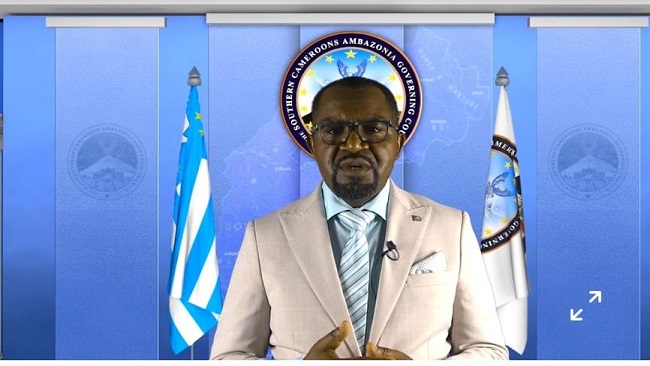
Cameroon will start a “national dialogue” on Monday in a bid to end the separatist conflict in the country’s Anglophone provinces, but key rebel leaders have already refused to participate.
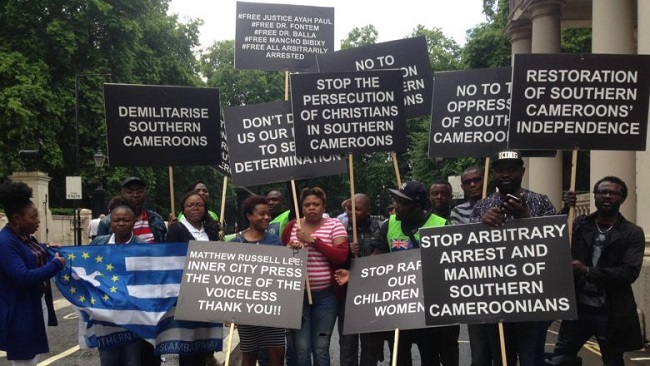
Nearly 3,000 people have died and half a million fled their homes since fighting broke out in 2017 between the army and armed fighters who want independence for Cameroon’s two English-speaking provinces.
The talks, led by Prime Minister Joseph Dion Ngute, are scheduled to take place from September 30 to October 4 at the Congressional palace in the capital Yaounde.
President Paul Biya, who has been in power for 37 years, hopes the talks will end a crisis that is also hurting the economy of the coffee and cocoa-producing Central African country.
October 1 marks the second anniversary of the spiral towards conflict – the declaration of the self-described “Republic of Ambazonia” for Cameroon’s English-speaking minority.
Even before it began, the national dialogue ran into trouble with many activists arrested and experts voicing scepticism that it would yield tangible results.
English-speakers account for about a fifth of Cameroon’s population of 24 million, who are majority French-speaking.
Anglophones are mainly concentrated in two western areas, the Northwest Region and the Southwest Region that were incorporated into the French-speaking state after the colonial era in Africa wound down 60 years ago. Many locals there complain of discrimination and marginalisation.
In a report published last week, the International Crisis Group (ICG) estimated that around 3,000 people have been killed by separatist violence and the military crackdown.
The ICG said the talks do not include separatists or Anglophone leaders who support more federalist solutions.
“It thus risks further frustrating Anglophones widening the gulf between the two sides and empowering hardliners,” the group said.
“The government should make greater space for Anglophones, particularly federalists who are willing to attend. It should also seek a neutral facilitator.”
Biya’s government has rejected both a return to more federalism and any proposed separation.
But Anglophone supporters are also divided between those two options for their regions.
The government’s dialogue spokesman, George Ewane, said Cameroonian authorities had held preliminary discussions with some separatists, adding that even hardliners were welcome to join the talks.
‘Smokescreen’
Mark Bareta, a separatist leader who is very active on social media, was the one most open to dialogue and it was through him that invitations to the others were sent, Ewane said.
But on Friday, Bareta announced that he was pulling out, saying that “the only way to have real negotiations is to hold them on neutral territory”.
Of the 16 separatist leaders invited, those heading armed groups such as Ebenezer Akwanga and Cho Ayaba are also snubbing the talks.
Akwanga told AFP that the event was a “smokescreen for the international community rather than an attempt to secure a complete and lasting solution … to the annexation of our country, Southern Cameroons.”
Most of the leaders have expressed willingness to hold talks with the government but in the presence of an international mediator and in a foreign country with the terms for secession the main item on the agenda, according to the ICG.
However, more moderate Anglophones like Cardinal Christian Tumi, the influential archbishop of Cameroon’s commercial capital Douala, have welcomed the initiative and urged the separatists to participate.
‘We can’t talk to ghosts’
An official from the Southwest Region said traditional chiefs had asked armed groups to attend the talks but they had spurned the offer.
The official, speaking on condition of anonymity, however asked the groups to “emerge from the woodwork”, adding that “measures have been taken to ensure the security of those who attend.”
“We cannot talk with ghosts,” the official said.
Locals are meanwhile divided about the outcome of the talks.
“No good can come of this. It’s a game,” said a hardcore secessionist who identified himself as Agbor.
“If we must go for talks, it would be to discuss the terms of separation and not anything else,” he said.
But Jeannette Benga, a prominent figure of civil society in Buea, the capital of the Southwest region, voiced hope that “the two come to an agreement.”
Blaise Chamango, the head of an NGO said the five-day talks were not enough to “debate the anglophone crisis and the other major problems in Cameroon.”
SOURCE: AFP NEWS AGENCY