5, May 2020
WHO rejects Trump, Pompeo’s claim Covid-19 originated from Wuhan laboratory 0
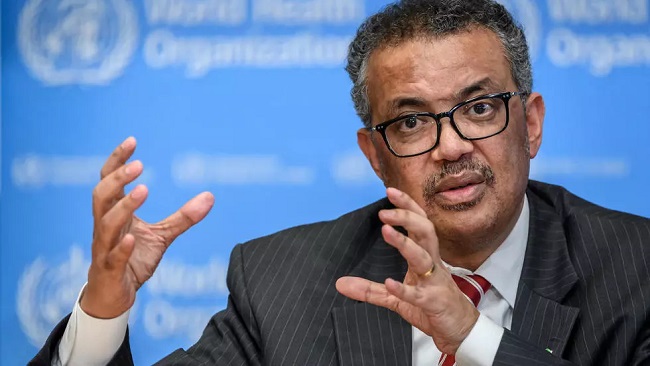
The World Health Organization says the US has provided no evidence to support US President Donald Trump’s claim that the coronavirus originated in a Chinese lab.
“We have not received any data or specific evidence from the United States government relating to the purported origin of the virus — so from our perspective, this remains speculative,” the UN health agency’s emergencies director Michael Ryan said.
Trump claims to have proof the new coronavirus (Covid-19) outbreak started in a laboratory in the Chinese city of Wuhan.
Last month, the US president halted funding to the World Health Organisation after he accused the UN boy of initially downplaying the seriousness of the outbreak to “shield China.”
US Secretary of State Mike Pompeo doubled down on the assertion that the outbreak originated from the Wuhan Institute of Virology.
“I can tell you that there is a significant amount of evidence that this came from that laboratory in Wuhan,” Pompeo told ABC News on Sunday.
China has vehemently denied suggestions the lab was the source.
The WHO emergencies director said, “Like any evidence-based organisation, we would be very willing to receive any information that purports to the origin of the virus.” Ryan stressed that this was “a very important piece of public health information for future control.
“If that data and evidence is available, then it will be for the United States government to decide whether and when it can be shared, but it is difficult for the WHO to operate in an information vacuum in that regard,” he added.
Scientists have condemned conspiracy theories about the Chinese laboratory, saying the new coronavirus jumped from animals to humans, emerging in China late last year, possibly from a market in Wuhan selling exotic animals for meat.
Top US infectious disease expert Anthony Fauci echoed the WHO’s statement, saying that, “If you look at the evolution of the virus in bats and what’s out there now, (the scientific evidence) is very, very strongly leaning toward this could not have been artificially or deliberately manipulated.”
“Everything about the stepwise evolution over time strongly indicates that (this virus) evolved in nature and then jumped species,” he said.
Intelligence assessment contradicts Trump, Pompeo’s claim
Intel shared among US allies indicated it is “highly unlikely” that the coronavirus outbreak was spread as a result of an accident in a laboratory but rather originated in a Chinese market.
“It is highly likely it was naturally occurring and that the human infection was from natural human and animal interaction,” an official from the Five Eyes intelligence-sharing coalition said.
The Five Eyes alliance is made up of the United States, United Kingdom, Canada, Australia and New Zealand.
A source from the Five Eyes nation said that “clearly the market is where the new coronavirus exploded from,” but how the virus got to the market remains unclear.
China’s state-owned Global Times newspaper slammed Pompeo’s Wuhan lab claim, saying that the former CIA director had “stunned the world with groundless accusations.”
“Since Pompeo said his claims are supported by ‘enormous evidence,’ then he should present this so-called evidence to the world, and especially to the American public who he continually tries to fool,” Global Times said.
As the war of words escalates between Washington and Beijing over the coronavirus pandemic, critics say the Trump administration has ramped up efforts to blame China for the global outbreak as it faces growing criticism at home for its own handling of the pandemic.
Nearly 70,000 people died of the coronavirus in the US, and 1,180,634 virus cases were recorded as of early Tuesday morning, according to Johns Hopkins University.
Source: Presstv












6, May 2020
Buea University Don summoned over question on Ambazonia crisis 0
Barrister Nkongho Felix Agbor alias Agbor Balla, Instructor at the English Law Department, Faculty of Laws and Political Science of the University of Buea has been summoned by authorities to justify why he set an examination question on the Anglophone Crisis.
The Disciplinary Hearing opens at 10:00 a.m. Wednesday, May 6, 2020 at the Board Room of the Central Administrative Block, said Prof. Atangcho Nji Akonumbo, Dean of the Faculty of Laws and Political Science.
The rights activist is said to have breached professional obligations when he set an exam question on the Anglophone Crisis in a first semester level one course titled “Political and Constitutional History of Cameroon”. The question read: “The Anglophone crisis since 2016 was caused by lawyers’ and teachers’ strikes. Assess the validity of this statement. (40 marks).”
An “Invitation Letter to a Disciplinary Hearing” dated April 29, 2020 was only delivered to Agbor Balla’s office at the Centre for Human Rights and Democracy in Africa (CHRDA) at 12:08 p.m. Tuesday, May 5, 2020, Cameroon-Info.Net has learnt. Although Agbor Balla was not on seat, the invite was received on his behalf by one of his collaborators at CHRDA where he is founder/president.
In the invitation letter, Prof. Atangcho writes: “On the instruction of the Vice-Chancellor of the University of Buea, and in keeping with article 16 of decree No. 93/036 of 29th January 1993, you are being invited to appear before a constituted Disciplinary Panel of the University to hear allegations against you for non-compliance of professional obligations for a question you set on LAW243: Political and Constitutional History of Cameroon, during the 2019/2020 first semester examination.”
The Minister of State for Higher Education and Chancellor of Academic Orders, Professor Jacques Fame Ndongo had on April 20 instructed the Vice-Chancellor of the University of Buea ,Professor Horace Ngomo Manga to put a definite end to all on-campus activities of Agbor Balla which breach the “ethics and deontology” of the University.
Cameroon-Info.Net recalls that when the crisis in the North West and South West regions started in October 2016 with the Lawyers’ and later Teachers’ strike, Agbor Balla was President of the Fako Lawyer’s Association (FAKLA) as well as President of the Cameroon Anglophone Civil Society Consortium, CACSC.
When pressure came to bear on government, the CACSC was banned on January 17, 2017 and Agbor Balla arrested same day along with Dr. Fontem Neba who served as Secretary General of the Consortium.
Brought before the Yaoundé military court for promoting terrorism among other charges that carry the maximum sentence, Agbor Balla was freed when President Biya ordered the discontinuance of proceedings against him and others on August 30, 2017.
Human Rights Lawyer Agbor Balla’s trouble at the University of Buea may not be unconnected to his indictment of government for the February 14, 2020 killings in Ngarbuh.
Culled from Cameroon Info.Net