27, September 2020
Cameroon Consulate in Lebanon is accused of blocking repatriation of stranded workers 0
Cameroonian women have been waiting for over six months, according to This Is Lebanon.
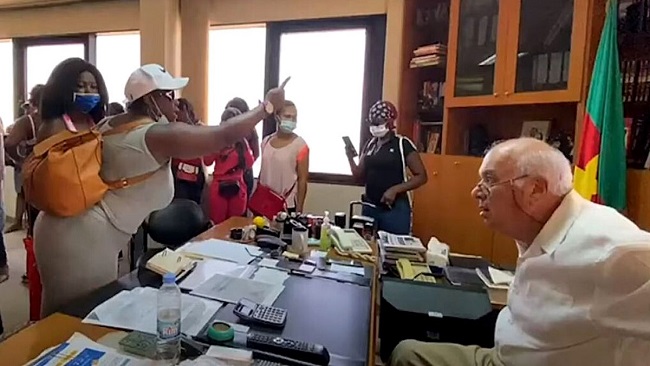
After the terrifying explosion on August 4th, Cameroonian women began to protest at their Consulate in Dbayeh, north of Beirut.
They are accusing the consulate of intentionally blocking the repatriation process of Cameroonian women stranded in Lebanon.
According to the activist group, each woman paid $800 to Honorary Consul Jean Abboud in order to process their Emergency Travel Certificate but they were given no confirmation about when they will be able to return home.
The process has been tedious with no end in sight.
Furthermore, the stranded women have complained of being mistreated by their consulate and facing discrimination by the Honorary Consul’s Secretary, Georgette Chidiac, saying that she doesn’t treat them as humans.
“She should work for us,” they said. “The Cameroonian government pays her each month.”
The Cameroonian women have since reached out to the General Security for help and were asked to provide a full list of names of those who need Emergency Travel Certificate.
However, the Consulate reportedly refused aid and “interference from outside.”
The activist group shared a WhatsApp conversation of a woman from New Zealand inquiring with the consulate about the status of the women.
The consulate’s reply seems ambiguous, and what could be understood from it is the consulate’s claim that the girls are its responsibility and that they are illegal, and some blame directed at “mafia.”
It is unclear, though, why the consulate is unwilling to provide the list of names and hand over the repatriation process to Lebanon’s General Security.
Recently, General Security took over the repatriation process of stranded Kenyan workers who also accused their consulate of mistreating them.
They have also facilitated the successful home-return of 48 Ethiopians, all thanks to “outside interference,” which is basically the local authorities and activists, and the International Organization for Migration.
However, good news has come. The961 was able to get in touch with the social initiative Help_Them_Home which said, “General Security has said as of Monday they will start to process the documents for the women, bypassing the consulate.”






















27, September 2020
US: Trump nominates conservative judge Amy Coney Barrett to Supreme Court 0
Donald Trump nominated on Saturday Amy Coney Barrett for the US Supreme Court to replace the late Justice Ruth Bader Ginsburg. Barrett is a federal appeals court judge known for her conservative legal positions on key issues.
Barrett, 48, was appointed by Trump to the Chicago-based 7th U.S. Circuit Court of Appeals in 2017. She has proven reliably conservative in that post, voting in favor of one of Trump’s hardline immigration policies and showing support for expansive gun rights. She also authored a ruling making it easier for college students accused of campus sexual assaults to sue their institutions.
Abortion rights groups have expressed concern that Barrett would vote as a justice to overturn the landmark 1973 Roe v. Wade Supreme Court decision that legalised abortion nationwide.
Although she has not yet ruled directly on abortion, Barrett twice signaled opposition to rulings that struck down Republican-backed Indiana abortion-related restrictions – one in 2018 requiring fetal remains to be buried or cremated after an abortion, the other in 2019 involving parental notification – voting to have those decisions reconsidered.
Religious dogma
In February 2019, Barrett joined a ruling that upheld a Chicago measure that places limits on anti-abortion activists gathered outside abortion clinics. The ruling, written by Judge Diane Sykes, said the court had to apply Supreme Court precedent.
During her 2017 confirmation hearing for her current post, US Senator Dianne Feinstein told Barrett, “The dogma lives loudly within you”. Barrett said her religious faith would not affect her decisions as a judge.
In June, Barrett dissented when a three-judge panel ruled in favor of a challenge to Trump’s policy to deny legal permanent residency to certain immigrants deemed likely to require government assistance in the future. In January, the Supreme Court, powered by its conservative majority, allowed the policy to take effect.
She also authored a ruling that makes it easier for college students who have been accused of sexual assault to challenge how their schools dealt with their cases. Barrett and her colleagues revived a lawsuit by a male student who had been suspended from Purdue University after sexual assault allegations. He accused the school of discriminating against him on the basis of his gender.
She wrote that in the case it was plausible Purdue officials chose to believe the female accuser “because she is a woman” and to disbelieve the male student accused “because he is a man.”
Barrett indicated support for gun rights in a 2019 dissent when she objected to the court ruling that a nonviolent felon could be permanently prohibited from possessing a firearm.
“Founding-era legislatures did not strip felons of the right to bear arms simply because of their status as felons,” Barrett wrote.
Conservative record
Barrett, born in New Orleans, received her law degree from Notre Dame Law School, a Catholic institution in Indiana. She is a devout Catholic. She is married to Jesse Barrett, a lawyer in private practice and a former federal prosecutor in Indiana. They have seven children, two of whom were adopted from Haiti.
She previously served as a clerk for Supreme Court Justice Antonin Scalia, a stalwart conservative who died in 2016.
In a 1998 law journal article she and another author said that Catholic judges who are faithful to their church’s teachings are morally precluded from enforcing the death penalty and should recuse themselves in certain cases.
Abortion rights groups, worried about preserving the 1973 ruling that a woman has a constitutional right to have an abortion, point to a 2003 law journal article in which Barrett argued that courts could be more flexible in overturning prior “errors” in precedent.
Barrett has also spoken publicly about her conviction that life begins at conception, according to a 2013 article in Notre Dame Magazine.
Her writings also signal views on other contentious topics including healthcare. In a law review article published in 2017, she criticized conservative Chief Justice John Robert’s major 2012 ruling preserving Obamacare.
“Chief Justice Roberts pushed the Affordable Care Act beyond its plausible meaning to save the statute,” Barrett wrote.
‘People of Praise’
Barrett and her family have been members of a Christian religious group called People of Praise, according to other members.
Craig Lent, the group’s overall coordinator, said in 2018 that the organisation, which is officially ecumenical but whose membership is mostly Catholic, centers on close Christian bonds and looking out for one another. They also share a preference for charismatic worship, which can involve speaking in tongues.
Certain leadership positions are reserved for men. And while married men receive spiritual and other advice from other male group members, married women depend on their husbands for the same advice, Lent said.
“We’re not unaware that could be misunderstood. Every member is free and responsible for their own decisions. No one should be servile, no one should be domineering,” Lent said.
Some women in leadership positions used to be called handmaids, but now are referred to as “women leaders,” Lent said, to avoid the perception of servility.
(FRANCE 24 with Reuters)