15, April 2020
Austria, Spain ease Covid-19 restrictions, others extend lockdown measures 0
Spain and Austria allowed partial returns to work on Tuesday but Britain, France and India extended lockdowns to rein in the new coronavirus while the United States, where the death toll exceeded 25,000, debated how to reopen its economy.
The World Health Organization (WHO) warned that infections had “certainly” not yet peaked.
Nearly 2 million people globally have been infected and more than 124,000 have died in the most serious pandemic in a century, according to a Reuters tally.
The epicentre has shifted from China, where the virus emerged in December, to the United States, which has now recorded the most deaths.
World leaders, in considering easing curbs, have to balance risks to health and to the economy as the lockdowns have strangled supply lines, especially in China, and brought economic activity to a virtual halt.
The shutdown is costing the U.S. economy perhaps $25 billion a day in lost output, St. Louis Federal Reserve President James Bullard said, calling for widespread testing and risk management strategies so the economy can restart.
President Donald Trump, who has declared he will decide when to lift lockdowns, suggested some Democratic state governors were “mutineers” after New York Governor Andrew Cuomo said he would refuse any order that risked reigniting the outbreak.
The White House said Trump would hold a video teleconference with leaders from the Group of Seven nations on Thursday to coordinate responses.
The global economy is expected to shrink by 3% this year, the International Monetary Fund said, marking the steepest downturn since the Great Depression.
The WHO said the number of new cases was tailing off in some parts of Europe, including Italy and Spain, but outbreaks were growing in Britain and Turkey.
“The overall world outbreak – 90 percent of cases are coming from Europe and the United States of America. So we are certainly not seeing the peak yet,” WHO spokeswoman Margaret Harris told a briefing in Geneva.
But world stocks gained after Chinese trade data came in better than expected and as some countries partly lifted restrictions.
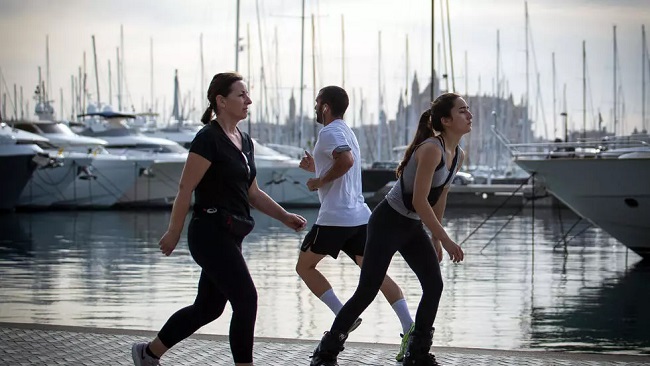
Some Spanish businesses, including construction and manufacturing, were allowed to resume. Shops, bars and public spaces are to stay closed until at least April 26.
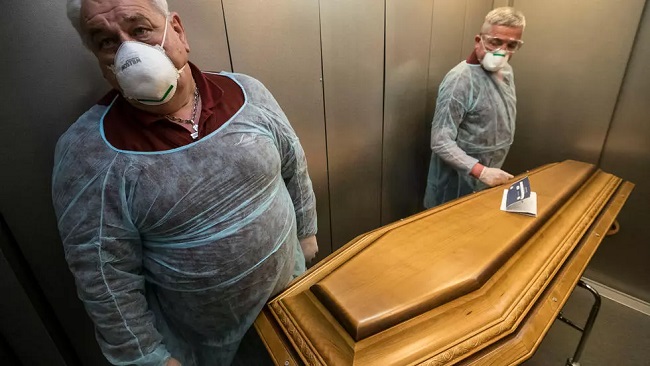
Spain was flattening the curve on the graph representing the rate of growth of the outbreak, Health Minister Salvador Illa said on Tuesday. The overnight death toll from the coronavirus rose to 567 on Tuesday from 517 a day earlier, but the country reported its lowest increase in new cases since March 18. Total deaths climbed to 18,056.
Some Spanish workers expressed concern that the relaxation of restrictions could trigger a new surge of infections. But for Roberto Aguayo, a 50-year-old Barcelona construction worker, the restart came just in time.
“We really needed it, just when we were going to run out of food we returned to work,” he told Reuters.
Italy, which has the world’s second highest death toll at 21,067, maintained some tight restrictions on movement, while Denmark, one of the first European countries to shut down, will reopen day care centres and schools for children in first to fifth grade on April 15.
The Czech government will gradually reopen stores and restaurants from April 20, although people will continue to be required to wear masks.
Thousands of shops across Austria reopened on Tuesday, but the government cautioned that the country was “not out of the woods”.
Austria acted early to shut schools, bars, theatres, restaurants, non-essential shops and other gathering places about four weeks ago. It has told the public to stay home.
The Alpine republic has reported 384 deaths in total, fewer than some larger European countries have been suffering each day. Hospitalisations have stabilised.
Lockdowns extended
Britain, where the government has come under criticism for its slow approach to testing and for not getting protective equipment to the frontlines of health care, has the fifth-highest death toll globally.
The toll in British hospitals rose to 12,107 as of Monday but is expected to be much higher when deaths in the community are included. Foreign Secretary Dominic Raab has said there would be no easing of lockdown measures when they come up for review this week.
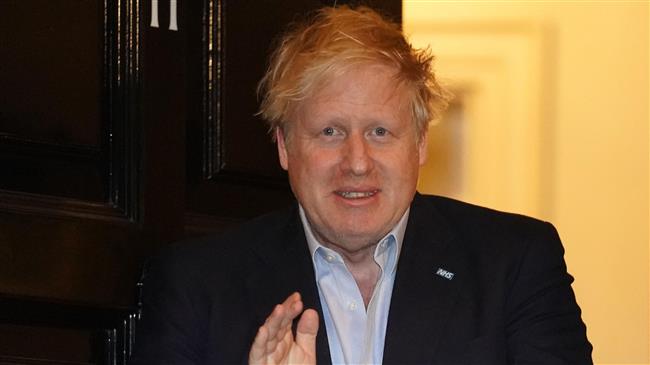
The Times newspaper said on Tuesday that Raab, deputising for Prime Minister Boris Johnson who is recuperating from a COVID-19 infection, would extend the curbs until at least May 7.
In France, President Emmanuel Macron on Monday extended a virtual lockdown to May 11.
India, the world’s second-most populous country after China, extended its nationwide lockdown until May 3 as the number of coronavirus cases crossed 10,000.
Neighbours Pakistan and Nepal also extended their curbs.
Russia might need to call in the army to help tackle the crisis, President Vladimir Putin said on Monday. Moscow warned the capital might run out of hospital beds in coming weeks.
China’s northeastern border province of Heilongjiang saw 79 new cases on Monday – all Chinese citizens travelling back from Russia, state media said.
As of Tuesday, China had reported 82,249 coronavirus cases and 3,341 deaths. There were no deaths in the past 24 hours.
Health ministers from the Group of 20 major economies will speak by video conference on Sunday to address the outbreak’s impact.
(REUTERS)


16, April 2020
Germany set to be European pioneer in partially lifting Covid-19 restrictions 0
Germany has drawn up a list of steps, including mandatory mask-wearing in public, limits on gatherings and the rapid tracing of infection chains, to help enable a phased return to normal life after its coronavirus lockdown is set to end on April 19.
Germany on Wednesday unveiled plans to lift some restrictions imposed because of the coronavirus pandemic, becoming the first major European nation to take on the delicate task of reopening without triggering a new wave of infections.
As US President Donald Trump came under increasing fire for ordering a freeze on American funding for the World Health Organization, the Group of 20 (G20) announced a one-year debt moratorium for the world’s poorest nations.
The number of COVID-19 cases around the globe soared past two million, meanwhile, according to an AFP tally, and the death toll topped 131,000.
Germany was the largest of several European countries announcing tentative steps on Wednesday to reopen their economies and societies.
Denmark began reopening schools for younger children after a month-long closure and Finland lifted a two-week rail and road blockade on the Helsinki region.
Lithuania said it would allow smaller shops to reopen from Thursday.
Other countries are also tweaking confinement rules, with Iran set to let some small businesses reopen and India allowing millions of rural people to return to work.
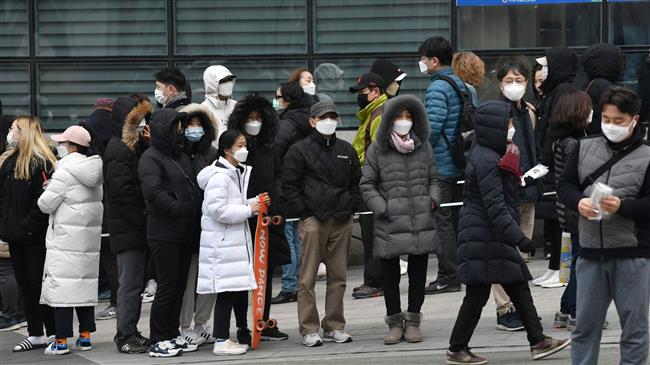
In South Korea, people went to the polls on Wednesday and delivered a strong show of support for President Moon Jae-in, commending his handling of the epidemic.
Once home to the world’s second-largest outbreak, South Korea has largely brought the virus under control through widespread testing, contact-tracing and social distancing.
Yet a full-scale return to normality still appears a long way off in most other countries.
Harvard scientists have warned that repeated periods of social distancing could be needed as far ahead as 2022 to avoid overwhelming hospitals.
Spanish Prime Minister Pedro Sanchez, who has allowed work to restart in some factories and building sites, warned that “nothing will be the same until a vaccine is found.”
Belgium extended its stay-at-home order until at least May 3 and banned mass gatherings until the end of August.
‘Extreme caution’
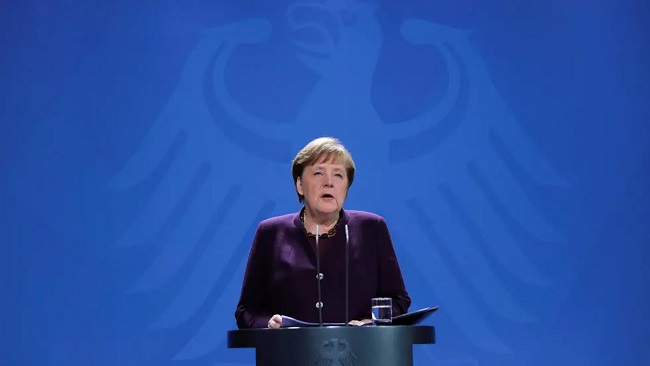
In Germany, Chancellor Angela Merkel announced first steps in undoing coronavirus restrictions that have plunged the economy into a recession.
Most shops will be allowed to open once they have “plans to maintain hygiene” although schools must stay closed until May 4 and a ban on large public events will remain in place until August 31.
“We have to proceed with extreme caution,” Merkel told reporters in Berlin.
Schools will gradually be reopened with priority given to pupils about to take leaving examinations.
And the government urged people to wear face masks when out shopping or on public transport, but stopped short of making it a requirement like in neighbouring Austria.
Offering a lifeline for the world’s poorest countries, the G20 — a group of the world’s leading economies — said it would temporarily suspend debt repayments from the most impoverished nations.
The reprieve will free up more than $20 billion for those countries to focus on the pandemic and will last at least a year, according to Saudi Finance Minister Mohammed Al-Jadaan.
But the global economic outlook remains gloomy, with Germany already in recession and US industrial output declining by 6.3 percent — its biggest fall in seven decades.
More than a third of French workers are on temporary unemployment, the government said.
The virus death toll topped 17,000 in France but in a hopeful sign hospitalizations went down for the first time.
On the horizon looms the worst economic downturn in a century, which the IMF has said could see $9 trillion wiped from the global economy.
‘Lessons’
As the world tries to chart a way out of the crisis, Trump came in for criticism for his freeze on payments to the WHO, the UN’s health agency.
“No doubt, areas for improvement will be identified and there will be lessons for all of us to learn,” WHO chief Tedros Adhanom Ghebreyesus said.
UN chief Antonio Guterres condemned Trump’s move while billionaire Bill Gates, a major WHO contributor, tweeted that cutting funding was “as dangerous as it sounds.”
European allies were similarly disapproving and Washington’s rivals also took aim — Russia condemning the “selfish approach” of the US, and China and Iran blasting the decision.
Trump accused the WHO on Tuesday of “severely mismanaging and covering up the spread of the coronavirus” and said it could have been contained if the organisation had accurately assessed the situation in China late last year.
As European nations made tentative moves to open up, in poorer and more densely populated countries, governments are still struggling to enforce restrictions on movement that are piling misery on the needy.
Fears over hunger and possible social unrest are especially acute in parts of Africa and Latin America.
In Cape Town, clashes erupted Tuesday as police fired rubber bullets and tear gas at residents protesting access to food aid.
A similar crisis is taking hold in Ecuador, where hunger trumps fear of the virus for residents in rundown areas of the badly affected city of Guayaquil.
“The police come with a whip to send people running, but how do you say to a poor person ‘Stay home’ if you don’t have enough to eat?” said Carlos Valencia, a 35-year-old teacher.
(AFP)