18, December 2020
EU, UK officials concede big gaps remain in post-Brexit talks 0
Britain and the European Union provided sober updates Thursday on the state of post-Brexit trade discussions, with only two weeks to go before a potentially chaotic split.
While Ursula von der Leyen, president of the European Union’s executive commission, noted “substantial progress on many issues,” she voiced concerns about the discussions taking place around fishing rights. British Prime Minister Boris Johnson also warned that a no-deal outcome seemed “very likely.”
The two spoke early Thursday evening, their latest in a series of conversations in the past couple of weeks aimed at unclogging the talks, which have moved at a snail’s pace since Britain left the EU on January 31.
Britain remains within the EU’s tariff-free single market and customs union until December 31. A failure to reach a post-Brexit deal would likely lead to chaos on the borders at the start of 2021 as tariffs and other impediments to trade are enacted by both sides. The talks have gotten bogged down on three main issues — the EU’s access to Britain’s fishing waters, the level playing field to ensure fair competition between businesses, and the governance of any deal.
Following their latest conversation, von der Leyen warned that bridging big differences, in particular on fisheries, “will be very challenging.” Negotiations, she added, would continue Friday.
According to a statement from Johnson’s office, the prime minister stressed that “time was very short” and that it “now looked very likely that agreement would not be reached unless the EU position changed substantially.”
Intractable dispute
Johnson, like von der Leyen, focused on the lack of progress on fisheries. which has proved to be a hugely intractable issue in the talks — even though it accounts for only a very small amount of economic output.
On fisheries, the EU has repeatedly said it wants an agreement that guarantees a reciprocal access to markets and waters. EU fishermen are keen to keep working in British waters and Britain’s seafood industry is extremely dependent on exports to the 27-nation bloc. Johnson has made fisheries and British control over its waters a key demand in the long saga of Britain’s departure from the EU.
According to Downing Street, Johnson stressed that Britain could “not accept a situation where it was the only sovereign country in the world not to be able to control access to its own waters for an extended period and to be faced with fisheries quotas which hugely disadvantaged its own industry.”
The EU’s position, according to Johnson, “was simply not reasonable, and if there was to be an agreement, it needed to shift significantly.”
Earlier, the European Parliament issued a three-day ultimatum to negotiators to strike a trade deal if it is to be in a position to ratify an agreement this year. European lawmakers said they would need to have the terms of any deal in front of them by late Sunday if they were to organize a special gathering before the end of the year.
If a deal comes later, it could only be ratified in 2021, as the Parliament would not have enough time to debate the agreement before that.
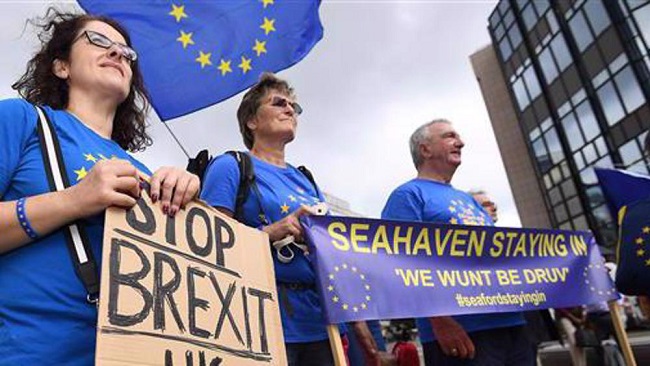
An anti-Brexit placard is held in Parliament Square, in London, Wednesday, Dec. 16, 2020. Ursula von der Leyen said Wednesday…
An anti-Brexit placard is held in Parliament Square, in London, Dec. 16, 2020.
‘Intolerable’ uncertainty
“We give until Sunday to Boris Johnson to make a decision,” said Dacian Ciolos, president of the Renew Europe group in the European Parliament. “The uncertainty hanging over citizens and businesses as a result of U.K. choices becomes intolerable.”
A trade deal would ensure there are no tariffs and quotas on trade in goods between the two sides, but there would still be technical costs, partly associated with customs checks and nontariff barriers on services.
Britain’s Parliament must also approve any Brexit deal, and the Christmas break adds to the timing complications. Lawmakers are due to be on vacation from Friday until January 5, but the government has said they can be called back on 48 hours’ notice to approve an agreement if one is struck.
Though both sides would suffer economically from a failure to secure a trade deal, most economists think the British economy would take a greater hit, at least in the near term, as it is relatively more reliant on trade with the EU than vice versa.
Both sides have said they would try to mitigate the impact of a no-deal, but most experts think that whatever short-term measures are put in place, the disruptions to trade will be immense.
“The prime minister repeated that little time was left,” Downing Street said in its statement after the call. “He said that, if no agreement could be reached, the U.K. and the EU would part as friends, with the U.K. trading with the EU on Australian-style terms.”
Australia does not have a free-trade deal with the EU.
(Source: AP)



















19, December 2020
French President Macron in ‘stable’ condition after positive Covid-19 test 0
French President Emmanuel Macron’s condition is stable and the results of a medical examination reassuring, the French presidency said on Saturday in an update on his bout of coronavirus.
“The medical condition of the president is stable compared with Friday,” the Élysée Palace statement quoted Jean-Christophe Perrochon, the chief doctor of the presidency.
“[Macron] presents the same symptoms of the Covid-19 illness (fatigue, coughing, stiffness) that do not prevent him from fulfilling his duties,” Perrochon said.
The Élysée statement also said that the results of medical tests on Macron have been “reassuring”.
Macron said on Friday he was doing fine a day after testing positive for Covid-19, but was working at a slower pace than usual outside Paris.
(FRANCE 24 with REUTERS)