2, October 2021
Southern Cameroons Crisis: 5 years of violent civil war 0
Protesters criticize that English-speaking regions of Cameroon are far less developed than French-speaking parts. They also take issue with crude oil extraction off the country’s southwestern coast, arguing the proceeds only benefit Cameroon’s Francophone central government. Teachers and judges complain that English speakers are underrepresented in parliament, the government, public administration and universities.
Thousands of French-speaking judges and teachers were dispatched to Anglophone Cameroon at the start of the 2016 school term. Cameroon’s central government has been working to supplant the region’s British-style legal and education system with the French model. Anglophone Cameroonians complain that those French-speaking judges and teachers are undermining the region’s English-language culture.
November 2016: The central government first remains silent on the situation, then suppresses the Anglophone protest movement. Subsequently, tension escalate, with English-speaking Cameroonians variously calling to reestablish a federal system, or split from Francophone Cameroon. Elements within the separatist movement now regard English-speaking Cameroon as an independent state, calling it Ambazonia.
A whole range of different, Anglophone separatist groups emerge, who total some 4,000 members altogether. They are supported by Cameroon’s diaspora. The most influential separatists organizations are the Ambazonia Defense Forces, Ambazonia Self-Defense Council, African People’s Liberation Movement and its armed wing, the Southern Cameroons Defense Forces. The secessionist movement is riven by ethnic rivalries, lacking overall military and political leadership.
December 2016: Several people are shot and killed by security forces in the city of Bamenda, in Cameroon’s northwestern Anglophone region. Dozens are wounded in the clashes. The army fails to bring the situation under control.
January 2017: Cameroon’s central government launches a concerted campaign to weaken Anglophone separatist groups. English-speaking Cameroon is cut off from the internet from January to April 2017. Relatives of Anglophone activists are arrested. Cameroon’s army and police force crack down on renewed protests staged by English-speaking teachers and lawyers. Separatist groups like the Cameroon Anglophone Civil Society Consortium subsequently call on all English speakers to participate in general strikes every Monday, bringing public life to a standstill.
Is a Biya political dynasty taking shape?
October 2017: Separatist leader Sisiku Julius Ayuk Tabe declares the Republic of Ambazonia an independent state on October 1, a national holiday officially celebrated as Unification Day. Several regions fall under the control of armed separatist groups. Cameroon’s president, Paul Biya, meanwhile, continues downplaying and suppressing the conflict.
International organizations become increasingly aware of the conflict. Human Rights Watch (HRW) reports some 4,000 people have died in clashes, with around 60,000 forced to flee to neighboring Nigeria. It says about 850,000 children are unable to attend school due to the ongoing conflict. Some 2.3 million out of the 5 million Anglophone Cameroonians depend on humanitarian aid, according to HRW.
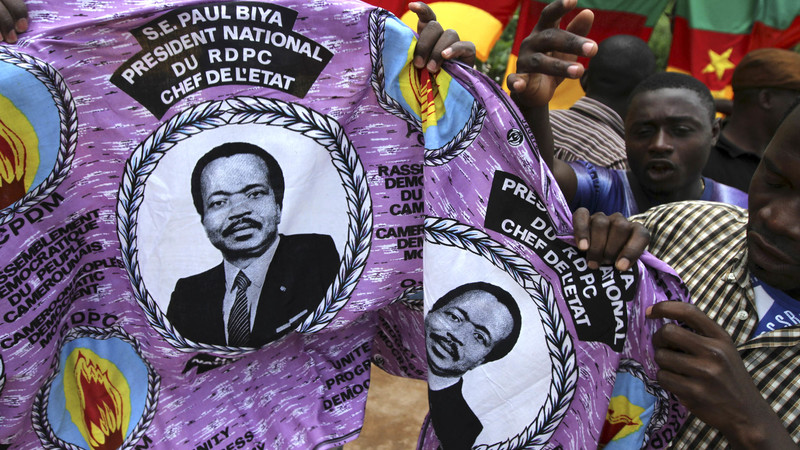
October 2018: President Biya, in office since 1982, is reelected with 71.28% of the vote. The election is, however, marred by allegations of fraud. Political and ethnic tensions between Biya supporters and the opposition intensify.
Paul Biya was reelected in October 2018
February 2019: Maurice Kamto, who heads the Cameroon Renaissance Movement (MRC) opposition party, is sentenced to eight months behind bars for inciting violence. Kamto is has repeatedly protested against systemic discrimination.
September 2019: Biya announces though state-run media outlets that a grand national dialogue will be held on September 10 to resolve the country’s protracted conflict. Talks are planned from September 30 until October 4. The governing Cameroon People’s Democratic Movement (RDPC) party, several religious organizations and civil society actors support Biya’s imitative. UN Secretary-General Antonio Guterres welcomes the step.
Most opposition parties, however, reject the format, as key separatist leaders remain in jail. They also criticize the summit will neither address a potential return to federalism, nor possible independence for English-speaking regions of Cameroon.
Biya dismisses mediation efforts by the UN, African Union (AU) and Catholic Church.
Opposition leader Maurice Kamto was released from prison on October 5, 2019
December 2019: Biya ratifies several laws designed to promote bilingualism and decentralization in Cameroon. Opposition figures, however, decry the move as “window dressing” to keep Biya in power.
February 2020: Kamto’s MRC party boycotts the parliamentary and municipal elections. The ruling RDPC party wins the vast majority of votes. Voter turnout, however, has reached a historic low.
March 2020: Attacks by radical Islamic terror group Boko Haram on northeastern Cameroon intensify. Incursions are launched from Nigeria and Chad, where Boko Haram is based. The campaign brings further instability to Cameroon.
March 2020: Amid the COVID pandemic, the separatist militant group Southern Cameroon Defense Forces declares a cease-fire from March 29, 2020, following a call by the UN secretary-general. The largest separatist militant group, the Ambazonian Defense Forces (ADF), declines to take part in the cease-fire. The attacks continue.
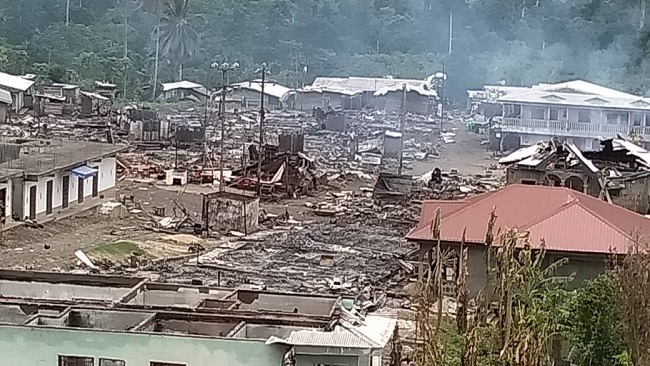
September 2021: Deadly attacks by various separatist groups on military posts and vehicles of the Cameroonian army continue to be a daily occurrence. Cameroonian security forces ready for robust clashes on October 1, which officially marks the founding of the Cameroonian state. On the same day, separatists celebrate the proclamation of the independent Republic of Ambazonia in 2017. The self-declared entity is still not recognized internationally.
Source: Deutchewelle











2, October 2021
CPDM looks to post-Biya future ahead of party conference 0
Elections to the local institutions of the ruling RDPC have now come to an end. The stakes are high, since those appointed to senior positions will be able to take part in the next party conference (the first since 2011), which could very well be decisive in terms of who succeeds Paul Biya.
Source: Africa Intelligence