26, April 2018
France won’t leave Iran nuclear deal, Macron tells US Congress 0
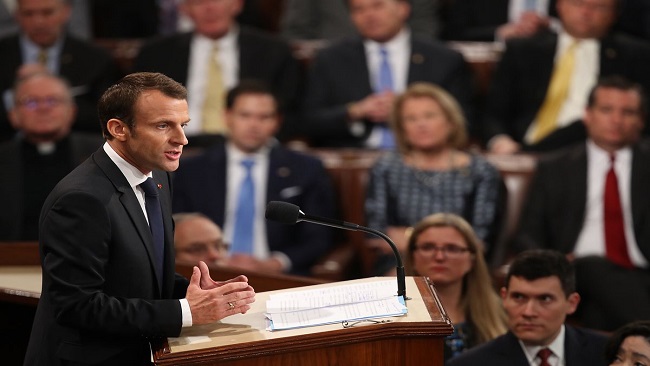
French President Emmanuel Macron says his country will not leave the Iran nuclear deal, known as the Joint Comprehensive Plan of Action (JCPOA), amid US efforts to persuade European parties to the agreement to withdraw from it.
Speaking at the US Congress Wednesday on the final day of a three-day state visit, Macron said the JCPOA was not addressing what he called “all concerns” but stressed that the deal could not be ditched.
“We signed it, both the United States and France.”
“We should not abandon it without having something substantial and more substantial instead. That’s why France will not leave the JCPOA, because we signed it,” he said.
He also vowed that Iran will “never” be allowed to develop atomic weapons.
“Our objective is clear. Iran shall never possess any nuclear weapons. Not now. Not in five years. Not in 10 years. Never,” Macron said.
Trump has often vowed to pull the United States out of the 2015 nuclear pact between Iran and the P5+1 group of countries, which was negotiated under his predecessor, Barack Obama.
Back in January, Trump said it was the last time he was extending the sanctions relief for Iran as part of the nuclear agreement, giving the European signatories a May 12 deadline to fix what he claimed to be the “flaws” in the agreement or he would refuse to waive those bans.
Iran has repeatedly warned that any failure to respect the multinational agreement would have grave consequences, stressing that there is no alternative to the nuclear accord.

‘Trade war’
Elsewhere in his remarks, the French president also warned against a trade “war” between allies and asked for a free and fair global trade.
“We need a free and fair trade, for sure,” Macron said. “A commercial war opposing allies is not consistent with our mission, with our history, with our current commitments for global security.”
Macron’s remarks came as US trade sanctions on European steel and aluminum will enter into force in coming weeks unless Trump agrees to sign a waiver.
Paris climate agreement
On climate, Macron told US lawmakers there was “no Planet B,” acknowledging a disagreement with Trump, who pulled his country from the landmark Paris accord on climate change.
“Let us face it. There is no Planet B,” Macron said.
“We have disagreements between the United States and France. It may happen, like in all families,” he said but added that such differences would be short-term. “We’re just citizens of the same planet,” Macron said.
He said he was confident the United States “would come back and join the Paris agreement.”
Trump said last year that his country would withdraw from the accord, which aims to reduce damaging emissions and was signed by almost 200 countries.
Culled from Presstv












26, April 2018
UN finds five mass graves in Congo amid ethnic violence 0
United Nations investigators have discovered five probable mass grave sites in eastern Congo’s Ituri province where an outbreak of ethnic violence has killed at least 263 people, a UN peacekeeping mission said.
The report from the mission provides the most comprehensive portrait to date of the human cost of months of violence between Lendu pastoralists and Hema herders since December that has caused one of Africa’s most serious refugee crises.
Violence across eastern Congo’s borderlands with Uganda, Rwanda and Burundi has spiked since President Joseph Kabila refused to step aside at the end of his mandate in 2016, eroding state authority and emboldening armed groups.
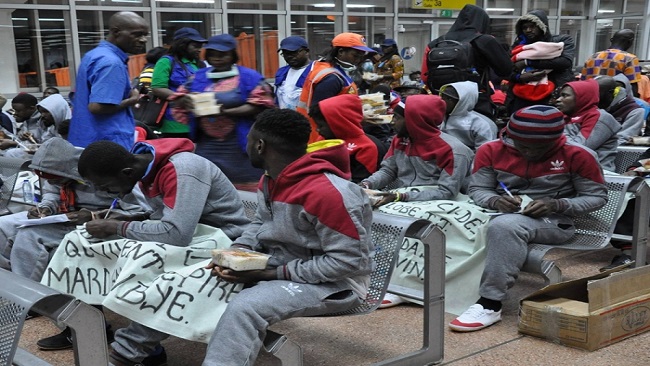
The mostly Lendu-led attacks have forced more than 60,000 people to flee across Lake Albert into Uganda, and the UN refugee agency expects 200,000 refugees to reach Uganda this year. Tens of thousands of others have fled to other towns inside Congo.
The investigators did not provide details about the suspected mass graves, but said that about 120 towns and villages were pillaged and destroyed between December and mid-March.
According to Hema refugees Reuters interviewed last month in Uganda, Lendu groups typically attack Hema villages shortly after dusk with guns, machetes, axes and bows and arrows.
The precise motives for the attacks are difficult to pin down but tensions between the two communities have long been stoked by disagreements over cattle grazing rights, crops, gold mining and political representation.
Open warfare between the two communities from 1999-2007 is estimated to have killed some 50,000 people in one of the bloodiest chapters of a civil war in eastern Congo that left millions dead from conflict, hunger and disease.
Aid agencies say the crisis is a “mega-disaster” and are trying to raise over $2 billion to respond but Congo’s government has accused them of exaggerating the situation and boycotted a recent donor conference.
(Source: Reuters)