
22, August 2017
South African civil rights group to challenge Grace Mugabe’s immunity 0
A group supporting victims of crime in South Africa says it will legally challenge a controversial Foreign Ministry decision to grant immunity to Grace Mugabe, a move which allowed the wife of Zimbabwe’s president to leave the country without standing trial for an alleged assault on a young model.
AfriForum’s chief Kallie Kriel said Monday that the civil rights organization was preparing a court injunction to set aside the decision to grant diplomatic immunity to Grace Mugabe after she reportedly assaulted Gabriella Engels, a 20-year-old model, with an electrical extension cord at a hotel in Johannesburg.
“We are going to ask the court to say that the decision to grant immunity is unlawful because our legislation says that diplomatic immunity cannot apply in serious crimes, and violence is part of that,” said Kriel.
The rights campaigner also said that Grace, the wife of Zimbabwe’s ailing leader Robert Mugabe, was in South Africa for medical assistance, adding that she could not enjoy diplomatic immunity during the stay.
“We believe that the diplomatic immunity should not have been granted,” Kriel said, adding, “She had been here for medical assistance with regards to her foot and therefore diplomatic immunity does not apply.”
Grace flew out of South Africa in the early hours of Sunday despite being sought by police for the assault on Engels, which left the young model with cuts on her forehead and on her head that required stitching. That had prompted the model to file an assault charge against Mugabe.
South Africa’s Foreign Ministry said later on Sunday in a statement that it had granted Grace Mugabe immunity, although it acknowledged that the decision “was not an easy one to make” and came after “careful consideration of all the relevant factors.”

AfriForum said, however, that seeking diplomatic immunity for Mugabe was an “afterthought” and that the Foreign Ministry’s decision was in line with a regional “culture of impunity.”
The group vowed to help Engels seek justice, adding that even if the court did not accept to overrule the immunity, the effort would still be positive as it could stop Grace Mugabe from visiting South Africa again.
“In the worst case scenario, if we get to a situation where she cannot come to the country any more, I think that will be a positive step,” said Kriel, adding, “But the first prize is to make sure she is being prosecuted.”
Source: Presstv









24, August 2017
“There was never a marriage between Southern Cameroons and La Republique” Tumi 0
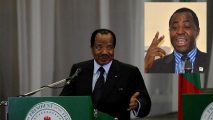
Cardinal Christian Tumi has revealed that the reunification of Cameroon was only a fake arrangement. In an interview the retired prelate granted recently to lavoixdukoat.com, Tumi said that “There was never a marriage between Anglophone and French Cameroon. They live in concubinage.”
The former archbishop of Douala opined that no act was formally taken in July 1961 in Foumban. “They signed nothing at Foumban. Prime Minister John Ngu Foncha (who was a former Catholic teacher) did not have the power to negotiate, because Cameroon was under the tutelage of France and England. As the French supported Ahidjo, they were at the conference. It was England and the United Nations that had to validate the act. But these two were not present. There has never been a document about what happened in Foumban. People went to drink wine. ”
The de facto federalism thus devoted left many fond memories to Cardinal Tumi. He recalled that the country enjoyed good governance. For him Cameroon was “well managed, development was the basis. There was a prime minister in every part of the country. Paul Biya had signed a text on federalism (Reference to the 1996 Constitution, Editor’s note) which specified that governors should be elected, it should have ten federated states. Paul Biya then promised decentralization. That must have been good. But I have the impression that he was asleep when he signed the document and that he woke up after doing so, since he did not implement anything. The problem is that you do not want to share power, “he said.
Christian Tumi believes that there is indeed an Southern Cameroons problem. He explained that even if the problems are the same everywhere in the country, West Cameroon has its specificities. According to him, Southern Cameroons was already considered a country and managed itself, with its administration, a prime minister before joining Cameroon. He believes that an effective implementation of decentralization would have eliminated any problem. Especially those he sees in other parts of the country.
Reacting to the acts of violence perpetrated here and there, the much respected Cardinal Tumi noted that “We can forgive the person, it’s passion, but it’s unacceptable. All violence is unacceptable. We cut the hand of a girl who was going to write her exams. No reason can support that. But We can forgive.”
Culled from Cameroon Info.Net