4, October 2018
Cameroon’s displaced thousands fear disenfranchisement 0
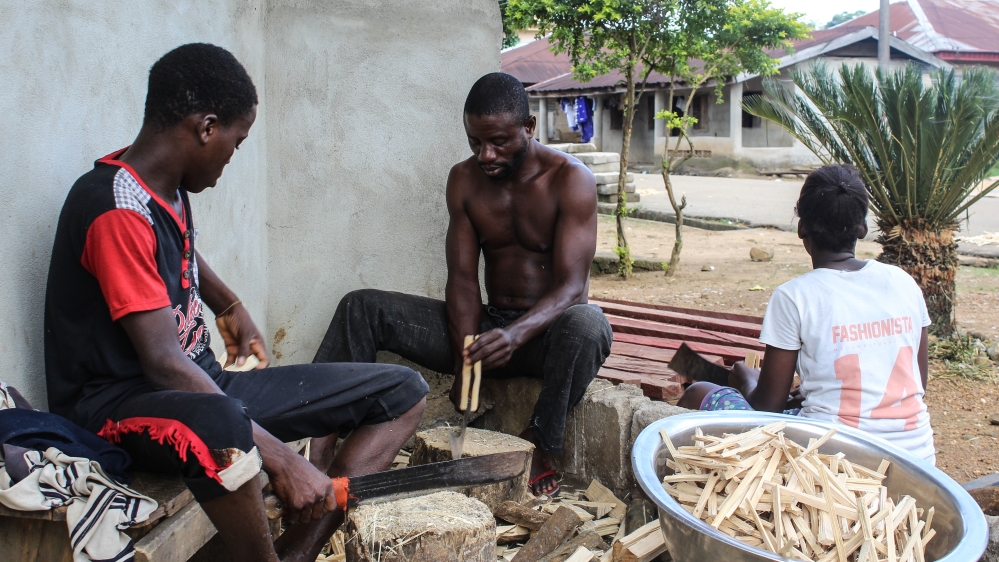
“If you have the polling card, you go and vote, but it’s complicated once you’re there,” said Yagana Adi, 55, who wants to vote in Cameroon’s presidential election on Sunday. Her identity papers were lost when she fled an attack on her village by Boko Haram jihadists in 2014.
The raid happened in Djakana in Cameroon’s far north near the Nigerian border and forced her to abandon her home along with her 13 children.
“I said to the children that we were leaving, we walked for hours, days, and we arrived in Maroua,” the regional capital, she said. Two of her daughters did not manage to flee in time and were picked up by jihadists.
Nearly one in 10 people in the far north have followed a similar path to Yagana, fleeing repeated attacks by Boko Haram which is based in neighbouring Nigeria.
Roughly 80,000 have since returned home but 238,000 remain displaced, according to the International Organization for Migration. Many have sought refuge with friends and family in the region’s towns like Maroua.
“If you go into a Maroua neighbourhood, they’re everywhere,” said a humanitarian source on the ground. “The problem is that they don’t have their papers anymore and so can’t register on the voter roll.”
– ‘Challenges for displaced people’? –
The electoral commission Elecam has vowed that those who have been “displaced will be able to vote,” according to the organising body’s regional director Amadou Ali.
“They’re not just displaced people — they are voters. The fact that they’ve been displaced will not have any impact on the election.”
He added that people without their documents will be able to register to vote in the towns where they have sought refuge. “It’s not true, I wasn’t able to get a voting card,” retorted Yagana, as she rested on a mat.
“I’ve requested it but a local official asked me for 40,000 CFA francs ($70, 60 euros).” Yagana and her family are now living on a vacant plot of land lent to her by a Maroua resident where they have erected a makeshift shelter using sheets and tarpaulins.
“I think less than one-third of those displaced in the far north are registered on the voters’ roll,” said Hans de Marie Heungoup, a Cameroonian researcher at the International Crisis Group (ICG) think-tank.
The region is Cameroon’s most populous and its poorest and has previously voted overwhelmingly for President Paul Biya.
“There’ll be an election in the far north, but who the people vote for is another question,” said a prominent figure in Maroua where Biya made his only appearance of the campaign so far at the weekend. It was also his first visit to the region since 2012.
Majority-francophone Cameroon’s two English-speaking regions — the southwest and northwest — have been rocked by a separatist insurgency since a symbolic independence declaration one year ago.
“The challenges for displaced people to vote there are greater,” said a senior military source based in Yaounde.
– ‘The election? It doesn’t concern us’ –
The army has been deployed to the two restive regions to battle separatist fighters since the end of 2017. According to the ICG, the secessionists control “a significant proportion of rural areas and main roads” in the regions. Skirmishes are violent and occur daily, displacing thousands of local residents.
In the southwest, 246,000 people have been displaced according to the UN, while no estimate exists for the northwest region which is largely inaccessible to aid groups and journalists.
Some 25,000 others are sheltering in neighbouring Nigeria, according to the UN. “The people have sought refuge in the bush and they are living in awful conditions,” said a humanitarian source in Buea. The town is rocked by bursts of gunfire daily, according to local sources.
No reception centres for displaced people have been opened in the anglophone areas where separatists have threatened to disrupt the vote. In the face of continuing clashes, a surge of troops is planned, according to the senior officer.
Elecam has also said that some polling stations will be “relocated” in the anglophone region which has traditionally been a reliable well of votes for the main opposition Social Democratic Front (SDF) whose candidate is Joshua Osih.
He has described the planned “relocations” in interviews as “an illegal measure” that could damage his chances. Asked about the looming vote, a student in Douala who fled Buea with his family said: “The election? It doesn’t concern us. I want to get my father’s job and our house back. Here, we are stuck.”
Source: AFP



 Cameroon is in crisis. It needs an intervention. Shutterstock













4, October 2018
UK accuses Russian military intelligence of global cyber attacks campaign 0
Britain accused Russian military intelligence on Thursday of directing a host of cyber attacks aimed at undermining Western democracies by sowing confusion in everything from sport to transport and the 2016 U.S. presidential election.
In a British assessment based on work by its National Cyber Security Centre (NCSC), Russian military intelligence (GRU) was cast as a pernicious cyber aggressor which used a network of hackers to spread discord across the world.
GRU, Britain said, was almost certainly behind the BadRabbit and World Anti-Doping Agency attacks of 2017, the hack of the Democratic National Committee (DNC) in 2016 and the theft of emails from a UK-based TV station in 2015.
“The GRU’s actions are reckless and indiscriminate: they try to undermine and interfere in elections in other countries,” said British Foreign Secretary Jeremy Hunt.
“Our message is clear – together with our allies, we will expose and respond to the GRU’s attempts to undermine international stability,” Hunt said. Britain believes the Russian government is responsible for the attacks.
Though less well known than the Soviet Union’s once mighty KGB, Russia’s military intelligence service played a major role in some of the biggest events of the past century, from the Cuban missile crisis to the annexation of Crimea.
Russian cyber power?
Though commonly known by the acronym GRU, which stands for the Main Intelligence Directorate, its name was formally changed in 2010 to the Main Directorate of the General Staff (or just GU). Its old acronym – GRU – is still more widely used.
It has agents across the globe and answers directly to the chief of the general staff and the Russian defence minister. The GRU does not comment publicly on its actions. Its structure, staff numbers and financing are Russian state secrets.
The GRU traces its history back to the times of Ivan the Terrible, though it was founded as the Registration Directorate in 1918 after the Bolshevik Revolution. Vladimir Lenin insisted on its independence from other secret services.
British Prime Minister Theresa May has said GRU officers used a nerve agent to try to kill former double agent Sergei Skripal, who was found unconscious in the English city of Salisbury in March. Russia has repeatedly denied the charges.
After the Skripal poisoning, the West agreed with Britain’s assessment that Russian military intelligence was to blame and launched the biggest expulsion of Russian spies working under diplomatic cover since the height of the Cold War.
Russian President Vladimir Putin, himself a former KGB spy, said on Wednesday that Skripal, a GRU officer who betrayed dozens of agents to Britain’s MI6 foreign spy service, was a “scumbag” who had betrayed Russia.
Britain said the GRU was associated with a host of hackers including APT 28, Fancy Bear, Sofacy, Pawnstorm, Sednit, CyberCaliphate, Cyber Berkut, Voodoo Bear and BlackEnergy Actors.
“This pattern of behaviour demonstrates their desire to operate without regard to international law or established norms and to do so with a feeling of impunity and without consequences,” Foreign Secretary Hunt said.
The United States sanctioned GRU officers including its chief, Igor Korobov, in 2016 and 2018 for attempted interference in the 2016 U.S. election and cyber attacks.
“Main Intelligence Directorate (GRU), a Russian military intelligence organization, knowingly engages in significant activities that undermine cybersecurity on behalf of the Russian government,” the U.S. Treasury said in March.
(REUTERS)