31, August 2018
Sensing threats from the West, Russia prepares to flex its military muscle 0
Russia this week announced the upcoming launch of its largest military exercises since the end of the Cold War, involving some 300,000 troops. The message seems clear: Russia feels under threat and will do what it must to protect itself.
The Vostok-2018 (East-2018) operation will be launched in Russia’s central and eastern military districts from September 11 to 15 and is set to mobilise around 300,000 troops, more than 1,000 military aircraft and two naval fleets, Defence Minister Sergei Shoigu said on Tuesday. The exercise will also involve forces from China and Mongolia’s militaries.
Shoigu painted a picture of a vast military operation that will closely mirror combat conditions. “Just imagine that 36,000 pieces of military hardware are simultaneously in motion: These are tanks, armoured personnel carriers, infantry fighting vehicles and, all this is, naturally, in conditions close to a combat environment,” hetold journalists.
Asked at a press briefing why the Vostok-2018 exercises will be so massive, Kremlin spokesman Dmitri Peskov expressed the Russian view that it remains under threat from international actors and thus has no choice but to prepare on a grand scale.
“The country’s ability to defend itself in the current international situation, which is frequently quite aggressive and unfriendly toward us, is absolutely justified and has no alternative.”
Russia’s ministry of defence announced Thursday that it would also be holding a week of naval exercises in the Mediterranean Sea starting September 1. Some 25 vessels and 30 aircraft are slated to take part, according to Russia’s TASS news agency, with exercises including anti-aircraft, anti-submarine and anti-mining operations.
The upcoming mobilisation comes a year after Russia’s Zapad-2017 (West-2017) exercise, conducted jointly with Belarus. According to NATO, up to 70,000 troops participated in those training missions. The 300,000 forces committed to Vostok-2018 thus mark a sharp increase in the numbers Russia is willing to mobilise for its annual strategic exercises, a practice it revived in 2008.
“This is a PR coup from Moscow to showcase large troop displacements and preparedness,” said Mathieu Boulègue, a research fellow in the Russia and Eurasia Programme at Chatham House who specialises in Russian military and defence matters. Chatham House is an independent policy institute based in London.
These exercises have two main goals, according to Boulègue. First, Vostok-2018 is aimed at highlighting Russia’s strategic mobility and its command of military logistics. Second, this year’s exercise is “clearly emphasising” size.
Moreover, the inclusion of China is designed to send the world a message.
“For Russia, the PR/communication strategy behind China’s participation is clearly to demonstrate that 1) Russia is not isolated militarily, and 2) Russia is seeking to form some sort of an anti-US military alliance with the help of China,” Boulègue said in an email.
China is not looking to antagonise anyone, but Beijing believes that Russia-China relations are currently “good enough to explore a deepened cooperation, and notably in the military sphere”.
“It’s also a strong signalling to the West and the US.”
Paranoid delusions and failed good intentions
Russia has been steadily increasing its military investment ever since its August 2008 conflict with Georgia. In 2013, Russian President Vladimir Putin committed the Kremlin to increasing military preparedness.
“The Russian Armed Forces learned some hard lessons in Georgia,” wrote Dave Johnson, astaff officer in NATO’s Defence Policy and Planning Division, of the Zapad-2017 exercise.
“Low manning and readiness levels forced the Russians to attack with a scratch force. Shortfalls in C4ISR (Command, Control, Communications, Computers, Intelligence, Surveillance, and Reconnaissance) were sorely felt, as was the limited ability of the land and air forces to operate together, and the lack of precision weapons.”
Russia remains ever vigilant of any NATO actions near its own borders, stridently opposing any manoeuvers in the Baltics. It has also roundly criticised plans for an October training exercise that nevertheless falls far short of the scale of Vostok-2018: TheNATO drill in Norway, the Baltic Sea and the North Atlantic will involve some 35,000 troops from 30 NATO members and partners backed by about 70 ships and 130 aircraft.
Russian foreign ministry spokeswoman Maria Zakharova said Thursday that the exercise was “clearly anti-Russian”.
These NATO exercises are plans for “defensive and – what is crucially important – offensive operations at northern latitudes during a ‘high-intensity’ conflict with an equal enemy”, Zakharova said.
“This show of force is to take place in direct proximity to the Russian borders and is clearly anti-Russian.”
Moscow has a “preoccupation” with the idea that a major conflict with the West is on the horizon, said Keir Giles, a senior consulting fellow at the Russia and Eurasia Programme of Chatham House and a specialist in Russian security policy.
While there are several reasons for this, it is partly a “paranoid delusion on the part of Moscow”.
Russia believes Western governments want to weaken it, even break it apart. “Nothing could be farther from Western intentions,” Giles said. “A destabilised Russia is the last thing the West wants.”
But the Kremlin tends to view international relations as a zero-sum game. Even security – something the West believes is best served through multilateral cooperation – is seen in these terms. Russia holds fast to the idea that “a finite amount of security” exists, Giles said. So Russia becomes less safe as other nations become more secure.
Moreover, Moscow continues to perceive security issues in “old-fashioned, brute force terms”.
‘Epicentres of chaos and instability’
And Western actions have helped fuel these fears. Western governments have an unfortunate recent history of “failed good intentions”, Giles observed. Interventions in Afghanistan, Iraq and Libya, however well-meaning, have in many cases made the situation worse. In the process, the West has left behind “epicentres of chaos and instability” that Russia sees as inching ever closer to Moscow.
For decades, entrenched attitudes on both sides have created a seemingly permanent impasse. Speaking at a press conference in Helsinki with his Finnish counterpart on Thursday, French President Emmanuel Macron said the European Union needed to rethink its post-Cold War relationship with Russia.
“It is in our interest” for the EU to pursue a strategic relationship with Russia that “brings stability, that will, in the long term, bring more strength and [coherence]”, Macron said.
But in a concurrent pronouncement that seemed certain to ruffle Russian feathers, Macron noted that Europe had for too long relied on US protection. While the transatlantic NATO alliance remains important, he said, the EU needs to boost its own defence capabilities.
Culled from France 24


1, September 2018
French Cameroun soldiers tortured and killed prisoners at base used for US drone surveillance 0
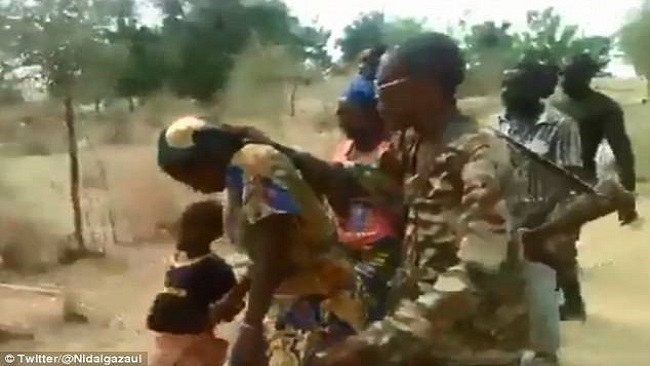
Troops in the West African nation of Cameroon have tortured prisoners at a remote military base that is also used by U.S. personnel and private contractors for drone surveillance and training missions.
As the U.S. military has fortified the Cameroonian site, known as Salak, and supported the elite local troops based there, the outpost has become the scene of illegal imprisonment, brutal torture, and even killings, according to a new investigation by The Intercept and the Goldsmiths, University of London-based research firm Forensic Architecture, based on extensive research by Amnesty International. Nearly 60 victims held at Salak described to Amnesty International how they were subjected to water torture, beaten with electric cables and boards, or tied and suspended with ropes, among other abuses.
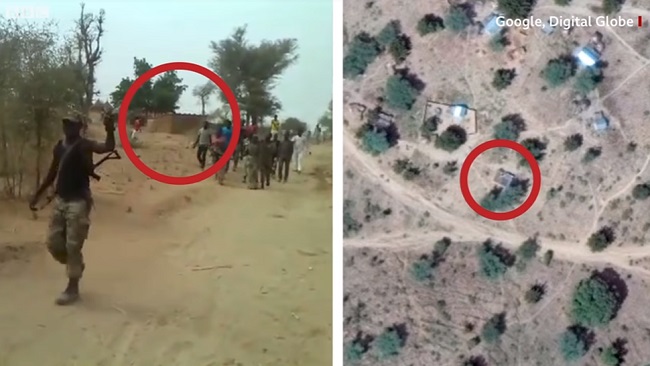
Forensic Architecture investigated conditions of detention and torture at two sites of illegal incarceration, run by Cameroon’s security forces, to accompany a new report by Amnesty International. See the full investigation here.Video: Forensic Architecture
No evidence has emerged that U.S. personnel were involved in torture, but photos and videos from Salak show U.S. soldiers and civilian contractors near the facilities where prisoners were held, and detainees testified to seeing and hearing Americans in uniform during their imprisonment.
“We can’t be 100 percent sure that Americans were aware of the torture,” said Ilaria Allegrozzi, Amnesty International’s lead researcher on a new report about abuses by Cameroonian forces. “But our evidence demonstrates that at Salak these practices occur in places that are accessible and can be visible to U.S. and other foreign personnel.”
Salak serves as ground zero for Cameroon’s fight against the Nigerian militant group Boko Haram, a campaign that the United States has thrown its full support behind. Last month, President Donald Trump sent a letter to Congress outlining current “deployments of U.S. Armed Forces equipped for combat.” In addition to Afghanistan, Iraq, Syria, Yemen, Libya, and Somalia, Trump mentioned Cameroon, where “approximately 300 United States military personnel are also deployed, the bulk of whom are supporting United States airborne intelligence, surveillance, and reconnaissance operations in the region.”
Over the last decade, the United States has devoted hundreds of millions of dollars to Cameroon (more than $111 million in security assistance since 2015) while training its elite military force and providing everything from arms to humanitarian aid to development assistance.
“We are proud of the Cameroonian Security Forces’ commitment to protecting Cameroonian citizens,” said U.S. Ambassador Michael Hoza in a speech earlier this month. Last spring, Hoza praised the conduct of Cameroon’s elite Rapid Intervention Battalion (known by its French acronym, BIR), which Amnesty specifically accuses of torture. “In their training, conduct, and leadership, the BIR exhibited all of the values we expect in our own armed forces — professionalism, protection of the civilian population, and respect for human rights,” Hoza wrote.
The new report by Amnesty International — which catalogues the cases of 101 individuals subjected to illegal incarceration, torture, or extrajudicial killing by Cameroonian security forces at multiple sites — stands in sharp relief to the ambassador’s comments and raises serious questions about ongoing U.S. support.
“During torture, they asked me in French to confess that I was a member of Boko Haram,” one former detainee told Amnesty. “They beat me with a wooden plank and a chain as they tried to force me to eat pork. I am Muslim and I don’t eat pork so I refused, and I was tortured. They beat me several times with the wooden plank, which had a nail stuck into it. I was beaten everywhere, especially on my legs and ankles. I received so many blows that I passed out.”
U.S. Africa Command did not respond to questions about whether the command was aware of reports of abuses being carried out at Salak. Multiple requests to the U.S. Embassy in Cameroon for an interview with Ambassador Hoza went unanswered, as did requests for interviews with the offices of Cameroon’s president and prime minister as well as the Cameroonian Embassy in Washington, D.C.
Between December 2013 and February 2015, two buildings appeared on the western side of Salak, and foundations were laid in the southwest corner for hangars.
“Everyone says they are Americans”
For years, the U.S. military has maintained an outpost in Douala, Cameroon, and a drone base in the remote town of Garoua. Little, however, has been reported about the U.S. facilities known as the “Salak Compound office” or the nearby “Team Maroua House Office.”
The Cameroonian airfield and military base at Salak, in the northern border region wedged between Nigeria and Chad, expanded as Boko Haram’s indiscriminate attacks on civilians increased, leaving tens of thousands across the region injured or dead and millions of others displaced, and following the April 2014 kidnapping of 276 girls from a school in Chibok, Nigeria, which generated international attention.
Satellite imagery shows the significant expansion of the base, including the construction of two buildings between December 2013 and January 2015 later described to Amnesty International by witnesses as “the Americans’ buildings.” By 2015, a U.S. Naval Mobile Construction Battalion appeared to be beefing up fortifications at the camp. Around the same time, the U.S. Defense Department arranged for Insitu, a subsidiary of the defense giant Boeing, to supply Cameroon’s military with six ScanEagle surveillance drones worth $9.3 million, according to contracting documents.
Between February 2015 and February 2017, the northwestern section of the base was expanded to make room for a ScanEagle unmanned aerial system.
Today, Salak serves as the headquarters of Operation Alpha, the BIR’s internationally backed counterterrorism campaign against Boko Haram, and an increasingly integral site for the U.S. military’s operations in West Africa.
“Maroua and nearby Salak air field are important hubs for our security assistance efforts in the region, and we regularly have small numbers of U.S. personnel (military and/or contractor) in the area supporting Cameroon’s aviation, logistics, counter-improvised explosive devices and force protection capabilities,” Capt. Jennifer Dyrcz, a spokesperson for AFRICOM, told The Intercept by email. “U.S. Africa Command does intend to assist Cameroon in refurbishing and improving Salak air field for Cameroonian use.”
Yet Amnesty International found that Salak is also used as an illegal prison to hold people detained by the BIR. The prisoners are mostly men — often military-age, often Muslim, and often members of the Kanuri ethnic minority — but women and children as young as 7 have also been held there.
“We’re not talking about real Boko Haram fighters, but about people arrested on suspicion of supporting Boko Haram, who are just ordinary people who were at the wrong place at the wrong time,” said Allegrozzi, of Amnesty International. “[The Cameroonian security forces] often arrest people on the basis of little to no evidence. These civilians are then transferred to illegal detention facilities.”
The human rights group documented pervasive use of stress positions, suspension by ropes, and water torture in addition to sleep deprivation, extraction of fingernails, burning, and electric shocks. Former detainees, their families, lawyers and others also described beatings with chains, batons, machetes, and other objects.
“In Salak, I was permanently chained up. I was only given one meal per day, and I was tortured at least three times. The first two times, men in plain clothes beat me severely all over my body with electric cables,” one former detainee told Amnesty.
Amnesty estimates that dozens of prisoners died as a result of torture and other ill treatment in detention facilities run by the Cameroonian security forces between 2013 and 2017, but the number could be far higher. Former detainees at Salak described a routine process by which corpses of those who died in group cells after being tortured were wrapped in plastic by other detainees and transported off site by BIR troops.
Multiple detainees witnessed white men, sometimes identified specifically as Americans, exercising or working in an open-air “garage” immediately south of the detention cells.
“During my detention in Salak, I saw white men there on several occasions. Most of the time, I saw them from the windows of my cell. I saw them jogging in the early morning, from the back window of my cell. … I also saw them standing or talking from the front window of the cell — the window that faced the garage,” recalled one former prisoner.
Another detainee, held from February to July 2016, told Amnesty:
Further evidence of a persistent American presence on the base comes from public social media postings by a 20-year veteran of the U.S. Air Force, now employed by Boeing subsidiary Insitu, who began working at the base this spring. Forensic Architecture discovered photographs geotagged at Salak and shared on social media by the American veteran, who did not respond to The Intercept’s requests for comment. The images offer an unprecedented window into activities at the base and line up with previously reported details about U.S. operations in Cameroon.
For instance, photos uploaded in April show a “skyhook,” which is used to land ScanEagle drones by plucking them out of the sky, as well as signal relay equipment located near a shipping container that the veteran referred to in a photo caption as “The Office.”
Top: BIR soldiers in discussion with unidentified foreign personnel. The device in the background is the “skyhook” for a ScanEagle drone. Bottom: On top of containers referred to as “The Office,” there appears to be a communications array probably linked to the ScanEagle unmanned aerial system.
In photographs posted to the veteran’s Facebook account in May, white men can be seen donning night vision goggles alongside members of the Centre Anti-Terroriste, a training program associated with BIR. (Publicly available contract information shows that in 2015 and 2016, the U.S. military purchased night vision goggles for Cameroonian forces.)
A video posted that same day by the veteran shows U.S. and Cameroonian forces playing a game of night vision soccer on a tree-lined square at the south side of the Salak base. At least one person can be heard speaking English with an American accent.
It’s impossible to know if all the white men on the base were Americans and which Americans were active duty military personnel. “What I can say is a small number of contractors and U.S. forces rotate in and out interminably based on mission,” AFRICOM’s Jennifer Dyrcz replied when asked if U.S. personnel were living on the Salak base.
Ilaria Allegrozzi of Amnesty International says there is no question that Americans serve there. “This was not challenged by the U.S.,” she says, referring to conversations with Ambassador Hoza and other U.S. officials regarding the U.S. troop presence at Salak. “Our evidence show that American personnel is present at Salak. They’re there.”
Spatial analysis by Forensic Architecture, utilizing satellite imagery, open-source material, and 3D modeling to geolocate the Air Force veteran’s photos, confirms the precise areas visited by Americans. Combined with interview material obtained by Amnesty International, the group’s work indicates Americans — and possibly French military personnel and Israeli contractors — have apparently unrestricted access to Camp Salak, and have regularly been present at, or very near, sites where detainees have been incarcerated or tortured.
Such abuses should come as no surprise to the U.S. government. The State Department’s Bureau of Democracy, Human Rights, and Labor has long chronicled human rights violations in line with Amnesty International’s findings. In 2007, the State Department’s annual human rights report noted that “more than 100 persons were reportedly beaten after members of the Rapid Intervention Brigade arrested them in and around Maroua, in the Far North Province. The victims were detained for several days at Salack [sic], where many of them were stripped naked, blindfolded and beaten, then held in a cell with water on its floor.” In every State Department human rights report since 2010, BIR troops have been cited for assaults, killings, and other outrages against noncombatants. Last year’s report specifically cited previous investigations by Amnesty International into torture and deaths at Salak.
The United States has a long history of supporting and working with foreign forces accused of torture, and recent events suggest the practices continue. Just last month, the Associated Press reported that U.S. military interrogators were collaborating with forces from the United Arab Emirates who tortured detainees in Yemen. A video also recently surfaced that appears to show U.S.-allied troops in Syria torturing prisoners.
And from the Philippines to Vietnam to Iraq, Americans have engaged in such acts themselves. Following the 9/11 attacks, the United States began employing methods of torture — including water boarding and stress positions — under the euphemism “enhanced interrogation.” According to the new Amnesty International report, when researchers confronted a representative of Cameroon’s minister of defense with accounts of prisoners being bound, suspended by ropes, and beaten, he claimed the practice was “exploitation approfondie.” Translation: enhanced interrogation.
Culled from The Intercept