21, February 2020
Ireland: Prime Minister Leo Varadkar resigns after inconclusive election result 0
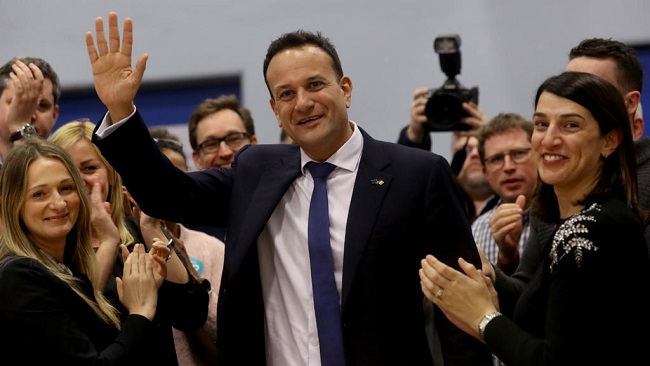
Irish Prime Minister Leo Varadkar resigned on Thursday, but stayed on as interim leader while the country’s three main parties battle out coalition talks after an inconclusive election.
Varadkar tendered his resignation as taoiseach, or premier, to President Michael Higgins after the first sitting of Ireland’s lower house of parliament since an 8 February election which radically recast the political landscape.
“In accordance with the constitution, the taoiseach and the government will continue to carry on their duties until successors have been appointed,” a government statement said.
Parties in the 160 seat chamber — the Dail — convened and nominated candidates to lead a new government as taoiseach but with none commanding a majority it was adjourned until 5 March.
Sinn Fein leader Mary Lou McDonald received the most votes backing her.
At 45 it was far short of the 80 needed to take office but it was a symbolic victory reflecting the surge the nationalist party enjoyed in the election.
Sinn Fein, which once served as the political wing of paramilitary the Irish Republican Army (IRA), became the second biggest party with 37 seats — breaking the historic duopoly of centre-right parties Fine Gael and Fianna Fail.
“The people who vote for us aren’t going anywhere,” said McDonald.
“We have made a commitment to them to represent them well and to make our very best effort to deliver that government of change — and that is precisely what we intend to do.”
‘A government for change’
McDonald outstripped the 36 votes backing Varadkar to continue as prime minister after his Fine Gael party slipped into third position in the election with 35 seats.
“The onus is on those who have made enormous promises of change to people during this election, who are entrusted with that mandate to bring a programme for government to the Dail for approval,” Varadkar said in parliament before departing to resign.
“If they cannot, they should say so and be upfront and honest about their failure, and the empty promises they made.”
Micheal Martin’s Fianna Fail party won the most seats in the election at 38, but suffered significant losses on their 2016 wins.
He received the backing of 41 lawmakers in Thursday’s contest.
Sinn Fein has been historically associated with the IRA which fought British rule in Northern Ireland for decades until the late 1990s, when a peace agreement largely ended violence that left more than 3,000 dead on all sides.
It won the popular vote with 24.5 percent of first preference ballots and picked up 14 seats by attracting voters with a campaign focusing on Ireland’s housing shortage and health crisis.
But its flagship policy on Irish unity is likely to be a top issue if it gains power.
It wants a referendum on uniting the two parts of the island within five years.
Talks
At least three parties will be needed to form a majority government in the Dail.
But with the three largest refusing to cooperate newly elected speaker Sean O Fearghail said the challenge of government formation remained “substantial”.
Fianna Fail and Fine Gael have both ruled out working with Sinn Fein, in part because of their association to past violence.
Varadkar told state broadcaster RTE on Monday he was prepared to go into opposition.
Meanwhile, Sinn Fein said Wednesday it was “intensifying” negotiations with smaller parties and independents seeking “a government for change”.
Talks may take some time and may result in a new election in which Sinn Fein could emerge as a favourite.
After a 2016 vote it took 70 days for a minority coalition government to form under Fine Gael, which was supported in a confidence and supply agreement by Fianna Fail.
Source: AFP









24, March 2020
Prospects Bright For Scottish Independence As Alex Salmond Proves His Innocence And Signals Return To Politics 0
Scotland’s former First Minister, Alex Salmond, has been cleared of sexually assaulting nine women.
A jury at the High Court in Edinburgh acquitted Salmond of 13 sexual assault charges.
An additional charge of sexually assaulting a 10th woman had previously been dropped by prosecutors.
All the charges against Salmond were alleged to have taken place between June 2008 and November 2014.
Salmond, who is also the former leader of the pro-independence Scottish National Party (SNP), had strenuously pleaded his innocence during the two-week trial.
The former SNP leader is widely regarded as an icon of Scottish nationalism and a pioneer of the independence movement. Indeed, Salmond led the SNP and the Scottish people into the 2014 independence referendum.
Because of his pioneering status – and continuing influence on Scottish politics – independence advocates have long argued the accusations against Salmond were politically motivated.
For his part, Salmond demonstrated humility and magnanimity as he emerged from court an innocent man. Instead of bemoaning the politically motivated witch-hunt against him, Salmond decided instead to focus on the coronavirus crisis in Scotland and the rest of the UK.
“Whatever nightmare I’ve been in over the last two years it is nothing compared to the nightmare that every single one of us is currently living through … People are dying, many more are going to do so”, Salmond said by referencing the deadly COVID-19 disease sweeping Scotland and the UK as a whole.
In an unmistakable gesture of statesmanship, Salmond told reporters to “go home – those who can – take care of your families and god help us all”.
Many Scots have taken to social media to commend Salmond for his statesmanlike behavior and refusal to engage in petty politics over what has now proven to be an unjust prosecution.
With his innocence now proven, there is mounting speculation about Salmond’s next move.
Sky News is reporting that “sources close” to Salmond claim the former First Minister is contemplating a political comeback.
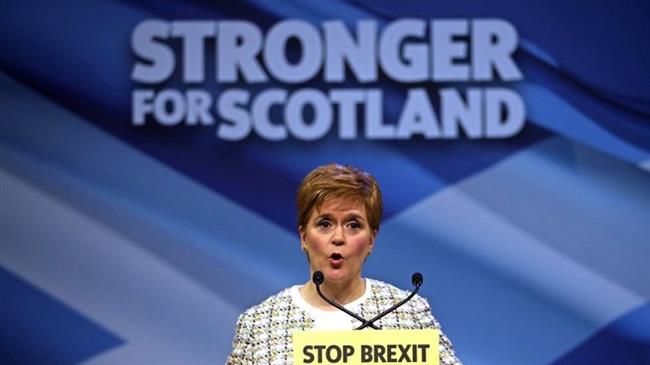
One of the more curious aspects of this case has been the current First Minister, Nicola Sturgeon’s deafening silence on the whole issue. Indeed, as of this moment Sturgeon has failed to congratulate Salmond on proving his innocence in court.
This has prompted a leading Scottish journalist to argue that Sturgeon faces “profound questions of integrity” over the whole affair.
More broadly, Salmond’s acquittal is a blow to the British establishment which has tried for many years to bring him down.
But the scale of Salmond’s legal victory has caused leading establishment figures to reflect on the loss and demand answers from the system that tried to destroy the former SNP leader.
In the final analysis, Salmond’s acquittal is a big boost to the Scottish independence movement which had begun to lose some of its momentum in the wake of last December’s British general election
Apart from issues connected to Sturgeon’s over-cautious leadership style, the coronavirus outbreak has forced the cancellation of plans to hold an independence referendum later this year.
If Salmond decides to return to the centre stage of Scottish politics – albeit in an advisory role – the Scottish independence movement stands to regain vigor, clarity and momentum.
Source: Presstv