12, March 2020
Nigeria: Emir’s fall shows limits for traditional rulers 0
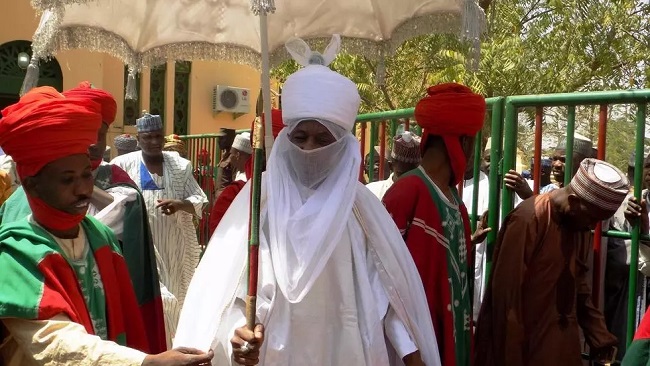
An outspoken ruler mired in conflicts is ousted without warning from his palace and banished under armed guard into an uncertain exile beyond the borders of his realm.
This is not the plot of a Shakespearean tragedy, but the real-life drama that has played out in northern Nigeria’s influential Islamic emirate of Kano as traditional leader Muhammadu Sanusi II was unceremoniously deposed by the local governor.
The sudden fall of one of the country’s most revered hereditary rulers on Monday rattled the 1,000-year-old kingdom — and has shown the difficult balancing act facing the ancient monarchies of modern-day Nigeria.
Sanusi, also known by his birth name Lamido, had been a mould-breaker since ascending to the throne of the emirate of millions in 2014 after the death of his great-uncle.
The 58-year-old former central bank governor was already known for his outspokenness when he claimed the title and carved out a reputation as a moderniser willing to criticise practices like having multiple wives and children without being able to support them.
He was also not afraid of taking on the powerful politicians running northern Nigeria — lambasting them for leadership failures.
“It’s no secret that many of our political leaders are inept and not well educated,” the emir wrote back in 2017.
“Nigerians have learnt from experience not to expect much from them.”
The ruler’s main nemesis — and the man who ultimately unseated him — was regional governor Abdullahi Ganduje.
Ganduje suspected the emir of backing his political rival and had already divided up his territory and launched a corruption probe to try to bring him to heel.
On Monday their feud came to a head when Sanusi was unexpectedly removed for “total disrespect”.
“The governor decided that enough is enough and moved against him,” said Adewunmi Falode, a history professor at Lagos state university.
“It’s a signal that the ultimate power rests with the government while the emir is just a symbol of spirituality, culture and tradition without real power and influence.”
The deposed ruler was detained by police at his palace before being spirited out of Kano to exile in a remote village in another state where he is expected to remain incommunicado.
– ‘Seen not heard’ –
There are dozens of traditional rulers across Africa’s most populous country.
They have no official constitutional powers but are important cultural custodians who often wield great influence over their followers.
Relics from a period when monarchies dominated this region, they rely now on regional governments for their funding and their succession is regulated by elected officials.
While they lack practical power, their patronage can be key at elections when Nigeria’s notoriously cutthroat politicians jostle for votes.
But their role remains ambiguous — and when Sanusi began to talk up some complained that he was overstepping the boundaries and flouting the strict protocol of the palace.
“It is an established custom that the emir should be seen not heard,” a Kano court insider told AFP on condition of anonymity.
“But Sanusi violated that important tradition and would talk like a parrot anywhere, anytime and on any topic — this eroded the mystic and prestige around his person in the eyes of the people.”
That could in part explain the muted response to his removal on the streets of his former kingdom.
While moves to depose previous emirs provoked deadly violence in decades past, this time around there have been no major protests.
– ‘Archaic practice’ –
If anything highlighted the uncomfortable divide between modernity and tradition that the monarchies straddle — it was the nature of Sanusi’s removal.
The lightning move to turf him out was down to a powerplay typical of the political tussles of contemporary Nigeria.
Within hours a replacement had been installed — and the former ruler released a video message pledging his allegiance.
But the decision to detain and banish Sanusi to an undisclosed location proved controversial.
Amnesty International’s Nigerian branch complained on Twitter that “placing him incommunicado violates his human rights”.
The tactic dates back to the days when the British Empire dominated Nigeria with its strategy of divide-and-rule and would exile leaders viewed as troublesome.
“The archaic practice of banishment of deposed Emirs, a colonial practice, has no basis under Nigerian law or the constitution,” Abubakar Balarabe Mahmoud, a lawyer for Sanusi, said in a statement.
His legal team insisted they would go to court to challenge the legality of his treatment.
“We are totally perplexed at the resort to this practice in present day Nigeria by its political leaders.”
Source: AFP



















13, March 2020
Southern Cameroons Crisis: After a week of tensions, Macron defuses the situation with Biya 0
Macron and Biya put aside their differences to talk about resolving violence in Cameroon.
The presidents of France and Cameroon “agreed on the need for an impartial inquiry” into the violence perpetrated in Cameroon’s Northwest Province during a phone conversation between the two heads of state on Sunday, 1 March.
Emmanuel Macron’s controversial remarks that set off a firestorm on 22 February when he promised to exert “maximum pressure” on Paul Biya to bring “Cameroon’s intolerable violence” to an end are but a distant memory. The French authorities are now evidently looking to calm the diplomatic spat.
The terse communiqué released by the French president’s press office expresses France’s evident resolve to de-escalate tensions between Yaoundé and Paris after they had mounted in the week leading up to 1 March.
Accordingly, during the phone call, Biya and Macron “agreed on the need for an impartial inquiry in response to the violence perpetrated against civilians in Ngarbuh village in the Northwest Province.”
Hardly a concession for Yaoundé given that it recently ordered the opening of an inquiry.
Significant support
The very same communiqué also indicates that “both presidents agreed to keep in touch to follow up on the political initiatives resulting from the Major National Dialogue,” without ever mentioning the issue of political prisoners or negotiations with secessionists, two taboo subjects for Cameroon’s government.
However, Macron had previously assured the leader of the Brigade anti-sardinards (BAS) activist group, Calibri Calibro, who had questioned him on the matter, that he would speak with the Cameroonian president about the crisis.
“I’m going to call President Biya next week and we’re going to put as much pressure as possible to bring an end to the situation,” the French head of state had said regarding the Ngarbuh massacre.
Does Macron’s return to diplomatic norms have something to do with the Cameroonian authorities’ strong reaction to his comments, with the government using every means at its disposal to convey its discontent? It is hard to say for sure.
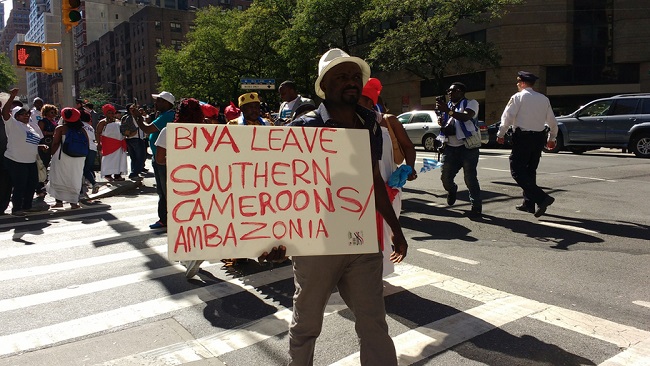
What is certain is that the chants shouted by the “young onlookers” who took to the streets to denounce Macron’s remarks outside the French embassy on 24 February reached the highest French officials via a detailed report which, according to our sources, was sent to the Quai d’Orsay, the site of France’s diplomatic headquarters.
In light of Macron’s tempered stance, Yaoundé is expected to retain France’s support in the endless crisis pitting Anglophone separatists against Cameroon’s government. Yaoundé is trying to negotiate with international players that seek to open a direct dialogue with the currently incarcerated leaders of the separatist movement. The violence continues to take a heavy civilian toll.
Source: The Africa Report