7, November 2019
French President says NATO is suffering ‘brain death’ 0
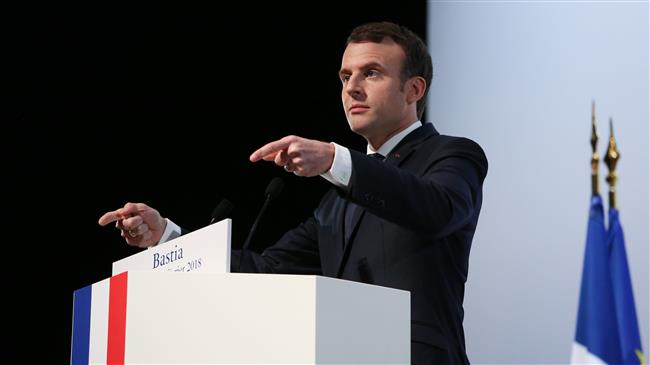
French President Emmanuel Macron said he believed NATO was undergoing “brain death”, lamenting a lack of coordination between Europe and the United States and unilateral action in Syria by key member Turkey, in an interview published Thursday.
“What we are currently experiencing is the brain death of NATO,” Macron told The Economist magazine.
The president’s explosive comments, appearing to question the very future of NATO, threatened to send shock waves through the alliance ahead of a summit in Britain next month.
“You have no coordination whatsoever of strategic decision-making between the United States and its NATO allies. None,” said Macron.
“You have an uncoordinated aggressive action by another NATO ally, Turkey, in an area where our interests are at stake,” he added, according to an English transcript released by The Economist.
Turkey’s latest military operation against Kurdish forces in northern Syria was staunchly opposed by fellow members like France, but made possible by a withdrawal of US forces ordered by President Donald Trump.
“There has been no NATO planning, nor any coordination,” Macron said.
And while NATO works well in communicating between armies and commanding operations, “strategically and politically, we need to recognise that we have a problem”, he said.
“We should reassess the reality of what NATO is in light of the commitment of the United States,” he warned, adding that “In my opinion, Europe has the capacity to defend itself.”
‘Drastic words,’ says Merkel
Macron said that while “it’s not in our interest” to expel Turkey from NATO – as has been urged by some politicians – member states should “reconsider what NATO is”.
But German Chancellor Angela Merkel on Thursday rejected Macron’s view that NATO was experiencing “brain death”, saying that such comments were not necessary.
Macron “used drastic words, that is not my view of cooperation in NATO”, said Merkel after talks with visiting chief of the translantic defence alliance Jens Stoltenberg.
“I don’t think that such sweeping judgements are necessary, even if we have problems and need to pull together,” she added.
Stoltenberg meanwhile stressed that “NATO is strong”, adding that the United States and Europe “work together more than we have done for decades”.
US Secretary of State Mike Pompeo, speaking during a visit to the German city of Leipzig as part of anniversary events for the fall of the Berlin Wall 30 years ago, also dismissed Macron’s remarks.
“I think NATO remains an important, critical, perhaps historically one of the most critical strategic partnerships in all of recorded history,” he told a press conference.
That was why it was “an absolute imperative that every country participate and join in and contribute appropriately to achieving that shared security mission,” he added, in a nod to Washington’s longstanding gripes about some member countries not paying their way.
German Foreign Minister Heiko Maas, speaking at the same press conference, also said he believed strongly in the military alliance “especially as we face ever more and ever greater global challenges”.
However, Moscow on Thursday hailed Macron’s comments.
“These are golden words… a precise definition of the current state of NATO,” Russian foreign ministry spokeswoman Maria Zakharova wrote on her Facebook page.
‘Strategic dialogue with Russia’
In the interview, Macron also emphasised it was crucial to seek a rapprochement with Moscow, which regards NATO and its expansion into ex-Communist bloc states with huge suspicion since the alliance was set up to counter the USSR.
“We need to reopen a strategic dialogue, without being naive and which will take time, with Russia,” said Macron, who is seeking to broker an end to the conflict in Ukraine and has courted President Vladimir Putin as a partner.
He said NATO did not reexamine its future in the early 1990s after the collapse of the Soviet Union and “the unarticulated assumption is that the enemy is still Russia”.
“So, the question about the present purpose of NATO is a real question that needs to be asked,” especially by the United States where Trump sees the alliance as a “commercial project”, he said.
And Macron said he believed that Putin, for all the anti-Western bombast from the Kremlin, would find his strategic options limited, in the long term, to “a partnership project with Europe”.
“If we want to build peace in Europe, to rebuild European strategic autonomy, we need to reconsider our position with Russia,” said Macron.
He praised the stance on the issue of Hungarian Prime Minister Viktor Orban – criticised by many in Europe for being authoritarian and close to the Kremlin.
“He’s quite close to our views and has a key intellectual and political role” in central Europe, said Macron.
‘Edge of a precipice’
The French president, seen by analysts as Europe’s most prominent leader amid Brexit and the looming exit of Merkel in 2021, has sought to stand tall on the foreign policy stage and implement a vision of reforming Europe.
But he said the European Union had been brought “to the edge of a precipice” by a dwindling focus since the mid-1990s on the bloc’s political integration.
“Europe has forgotten that it is a community, by increasingly thinking of itself as a market, with expansion as its end purpose,” said Macron, who recently blocked expanding the EU to include North Macedonia and Albania.
He also said he wanted European nations to break the “taboo” against using deficits to stimulate growth and investment, and scrap a strict limit on eurozone deficits.
Macron said it was a time of turmoil with Europe losing track of history, a risk of the US and China becoming the sole global powers, and authoritarian regimes emerging in its neighbourhood.
“All this has led to the exceptional fragility of Europe which, if it can’t think of itself as a global power, will disappear, because it will take a hard knock,” he said.
(FRANCE 24 with AFP)






















8, November 2019
US: Democrats discussing multiple articles of impeachment against Trump 0
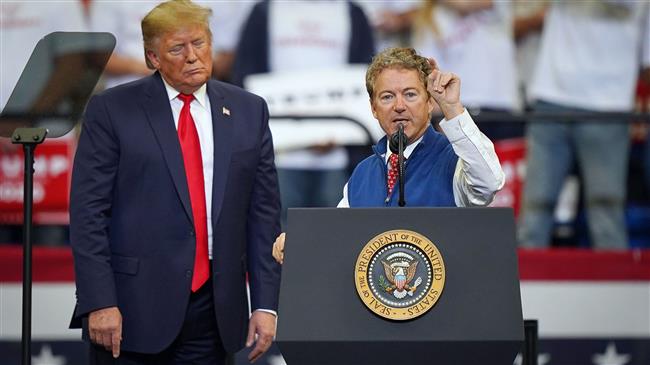
Democrats in the US House of Representatives have considered drafting as many as three articles of impeachment against President Donald Trump, as they prepare to take their Ukraine impeachment inquiry public next week after a month of closed-door depositions, according to multiple sources familiar with the deliberations.
No decisions have been made, and what happens will ultimately be shaped by the conclusions and findings of the ongoing impeachment inquiry.
In the last two modern impeachment proceedings against Presidents Richard Nixon and Bill Clinton, the House Judiciary Committee sent three and four articles of impeachment, respectively, to the full chamber for consideration, including articles charging abuse of power, obstruction of justice, and contempt of Congress for defying congressional subpoenas.
Democrats have floated the possibility of charging Trump with abuse of power for efforts to pressure the Ukrainian government to investigate former Vice President Joe Biden’s family and the 2016 election, as well as obstruction of Congress for the administration’s refusal to comply with subpoenas for records and witness testimony.
They have also weighed an obstruction of justice charge centered on the president’s efforts to obstruct former special counsel Robert Mueller’s investigation. Mueller’s findings in the second volume of his report, focused on obstruction, are repeatedly referenced in the report accompanying their resolution laying out the impeachment inquiry.
Some Democrats have suggested that the article charging Trump with obstruction of Congress could resemble the article drawn up on the same charge against President Nixon, and itemize all the subpoenas the administration has defied.
House of Representatives Speaker Nancy Pelosi’s office declined to comment on the potential articles of impeachment at this stage in the process, and the speaker has not endorsed any number of articles or specifics suggested in the caucus.
The topic of the number of articles was raised by a lawmaker in one recent meeting Pelosi held with a group of Democrats focused on impeachment messaging, according to sources familiar with the discussion, though Pelosi did not appear to engage with the comment one way or another.
The focus is on what’s in front of us right now: making the public case about the president’s abuse of power and his actions to undermine the 2020 election,” a senior Democratic leadership aide told ABC News.
While some lawmakers also support charging Trump with violating the Emoluments Clause of the Constitution, though others have advocated for keeping the impeachment push narrowly focused on the Ukraine matter.
Although the bulk of the impeachment hearings will happen in the Intelligence Committee, the Judiciary Committee will draft the articles of impeachment. It’s not clear whether they will include accusations of criminal wrongdoing.
The Judiciary Committee is expected to move forward with the process after receiving a report from the House Intelligence, Oversight and Foreign Affairs Committees summarizing their inquiry in the coming weeks. Other panels, including the House Ways and Means and Financial Services Committees, could also share information with the Judiciary Committee from their ongoing investigations that could be used to craft the articles of impeachment.
Politically, putting forward multiple articles of impeachment could benefit some House Democrats – including the freshman lawmakers from moderate and GOP-leaning districts who have raised concerns about the administration’s obstruction of Congress, but who have yet to say conclusively whether they believe Trump’s actions towards Ukraine are impeachable.
It could also focus pressure on some Republicans in the House and Senate who have disapproved of the administration’s refusal to comply with some of House Democrats’ oversight efforts, but rejected concerns of whether Trump has abused his power as president.
in 1998, the GOP-led House Judiciary Committee approved four articles of impeachment against President Bill Clinton, though the House only passed the first and third articles – charging Clinton with providing false testimony to a grand jury in the Paula Jones case, and obstruction of justice related to evidence in the Jones case.
The second and fourth articles were defeated, with 28 Republicans voting with Democrats against a second perjury charge, and 81 siding with the minority against charging Clinton with abuse of power.
“It gives Democrats in tighter districts the opportunity to say they’re open-minded,” Rep. Peter King, R-N.Y., who voted against Clinton’s impeachment in 1998, told ABC News.
But King, who said he did not find Trump’s comments to Ukraine’s president impeachable and defended the White House’s ability to challenge congressional subpoenas, predicted that few Republicans would cross party lines in any vote to impeach Trump in the House.
“Most if not all Republicans will look at all the articles as being tied together,” he said.
(Source: ABC News)