
11, September 2019
Japan: Prime Minister Abe shakes up cabinet, brings in rising star 0
Japan’s Shinzo Abe on Wednesday appointed new foreign and defense ministers and promoted a popular rising political star, in a cabinet reshuffle that fueled speculation over the prime minister’s successor.
The spectacular appointment as environment minister of the telegenic Shinjiro Koizumi, the 38-year-old son of much-loved former PM Junichiro Koizumi, set tongues wagging in Tokyo political classes as the Abe era draws to a close.
“Abe intends to start an open race to pick the next prime minister or even the one after that,” said SMBC Nikko Securities chief market economist Yoshimasa Maruyama.
A darling of the Japanese media, Shinjiro Koizumi received blanket coverage for his recent marriage to television broadcaster Christel Takigawa, which was announced at the prime minister’s office.
He is the third-youngest minister appointed to the cabinet in Japan since the end of World War II, in a country where seniority is prized in politics and many other walks of life.
Despite intense media spotlight, he has been coy on expressing his view on the issues of the day and there will be close scrutiny over his policies on nuclear power, particularly on whether he will break with his father’s anti-nuclear stance.
Abe is set to become Japan’s longest-serving prime minister in November but is expected to step down at the Liberal Democratic Party (LDP) leadership election in 2021 and the jostling for position is already beginning.
Japan’s new foreign minister is Toshimitsu Motegi, who was promoted as a reward for his work in negotiating a trade deal with the United States.
Outgoing foreign minister Taro Kono was shifted to the defense portfolio, in a move seen as reinforcing Tokyo’s hard line towards South Korea at a time of worsening ties between the two neighbours.
Kono, who has amused commentators by interacting with people on social media — even offering relationship advice at times — struck a hard line during the recent spat with Seoul that has infected their trade and security ties.
Motegi, 63, is a Harvard-educated political veteran who worked as a McKinsey consultant before winning a lower house seat in 1993.
Analysts do not expect the shake-up to herald significant changes to Japan’s diplomatic policy, which is managed largely by the prime minister’s office.
But it may also put Motegi in the starting blocks in the race to succeed Abe, noted Tobias Harris, an expert on Japanese politics at consultancy Teneo.

Speed skating Olympics minister
Abe retained the services of his trusted associate Taro Aso as deputy prime minister and finance minister, as well as Yoshihide Suga as the powerful chief cabinet secretary.
The PM also kept key allies and aides within the cabinet and top layers of the party to shore up his position for the next two years.
The Abe government is poised to hike its consumption tax from eight percent to 10 percent on October 1, amid fears this could act as a brake on the world’s third-largest economy.
He is also hoping to achieve his long-cherished ambition of amending Japan’s post-war constitution to change the status of the country’s Self Defense Forces.
Ahead of the cabinet announcement, Abe told party members he wanted a “united front in the party, and (to) powerfully push for a revision of the constitution,” calling it the LDP’s “long-term earnest desire.”
Abe also kept LDP Secretary General Toshihiro Nikai, who has deep contacts in China, as Japan prepares for an expected state visit by Xi Jinping in 2020.
Among other key figures are former Olympic speed skater Seiko Hashimoto, who became the latest in a string of Olympic ministers ahead of the 2020 summer Games.
Hashimoto is one of just two women out of 19 in the new cabinet despite Abe’s much-heralded “womenomics” programme. His previous cabinet included just one woman.
Japan ranked 125th in the 2018 World Economic Forum’s Gender Gap Report in terms of women’s political empowerment.
The other woman is Sanae Takaichi, appointed as interior minister. She is seen as a hard-right nationalist, who regularly visits the Yasukuni shrine housing war criminals that enrages South Korea and China.
During her previous stint as interior minister, she threatened to cut off TV news stations over perceived unfriendly coverage.
(Source: AFP)



















12, September 2019
Southern Cameroons Conflict Goes Back 100 Years 0
The west African nation of Cameroon is plagued by near-daily clashes between security forces and anglophone separatists that can be traced back to its split between Britain and France 100 years ago.
Here is some background:
WORLD WAR I SPLIT
Germany was stripped of its African colony of Kamerun after its 1918 World War I defeat when the League of Nations, the forerunner to the UN, split the territory between victors Britain and France.
Four-fifths went to France, becoming independent Cameroon in 1960.
The British portion, along the border with Nigeria, became independent in 1961. A northern Muslim-majority section chose to join Nigeria while the remaining southern area was unified with Cameroon in a federation.
The federal structure was scrapped in 1972 and the anglophone portion was annexed.
ENGLISH-SPEAKING MINORITY
Largely francophone Cameroon has 10 regions, two of which are mainly English-speaking: Northwest Region, whose capital is Bamenda, and Southwest Region with Buea as its capital.
They are home to around 14% of Cameroon’s population of 23 million.
The two regions are permitted some self-governance and language rights, including bilingual schools. But many complain of francophone-favoured discrimination in education, the justice system and the economy.
DEADLY PROTESTS
Calls for a breakaway English-speaking state mounted in the 1990s with demands for a referendum on independence accompanied by low-level unrest.
In 2001, secessionists defied a ban on rallies to protest the 40th anniversary of unification with Cameroon and were confronted by security forces. Several people were killed and secessionist leaders arrested.
The separatist Southern Cameroons National Council (SCNC) set up a “government” in Britain and leaders moved into exile.
There was a new outbreak of violence in 2016 after lawyers went on strike to demand the right to use Anglo-Saxon common law. Teachers followed, protesting at the appointment of francophones in the region.
While some protesters want only a return to federalism, a minority is pushing for the creation of an independent state called Ambazonia.
ARMED REVOLT
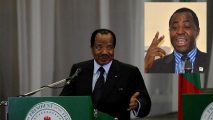
In January 2017, senior secessionist activists were arrested and charged with terrorism and rebellion. President Paul Biya halted their trials in August, apparently trying to calm the situation.
In October 2017, separatist leaders issued a symbolic declaration of independence. At least 17 people were killed in clashes on the sidelines.
Radical separatists took up arms in late 2017, attacking security forces and torching symbols of the administration, such as schools. They also kidnapped police officers, civil servants and businessmen, sometimes foreigners.
CIVIL WAR
In April 2018, the main opposition Social Democratic Front (SDF), which defies the separatists, described the violence as “civil war”.
Separatists torched the Northwest Region home of SDF leader Ni John Fru Ndi in October and also kidnapped his sister, who was later released. Fru Ndi was briefly kidnapped twice in 2019.
A US missionary was killed in the unrest in October 2018 and the following month 79 schoolboys were kidnapped in Bamenda but freed two days later.
In December 2018, Biya ordered the release of 289 people arrested in connection with the crisis. However, in August 2019, separatist leader Julius Ayuk Tabe and nine others were sentenced to life in prison for charges including “terrorism and secession”.
Nearly 2,000 people have been killed in violence between separatists and security forces in the anglophone regions since October 2017, Human Rights Watch says. Around 530,000 have fled their homes, according to the UN.
EWN