
11, May 2019
Month after Bashir ouster, Sudan far from civilian rule 0
One month after ousting veteran president Omar al-Bashir, Sudan’s military rulers show no sign of handing power to a civilian administration and talks with protest leaders remain deadlocked.
Thousands of protesters remain encamped outside army headquarters in central Khartoum, vowing to force the generals to cede power just as they forced Bashir from office.
“We want civilian rule or we will stay here forever,” said protester Iman Hussein, a regular at the sit-in which protesters have kept up since April 6.
Protesters initially gathered at the army complex to seek the generals’ help in ending Bashir’s three decades of iron-fisted rule.
On April 11, the army toppled Bashir in a palace coup replacing him with a military council formed entirely of generals that has shattered protesters’ dreams of a civilian-led transition to democracy.
The deepening economic crisis that fuelled the four months of nationwide protests which led to Bashir’s ouster shows no sign of abating.
Huge queues form daily at ATM machines as the freezing up of the banking system forces consumers to use cash to buy basic goods made ever more expensive by the sliding value of the Sudanese pound.
The generals insist they will not use force to disperse the sit-in which protesters have kept up through the daytime fasts observed by Muslim during the holy month of Ramadan.
The generals have offered several concessions to placate the protesters, including detaining Bashir in Khartoum’s Kober prison, arresting several of his lieutenants and promising to prosecute officers who killed protesters during the demonstrations against the old regime.
– Winner ‘will be us’ –
But when it comes to the protesters’ key demand for a civilian authority to oversee a four-year transition, the military has simply dragged its heels.
“They are pressuring us with time, but we are pressuring them with our presence here,” said protester Hussein.
“One of us has to win in the end, and it will be us.”
Last month, the Alliance for Freedom and Change, which brings together the protest movement and opposition and rebel groups, handed the generals its proposals for a civilian-led transition.
But the generals have expressed “many reservations” over the alliance’s roadmap,
They have singled out its silence on the constitutional position of Islamic sharia law which was the guiding principle of all legislation under Bashir’s rule but is anathema to secular groups like the Sudanese Communist Party and some rebel factions.
The protest movement says the military appears intent on hijacking the revolution and determining its outcome.
Protest leader Khalid Omar Yousef told reporters on Wednesday that the movement was now considering “escalatory measures” like launching a nationwide civil disobedience movement to achieve its demand.
– US pressure –
The generals are under pressure too, with the United States and the African Union calling on them to ensure a smooth transition of power.
In a telephone call with military council chairman General Abdel Fattah al-Burhan, US Deputy Secretary of State John Sullivan, backed “the Sudanese people’s aspirations for a free, democratic and prosperous future”.
The State Department said Sullivan encouraged Burhan to reach agreement with the Alliance for Freedom and Change and “move expeditiously toward a civilian-led interim government”.
But the generals have strong support from oil-rich Saudi Arabia and the United Arab Emirates, which have extended a $3 billion credit line to shore up the Sudanese pound and fund imports of basic goods.
Some members of the protest movement are optimistic however that the generals will ultimately cede power.
“They will hand over executive power to a civilian government if we present a credible, viable form of a civilian government,” opposition leader Sadiq al-Mahdi, the prime minister Bashir overthrew in an Islamist-backed coup in 1989, told AFP earlier this month.
“Because they know if ultimately they settle for a military dictatorship, they will be in the same position as Bashir.”
AFP






















12, May 2019
Southern Cameroons Restoration Council Dossier: A “hotchpotch of Lies” 0
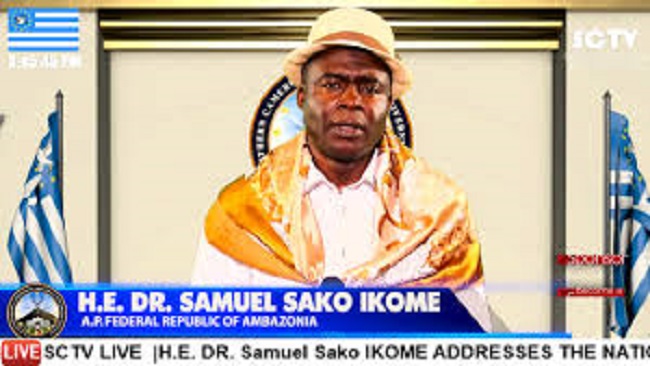
The former Acting President of Ambazonia, Samuel Ikome Sako has reportedly displayed a well-developed criminal intent all in a bid to hang on to leadership. Earlier this week, on the 6th of May 2019, Cameroon Concord News Group sounded a note of caution to Southern Cameroonians that Sako was planning to offer Elvis Kometa money in exchange for the Restoration Council’s approval of his dubious 75 member IG Cabinet. Two days after our publication, the Restoration Council issued a statement that it had completed the vetting process and Sako could proceed to announce his cabinet.
It has now been revealed in the USA that the document which accorded Sako Ikome the right to form a new government bearing Chairman Kometa’s signature was a Sako fabrication. Our correspondent in the US hinted that Chairman Kometa made calls yesterday disassociating himself from the Restoration Council’s decision and documents. We have not been able to establish the source of the document but fingers are all pointing at Otto Tiale, Sako, Irene Ngwa and Chris Anu.
“Kometa has to come out and publicly state on camera that he didn’t sign those documents. It’s not good enough for him to make calls to activists and media outlets stating his innocence” noted a senior Southern Cameroons citizen in Germany who spoke to us and sued for anonymity. “Until he does that the people of Ambazonia will continue to hold him jointly accountable in undermining the Interim President’s decision to dissolve the cabinet last week” he added.
While the situation in the exiled Southern Cameroons Interim Government remains confused, events on Ground Zero, the US and Europe demonstrate once again that the likeliest resolution to Ambazonia’s seemingly endless USA political crisis lies in the hands of President Sisiku Ayuk Tabe and the Southern Cameroons Restoration Forces.
The Sako Ikome failed dictatorship and the President Sisiku Ayuk Tabe’s decision dissolving the controversial Interim Government’s cabinet has been locked in a tense stand-off ever since a financial scandal rocked the Interim Government in the USA.
The United Nations now estimates that a quarter of Southern Cameroon’s population is in need of humanitarian assistance, with almost half a million suffering from undernourishment in the forest. It also calculates another 50,000 have already fled to Nigeria in desperation. But the continuing support of ill informed Ambazonians in the USA has so far given Sako Ikome the feeling that he has survived the fallout from his leadership failure.
By Sessekou Asu Isong in London