5, January 2018
Bishop Andrew Nkea says “Kembong people are not running away from attackers, but from the military which is supposed to be protecting them,” 0
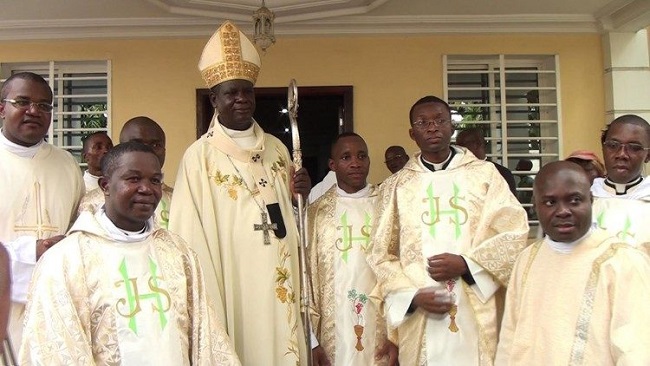
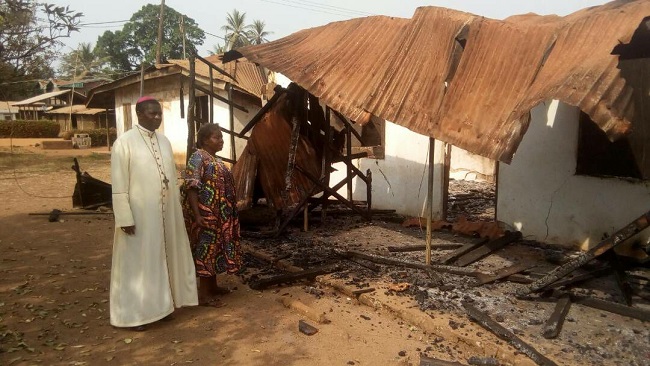
The Bishop of Mamfe Diocese, Mgr. Andrew Fuanya Nkea, has reacted to a recent incident in Kembong village, Eyumojock Sub-Division, Mamfe, in which the military wreaked havoc in the village following the killing of four (4) security officers by unknown assailants. The Bishop visited the victims in Kembong recently and told L’Effort Camerounais what he heard and saw and proposes a way out of the current socio-political impasse. Excerpts:
My Lord, you were in kembong recently. People are running away from Kembong but you instead went there. May we know what actually took you to Kembong?
The Christians and parish priest in Kembong were calling me about the difficult situation they were facing. They reported to me about the shootings, killings and burning of houses that was going on there. This concerns my Christians, so I decided to go there despite the danger to see exactly what the situation was for myself. With what is being reported on social media, you can never be too sure what the truth is, so I decided to go to Kembong to be a witness to these happenings.
And what exactly is the situation on the ground in Kembong?
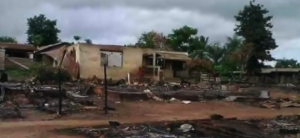
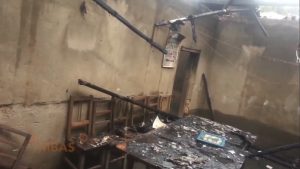
The situation I found as of December 21 was very delicate and disturbing. Kembong is actually the largest village in Central Ejagam with a population of about 5.000 people. It is a place that is normally booming with life, but when I went there all the streets were empty and it was virtually a ghost village and looking like a place after a war. I went straight to the parish and the presbytery was full with men, women, the young and old. There were about 30 people sitting on the veranda and parlour looking very destitute and I asked them what they were doing there. They told me the military had burned their houses and they had nowhere else to go and that is why they rushed to the mission for protection. I decided to go round and I was with the local superior of the Mill Hill Fathers because we have Mill Hill priests in Kembong. The people who were in the mission took me and showed me their houses that had been destroyed and burnt down. They did not even take anything out of their homes. A man told me he only had a loin round his waist and that was the only thing he took out of his house. The trouser and shirt he was wearing at the time he was talking to me was given to him by a priest. This is a reflection of the situation in the village. Four soldiers had been killed on Monday and when soldiers got there a few hours later they started burning houses, beating people up and sending them away from the village. Many people just ran away and we have many in the parish house now living under very difficult conditions. We do not know how many are hiding in the bush and how many have run away to Nigeria. So, Kembong is actually an abandoned village now.
You have actually mentioned the killing of four soldiers and the government claims Kembong is actually paying the price for killing soldiers. What is your reaction to this claim?
The people of Kembong, Christians and my priests did not kill gendarmes. Some assailants and unidentified people came into the village and attacked and killed the gendarmes and left. They do not stay in Kembong. According to the report I received this is what they have been doing. It was not the boys of Mamfe who killed the gendarmes. When they attacked gendarmes in Otu and Agborkem, it was not the people of these villages who did it. The fact that those gendarmes were stationed and were attacked in Kembong does not make the people of Kembong accomplices in the crimes of those attackers. The government should track down and punish those attackers for their crimes. So, why take it out on the population? This is why I am very angry.
So you mean that any military operation should have been preceded by a thorough investigation?
Absolutely! The government should find out who these assailants are, where they are from, track down and punish them according to the law. Soldiers have been killed in Mamfe, so should my house be burned down because I live in Mamfe? No, this is unacceptable.
How have recent military operations in Kembong affected the activities of the Church which you head?
There is no Church activity there. The Church is the people of God. There is nobody in Kembong, so there can be no Church. The parish priest and his assistant are both living with me in the Bishop’s House in Mamfe because Kembong is too dangerous for them and for everybody. The refugees are living under difficult conditions in the Parish Hall in Mamfe. Everybody in Kembong has left as the place has become far too dangerous for anybody to live there.
What actually are you doing to help the destitute people who have taken up refuge at the mission?
I must confess that the people of Mamfe have been super generous and collaborative. Since these people arrived on December 23 when I moved them from Kembong the community is supporting them and making sure that they have food. We have provided them with some matrasses on which they are sleeping. However, the most difficult part is to get these people go over the trauma and shock that they are going through. Other people who have heard what is going on are sending their support and the people are happy with what they have received so far. A woman actually told me on December 26 that it was the first day she had slept and eaten in a week because she could not cope with what had happened to them.
When part of the Church is suffering, it is the whole Church that is suffering. What message do you have for people who may want to be of assistance for people in Kembong?
The focus is on Kembong because I visited the village but this disturbing situation is not limited to Kembong. The parish priest of Kajifu in Mamfe Overside is also in the Bishop’s House in Mamfe as he fled the village because of the violence going on there. All the Christians of the Booki area have escaped and are presently refugees in Nigeria. A cross section of the population of Manyu Division, who are under attack, have fled. I keep insisting that these assailants should be tracked down, arrested and punished. The fact that they passed through a certain village, does not make the people of that village an accomplice and the village should not be persecuted by the military. The people are not running away from the attackers, but from the military which is supposed to be protecting them. And this is the most difficult part of the ongoing military operation. There are too many displaced people. Akwaya is in the same situation as the parish priest called and told me that the town is virtually empty. I visited Kembong just because it is near and the situation was urgent.
You issued a letter following the incident in Kembong. What exactly was the content of your letter?
When I saw the situation I said only God can help us. We must turn to God and pray, especially as we are celebrating the birth of Jesus Christ the Prince of Peace. So, I wrote a letter asking all parishes to expose the Blessed Sacrament 30 minutes before every morning Mass to pray for peace. Secondly, I asked that on Thursday every week there should be Perpetual Adoration from after morning Mass to 5pm for peace to reign in our diocese, country and the world. I also gave instructions because of the situation for all vigil Masses in Mamfe Diocese for Christmas to be said at 4pm because it was too dangerous to carry out any activity at night. So, that letter was a desperate call for peace to reign in our land.
This is a spiritual way out of the present crisis, but it also needs a political solution. What do you think can be done from a political standpoint to put an end to this problem that has been dragging on for more than a year now in the English-speaking Regions?
We have said it over and over in the Bishops’ Conference of the Bamenda Ecclesiastical Province and in the National Episcopal Conference that we do not see any other solution to this conflict other than dialogue. Dialogue is the only way forward. We need to find out what people want and why the Anglophones are behaving the way they are behaving and look for a way forward. Running away from the problem or pretending that it does not exist cannot help anybody. We all love and want peace in this country. The only way to maintain this peace is not by fighting but through dialogue. I am also making the situation back here known to the powers that be so that they can take action. I am letting stakeholders know the exact situation on the ground. We need to pray as there is too much talking and very little prayer. We should turn to God and beg Him to intervene miraculously and bring peace to this country.
Culled from L’Effort Camerounaise


14, March 2018
Cardinal Christian Tumi accuses military of abuses in fight against Anglophone separatists 0
Cardinal Christian Tumi, the Archbishop emeritus of Douala, has accused the Cameroon military of excessive use of force against unarmed civilians in Cameroon’s North West and South West regions. The two English-speaking regions, that constitute 20 percent of Cameroon’s over 24 million people, have been in turmoil for over a year now over perceived marginalization and an assimilation drive by the predominantly French-speaking administration of long-serving President Paul Biya.
The current “Anglophone crisis” began in late 2016, when disgruntled lawyers and teachers began protesting the use of French in courts using the Anglo-Saxon common law tradition (practiced in the English parts of the country) and in Anglophone schools. The demonstrations soon spread to the general public, and the calls for outright secession started growing.
In a strongly-worded statement released on October 6, 2017, the Anglophone bishops condemned “the barbarism and the irresponsible use of firearms against unarmed civilians by the Forces of Law and Order” and called on Biya to stop “the bloodbath and genocide that has skillfully been initiated in the North West and South West Regions.”
In the absence of a dialogue initiative from the government, many English-speakers are now calling for secession, and the formation of a new state called Ambazonia.
The country’s president has promised to “eliminate the secessionists.” Biya has deployed the military to the two regions, but their actions on the ground have met with severe criticism by Tumi.
During a visit to the country’s North West Region, the cardinal gathered harrowing tales of torture, destruction and killings. “I was in Mbim village on 28 February and the military had visited the same village a day earlier,” Tumi told Crux.
“I saw and listened to people in their depression…I saw houses that had been reduced to ruins, to dust and ashes. I saw the house of a man who had fled with his wife and six children, reduced to dust and ashes,” the cardinal said.
Tumi described various signs of destruction in the village, including a destroyed water project, and a vandalized cooperative union. He also said the military harassed the population and committed crimes against the people.
“I saw the house of an old man ramshackled and I was told that the army had made away with two generators of the family. I saw a man looking completely depressed from whom the military had made away with $1500,” the cardinal said. “I saw the bar of a young man running a small business from where hundreds of bottles of beer had been taken away by the army, and what could not be taken was broken to bits and pieces.”
He said security forces also burned the villagers’ crops, destroying the year’s harvest. Tumi told Crux he was struck by the question an old man in Mbim asked him: “Cardinal, just what crime have we committed, that the army should be sent to treat us this way, as if we were foreigners who had come to ransack the village?”
Tumi said the lives of the “simple, innocent people” had been shattered by the actions of the military.
“If they are looking for a criminal, let them look for the criminal in all patience. They should not draw the conclusion that since the criminal was in this village, everybody in the village becomes a criminal. It’s not a logical conclusion,” the cardinal said.
Similar scenes of destruction are visible in many parts of Cameroon’s South West Region, where “Ambazonian” fighters have been engaged in hit-and-run attacks on security forces.
The attacks in both regions have so far left at least 24 members of the security forces dead. It is difficult to estimate civilian deaths, but UN human rights chief Zeid Ra’ad Al Hussein has noted that “allegations of summary executions of civilians by members of the security forces have been reported, and are generating widespread resentment.”
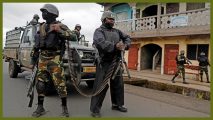
The military action has been hard and decisive, with entire villages being burned to the ground, and several people being killed extrajudicially.
“An old woman who couldn’t flee was burnt to death in the South West,” Tumi said.
Bishop Andrew Nkea Fuanya of Mamfe – in the South West Region – said the destruction in Kembong village, where four soldiers had been killed by secessionists, looked like “a horror movie.”
“I saw more than 20 houses burnt down by soldiers and one dead body still lying there, being fed on by dogs and chicken,” said Nkea.
“Of the village’s 5,000 or so residents, only 30 remained, all huddled in the house of the area’s priest because they had nowhere else to go,” he said.
Tumi also claimed that the crisis could be serving to enrich some top-ranking people in the military.
“We are told that some high-ranking military people use the crisis to enrich themselves, because the state spends on these military operations, and the account on how the money is spent is not given,” he told Crux.
The cardinal blamed Biya for choosing a military solution for a purely political problem.
“The presence of the army is no solution. With a human being, you reason: You don’t use violence as if you are treating a beast. That is why the world is calling for dialogue. Nothing can be done without our meeting to talk about the problems. Many have called for what is called inclusive dialogue. The government should dialogue with everybody,” Tumi said.
Cameroon’s bilingual and bi-cultural status derived from its colonial heritage. Initially administered as a German Protectorate in 1884, Cameroon would later be shared with France and Britain as League of Nations Mandates after Germany was defeated in the First World War.
The end of the Second World War and the establishment of the United Nations saw the two parts of Cameroon transition from mandated territories to UN Trust Territories.
In 1960, the northern part of Cameroon administered by France gained its independence. The southern part administered by Britain as part of Nigeria was in 1961 subject to a plebiscite in which they were offered independence by reuniting with their francophone Cameroonian “brothers” or by remaining part of Nigeria.
The results showed an overwhelming desire by English-speaking Cameroonians to reunite with the French-speaking part of Cameroon.
The “marriage” was guaranteed by a Federal Constitution that was meant to preserve and protect the minority Anglophones and their colonial heritage. But in 1972 then-President Ahmadou Ahidjo organized a referendum that dissolved the federation in favor of a united republic, thereby removing the protections Anglophones enjoyed.
As the current crisis worsens, several Anglophones have fled to Nigeria, causing a refugee crisis in Cameroon’s neighbor. The United Nations has expressed “great concern” over Nigeria returning dozens of asylum seekers to Cameroon.
“We also urge the Government of Cameroon to ensure that the group is treated in accordance with human rights law and standards,” the UN refugee agency said in a statement.
Culled from Cruxnow.com