
24, August 2025
Obala: Bishop Sosthène Leopold Bayemi will be cleared of harassment charges 0
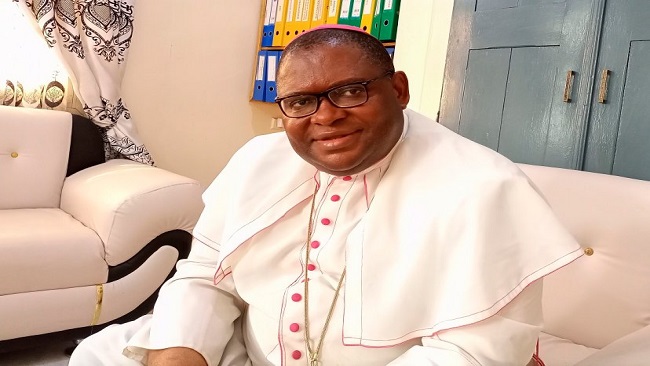
His Lordship Bishop Sosthène Leopold Bayemi of the Obala Diocese is reportedly implicated in a sex scandal by a dodgy Francophone so-called whistleblower. An audio recording circulating on social media accuses the Roman Catholic cleric of sexual harassment.
Our senior correspondent in Yaoundé the nation’s capital reported late today that the Bishop of Obala will be cleared of charges of sexual harassment soonest and that the Diocese of Obala will emerge stronger and united.
“Bishop Sosthène Leopold Bayemi will be acquitted of making sexual advances against members of his community as alleged by a person operating deep within a political space in Yaoundé” Rita Akana said.
Rita Akana pointed out that the Roman Catholic Church in the Centre and South regions has been standing shoulder to shoulder with the corrupt ruling CPDM party and that Bishop Sosthène Leopold Bayemi is simply paying the price of trying to maintain the status quo.
“The Vatican is very much aware that the Roman Catholic Church in Cameroon does not have kissing and hugging issues! let alone porn videos,” Rita Akana furthered.
Bishop Sosthène Leopold Bayemi is heading a very poor diocese in the outskirts of Yaoundé that relies on financial donations coming mainly from senior political elites running state affairs in Yaoundé.
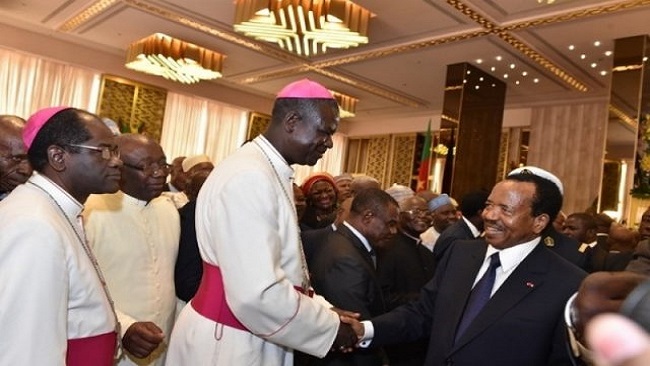
The allegations, reported by N’zui Manto, are causing uproar in the Christian community, especially as the bishop was among those at the Unity Palace to support the 93 year old President Paul Biya for the October presidential election.
By Soter Tarh Agbaw-Ebai










26, August 2025
Southern Cameroons Crisis: Archbishop Nkea says priests ‘ready to die for the Gospel’ 0
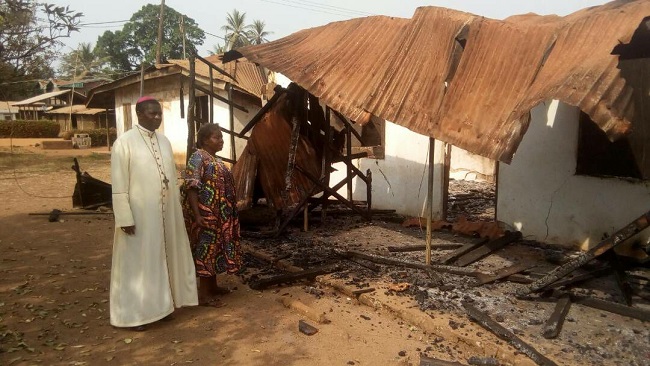
Archbishop Andrew Nkea Fuanya of Bamenda in Cameroon’s North West region says priests serving in the war-ravaged English-speaking regions of Cameroon “are ready to die for the Gospel.”
Nkea was speaking to Crux on the sidelines of the 78th Ordinary Meeting of Bishops of the Bamenda Episcopal Conference that took place in Bamenda from Aug. 16-22.
The Archdiocese of Bamenda oversees the suffragan dioceses of Buea, Mamfe, Kumba, and Kumbo and covers the entire English-speaking regions of Cameroon, areas devastated by nearly nine years of ongoing conflict.
The conflict stems from the complex colonial legacy and post-independence political arrangements in the country.
Following the defeat of Germany in World War I, the German colony of Kamerun was partitioned under League of Nations mandates, with France administering the larger eastern section and Britain governing two smaller non-contiguous areas – Northern and Southern Cameroons – adjacent to Nigeria.
In 1961, a UN-sponsored plebiscite resulted in the reunification of the British Southern Cameroons with the former French territory to form the Federal Republic of Cameroon.
The federal structure was dismantled in 1972 following a controversial referendum in favor of a centralized unitary state dominated by a Francophone majority government.
This centralization led to decades of perceived marginalization among Anglophones, which make up roughly 20 percent of the population, who felt their distinct legal and educational systems based on British common law, cultural identity, and political participation were eroded.
Resentment festered over the systematic appointment of Francophones to key positions in Anglophone regions, the exploitation of their rich natural resources, and the perceived imposition of French language and practices in Anglo-Saxon schools and courts.
The pent-up frustrations erupted into large-scale protests in 2016 led by lawyers and teachers demanding reforms.
The government took a hardline, ultimately escalating the crisis into a violent armed conflict with separatist groups declaring independence for the self-proclaimed republic of “Ambazonia.”
The conflict has led to at least 6,500 deaths, according to the International Crisis Group. Nearly a million people have been forced to flee from their homes, with over 70,000 people seeking refuge in Nigeria.
The conflict has also made investments in infrastructure difficult, worsening an already dilapidated road network.
Nkea told Crux that amid the conflict and the social difficulties, Catholic priests and Bishops in the region have kept faith with their mission of spreading The Good News.
“Priests have given their lives for the faith. They are ready to die for the gospel, and therefore, where there is a Christian, there is a priest,” the archbishop told Crux.
“The priests are determined, and we have very heroic priests and nuns who are running hospitals, running health centers, schools and other social services,” he said.
The archbishop noted that while conflict and inaccessibility present real challenges, they are external to the core mission of the Church.
“Those two problems are not problems of evangelization. They are social problems, but they don’t touch our spreading the gospel,” he told Crux.
“Personally, when traveling to areas inaccessible by car, I park the vehicle and continue by bike. For places even bicycles cannot reach, we proceed on foot. We see videos and accounts of priests and bishops walking great distances to connect with their communities. I want to emphasize that these transportation challenges are social problems, not obstacles to evangelization itself,” the archbishop explained.
“Wherever there is a Christian, we make every effort to reach them,” he said, emphasizing the determination of the clerics and religious in the two regions to leave no believer “without spiritual support,” regardless of their location or the challenges involved in reaching them.
Youth education and economic empowerment
The bishops during their meeting also addressed what Nkea called the “desperate situation” of unemployed youth amid the socio-political turmoil, and said the Church was revolutionizing education access to ensure that no youth is left behind.
He said this is done not only by making sure that schools are open, but through the establishment of diocesan-wide Education Funds.
These funds, supported by benefactors and friends of the dioceses, specifically target underprivileged children who cannot afford school fees, as exemplified by the Archbishop’s Education Fund in Bamenda covering costs for students in places like Mbesa.
“If you go to St. Agnes School Mbesa, there is an archbishop’s batch there. And from the first year…and they are now in their fourth year, the archbishop pays a percentage of their school fees every year just to ensure that these children have the opportunity to go to school,” Nkea said.
Recognizing the limitations of purely general education, the bishops have also emphasized a strategic pivot towards technical and professional training. They are adding technical sections to existing colleges and developing vocational training centers across dioceses, aiming to equip those who dropped out due to the crisis or other reasons with practical skills for self-reliance and establishment in life.
The bishops toured the sprawling campus of the Catholic University of Cameroon (CATUC) in Bamenda, to assess its significant infrastructure modernization.
Nkea said it has been equipped with WiFi-connected classrooms, large digital screens enabling international lectures, like recent medical training from Dallas, and new facilities designed to ensure competitiveness and sustainability.
These upgrades, he said, are essential to accommodate rapid growth and position CATUC for the future in the digital age.
Justice and peace in an election year
The bishops during their meeting also prioritized the critical issue of justice and peace, acknowledging its significance, especially in a year in which some 8.2 million Cameroonians are expected to vote for a president.
Drawing inspiration from the National Episcopal Conference, they resolved to actively engage in the upcoming presidential and other elections.
“We are going to deploy election observers in all the polling stations in our ecclesiastical province to have a feel of what Cameroonians will go through in these elections and be able to make an evaluation after,” Nkea told Crux.
He urged Cameroonians to foster a sense of peace before, during and after the elections, noting that he has witnessed too much death and devastation in Cameroon’s Anglophone regions and it won’t be a good thing that “our country witnesses such devastation again.”
Source: Crux