25, December 2021
The Holy Father calls for dialogue in ‘Urbi et Orbi’ Christmas address 0
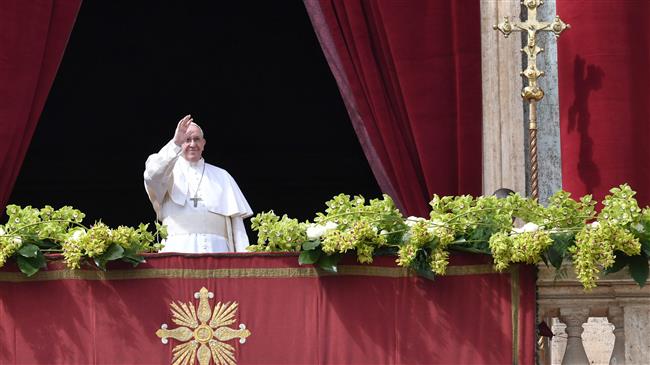
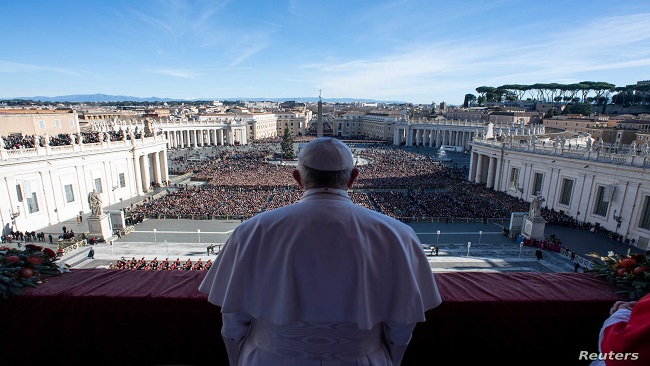
Pope Francis on Saturday urged dialogue on both personal and political levels as he celebrated a second Christmas under the shadow of a coronavirus pandemic that was pushing people into isolation.
In his traditional Urbi and Orbi Christmas Day message to the faithful gathered in St Peter’s Square at the Vatican, the pontiff also deplored that the “immense tragedies” in Syria, Yemen and Iraq were “being passed over in silence” and cautioned against fresh violence in the simmering conflict in Ukraine.
“In this time of pandemic…Our capacity for social relationships is sorely tried; there is a growing tendency to withdraw, to do it all by ourselves, to stop making an effort to encounter others and do things together,” he said.
“On the international level too, there is the risk of avoiding dialogue, the risk that this complex crisis will lead to taking shortcuts rather than setting out on the longer paths of dialogue.”
“Yet only those paths can lead to the resolution of conflicts and to lasting benefits for all.”
Around the world, “we continue to witness a great number of conflicts, crises and disagreements. These never seem to end; by now we hardly even notice them. We have become so used to them that immense tragedies are now being passed over in silence,” he said, mentioning Syria, Iraq and Yemen, among others.
“In Ukraine, prevent fresh outbreaks of a long-festering conflict,” he said, as tensions mounted between Russia and the West over the fate of the strategic ex-Soviet country.
Source: AFP









25, December 2021
Covid-19 clouds Christmas celebrations for a second year in a row 0
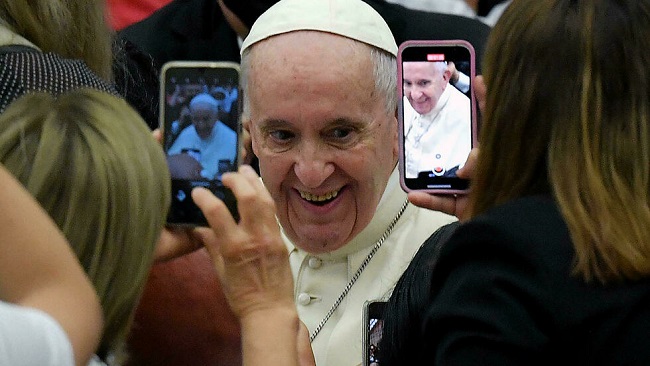
Pope Francis called for more solidarity with those living in poverty as he celebrated mass in Rome in front of a masked congregation of around 2,000 people, while billions around the world again marked Christmas under the shadow of the coronavirus.
An explosion in cases driven by the rise of the Omicron variant has meant a Christmas season tainted by the pandemic for a second year running, with Santa’s arrival and longed-for family reunions overshadowed by the prospect of yet more Covid-19 restrictions.
In St Peter’s Basilica, the 85-year-old Argentine pontiff urged the faithful to “value the little things in life”.
“On this night of love, may we have only one fear: that of offending God’s love, hurting him by despising the poor with our indifference,” said Francis, who later Saturday will give his traditional Urbi et Orbi address and blessing.
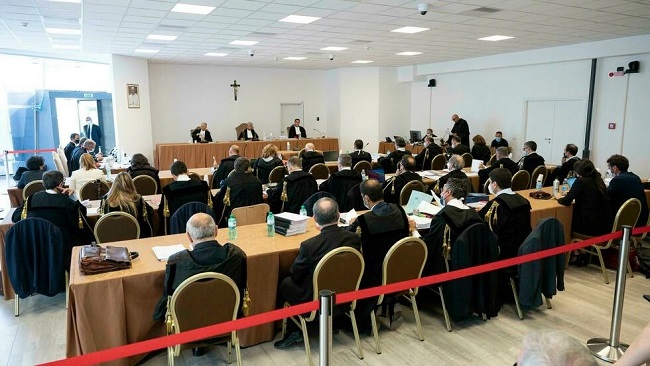
About 2,000 members of the public and 200 religious figures attended the Christmas Eve mass, wearing face masks and respecting social distancing as part of measures against the coronavirus.
In Bethlehem’s Manger Square, visitors in Santa hats and scouts beating drums marked Christmas Eve, but numbers were lower than usual as coronavirus fears overshadowed celebrations for a second straight year.
The city where Christians believe Jesus was born is usually a focal point of the holiday, with thousands packing the streets and filling hotels.
But Israel, which controls all entrances to Bethlehem in the occupied West Bank, barred its borders to foreigners in an effort to rein in infections from the Omicron strain of the coronavirus.
“It is a bit surreal,” American student Hudson Harder told AFP.
“There is a selfish part where it’s like ‘Oh I get to see this place so empty’ but on the other hand you feel for the shops, all the money they are losing, it’s really quite tragic.”
Flights cancelled
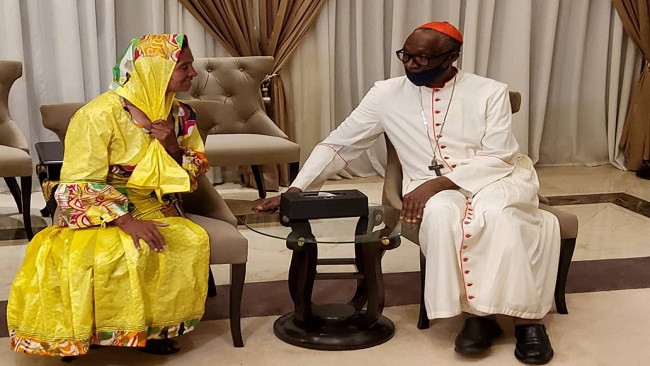
In his homily for midnight mass celebrated in St Catherine’s Church in Bethlehem, the Latin Patriarch of Jerusalem Pierbattista Pizzaballa said it was however encouraging that celebrations were “certainly more joyful this year”.
“Compared to last year’s Christmas, the participation is much greater and this is an encouraging sign,” he told the masked congregation, but regretted the absence of foreign worshippers due to the pandemic.
In the southern Philippines, standing in a pool of water in his typhoon-hit church, Father Ricardo Virtudazo celebrated Christmas Day mass with dozens of devotees who prayed for a better year after the storm killed nearly 400 people and left hundreds of thousands homeless.
“What’s important is all of us are safe,” said Joy Parera, 31, attending the service with her husband in the town of Alegria on the island of Mindanao.
Another survivor, Marites Sotis, said she would usually serve up meat, spring rolls and salad for Christmas but that her family was struggling after the storm felled most of their coconut trees.
“We won’t have those this year because they cost a lot of money,” Sotis, 53, told AFP. “We’ll make do with spaghetti.”
For the second year, surging infections have complicated yuletide plans from Sydney to Seville.
The new coronavirus strain severely disrupted holiday travel, with tracking website Flightaware.com reporting more than 2,300 flights had been cancelled around the world, hundreds of them in the United States.
Millions of Americans were nevertheless on the move to see loved ones for Christmas, even as Covid infections surpass the peak of the previous wave and hospitals run out of beds.
In Washington, US President Joe Biden and his wife Jill visited a children’s hospital for the traditional Christmas book-reading by the first lady.
The couple chatted with patients and doctors, showing one boy a photo of “Commander” — their new puppy — before settling into chairs beside a Christmas tree and reading a book inspired by the Disney movie “Frozen”.
In Europe, governments are reimposing misery-inducing safety measures that are draining the fun from Christmas for many.
The Netherlands is back in lockdown while Spain and Italy have made wearing masks compulsory outdoors.
And with Britain hitting a record high number of Covid-19 infections again on Friday for a third day in a row, British Prime Minister Boris Johnson suggested getting a vaccine booster shot as a Christmas gift for relatives.
‘Ray of light’
Still, Christmas gatherings will be easier than a year ago in many other places around the world.
Most Australians are allowed to travel interstate over the festive break for the first time in two years, with Sydney’s Catholic Archbishop Anthony Fisher saying that Christmas was “a ray of light” in dark times.
And Santa Claus was not deterred from doing his rounds and been cleared for travel in Canada’s airspace after showing proof of vaccination and a pre-flight negative Covid test, Ottawa’s transport minister said.
According to the North American Aerospace Defense Command’s (NORAD) Santa-tracking website, Father Christmas had delivered nearly five billion gifts and was flying over Canada at around 0200 GMT.
“He’s been at it for many hours already and will go throughout the evening as well,” said Major General Eric Kenny, commander of the Canadian NORAD region.
Source: AFP