
10, November 2016
A busy Thursday for the Cameroonian dictator 0
President Paul BIYA, has received Letters of Credence from Gilles Thibault, Ambassador of France to Cameroon, and Mahamat Ahmat Karambal of the Republic of Chad. The ceremony held at the Unity Palace on Thursday, 10 November 2016.
Ambassador Gilles Thibault’s predecessor was Christine Robichon who spent three and a half years in Cameroon. Before his arrival in Cameroon Gilles Thibault was the French Ambassador to Burkina Faso and the West African Economic and Monetary Union.
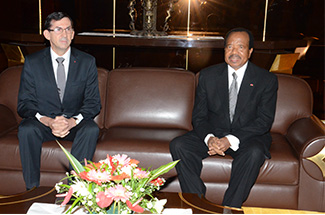 The Head of State and the French diplomat seized the opportunity to make an overview of bilateral ties. A long-standing, dense, and multifaceted cooperation exists between Cameroon and France. This fruitful friendship has touched areas like governance, health, education, infrastructure, rural development, environment, higher education, research and culture.
Economically, Cameroon is the first trade partner of France in Central Africa and the second largest supplier of certain products like cash crops, aluminium, wood, etc.
Both countries have longstanding defence agreements. As the first partner of France, Cameroon plays a special role in the preservation of peace and security in Central Africa. Thus, Paris supports Yaounde with equipment and the training of defence forces engaged in the fight against the Boko Haram terrorist group.
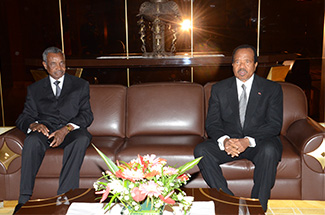 The second diplomat to hand letters of credence to President Paul BIYA was Ahmat Mahamat Karambal of Chad. Prior to his appointment in Cameroon, he was the Governor of the Moyen Chari region of Chad.
Bilateral relations between Cameroon and Chad are ongoing and have been diversified under the visionary leadership of Presidents Paul BIYA and Idriss DEBY ITNO. The Chadian leader paid a condolence visit to Cameroon last month after the Eseka train derailment.
Both countries are actively engaged in the fight against the Boko Haram terrorist group. Economically, studies and the sourcing of funds have been accelerated lately to realise projects like: the bridge over the Logone River between Yagoua (Cameroon) and Bongor (Chad); the extension of the railway from Ngaoundere (Cameroon) to Ndjamena (Chad); and the Ngaoundere-Touboro-Moundou road.
Culled from the Presidency of the Republic


















11, November 2016
The declining state of public hygiene under the CPDM regime 0
The Minister for Youths and Civic Education was in Kribi recently to launch a national initiative which seeks to generalize good civic practices in the country. Many see it as a last-ditch effort to improve on the declining state of public hygiene, especially as the Africa Nations Cup competition draws nearer and nearer. Many have criticized the state of public hygiene in the country and the authorities were beginning to fear that we were going to be caught pants down when the numerous visitors coming into the country for the AFCON if they met the situation uncorrected. Some have rightly called it a national disease. On the major streets of Yaoundé, it is not unusual to find passengers throwing out banana peelings or used Kleenex paper from car windows and quite often this is even done by those in vehicles no one would ever have suspected simply by the quality of their occupants!
Once upon a time, the cities of Yaoundé and Douala had some of the best public telephone booths; but all were gone within months of their installation because hoodlums broke them up and shattered them in the hope of extracting the coins put in to obtain communication lines. Across the country, entire communities have been cut off from electricity by thieves in search of such lines to sell out for use in the manufacture of other lucrative uses. Many Mayors and other authorities have been making appeals for better manners as the countdown for the beginning of AFCON comes closer. The appeals were prompted by the need to address some disturbing actions around newly constructed structures in the country where citizens have not given them the care they require. Within these structures and where toilets and other facilities exist, people would rather urinate just about anywhere.
One must however blame the public authorities for the rise in these condemnable acts because all too often essential services such as toilets and other hospitality services are not provided for when public buildings are conceived. It is possible to go for several kilometers in our major cities with seeing a refuse disposal basket or a public toilet. In such a situation, where does one expect even the most willing person faced with the need to urinate do? Or where does one throw a used piece of Kleenex? It takes both a campaign such as the one being organized by the public authorities but, above all, by the provision of facilities to expect a radical turnaround in the poor habits experienced today. It will take only that to expect to instill a culture of public hygiene and the need to respect common-use facilities in the minds of Cameroonian citizens.
Culled from Cameroon Tribune