18, June 2025
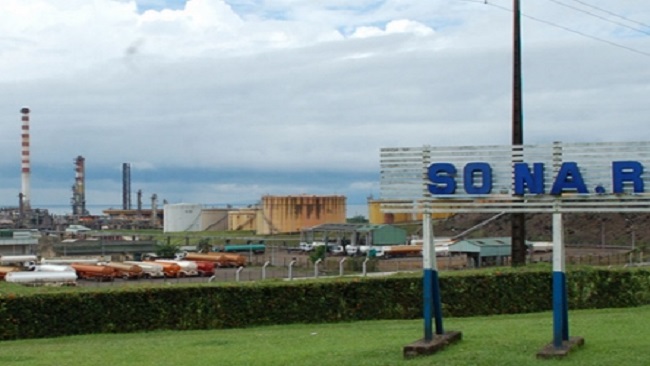
BEAC Governor calls for urgent restoration of SONARA 0
Yvon Sana Bangui, Governor of the Bank of Central African States (BEAC), is urging CEMAC countries to refine their own crude oil. He noted that the six CEMAC nations collectively spend approximately 2 trillion CFA francs annually on imported petroleum products like gasoline, diesel, kerosene, and domestic gas. This spending continues despite five of the six countries, excluding the Central African Republic, being crude oil producers.
Speaking on June 17, 2025, in Yaoundé during “Finance Week,” a platform for financial stakeholders, the BEAC governor argued that building crude oil refineries within CEMAC could significantly reduce or even eliminate these imports. This shift, he emphasized, would help preserve and strengthen the region’s foreign exchange reserves, which are currently strained by the heavy reliance on fuel imports. These reserves consist of foreign currency payments received by states and their economic agents, enabling them to make payments to international partners.
“We have the raw material, and its price trend is downward. Let’s commit to an import-substitution strategy and refine our oil,” Bangui declared. He added, “The cost of road infrastructure awaited by economic operators is very high in our region. To avoid this, we must locally produce bitumen. We must locally produce lubricants. All of this comes from oil. Even fertilizer can be produced from oil.”
The Sonara Refinery Fire and Regional Self-Sufficiency
This isn’t the first time Bangui has advocated for building oil refineries in the CEMAC zone to protect foreign exchange reserves from the impact of imported refined petroleum products. On June 24, 2024, during a press conference following the BEAC Monetary Policy Committee’s second ordinary session, he stated, “In Cameroon, I am calling for the urgent restoration of Sonara—the National Refining Company.”
Cameroon has been importing all its refined petroleum products since a fire destroyed Sonara in May 2019. At the time of the incident, Sonara was refining imported oil, not Cameroonian crude. The rehabilitation of Sonara, estimated at 250 billion CFA francs, was initially scheduled to begin in 2022 but remains pending.
Bangui’s call for Sonara’s rehabilitation echoes his statements made on June 14, 2024, during a visit to the Djermaya refinery in Chad. There, he urged company leaders to increase production to curb imports. “Today, the fact that all CEMAC countries import petroleum products places enormous pressure on our foreign exchange reserves. I issue a solemn call to the authorities and company leaders to do everything necessary to meet national and subregional demand,” he asserted.
Source: Business in Cameroon










18, June 2025
Biya’s health, Ambazonia violence looms over October presidential vote 0
Cameroon is counting down to a presidential election with key questions over the health of 92-year-old veteran leader Paul Biya, separatist violence in its English-speaking regions and ethnic tensions all unresolved.
With less than four months until the first ballot is cast, any prospective challenger will have to soon announce their tilt at taking over the central African nation at a tough time for the economy.
Ratings agency Fitch on May 9 predicted that should Biya run he would win the upcoming vote, “guaranteeing political and policy continuity” at a time of upheaval for many ordinary Cameroonians.
In the capital Yaounde, Biya’s likeness is plastered — as usual — on billboards all over the city, while his critics are nowhere to be seen.
Yet Biya, who came to power in 1982, has kept schtum on whether he will run in October’s election to extend his more than four-decade rule.
Given Biya is already the world’s oldest head of state, questions over his health and capacity to govern have dominated debate over the vote.
Cameroon’s opposition appears more fragmented than ever, undermining its ability to oust the longtime leader despite the favourable political winds.
That Biya’s critics have been unable to agree on a unity candidate is largely down to “the egoism of the players, the lack of humility of the leaders, ideological fractures and the whiff of tribalism”, said Simeon Ekodo Mveng, a political researcher at Laval University.
University of Yaounde 1 professor Charles Romain Mbele said that the opposition had decided to band together in various groups “to give itself a chance”.
“We see that that is laborious, while the ruling party is firmly rooted across the nation, with alliances with other parties in government,” he added.
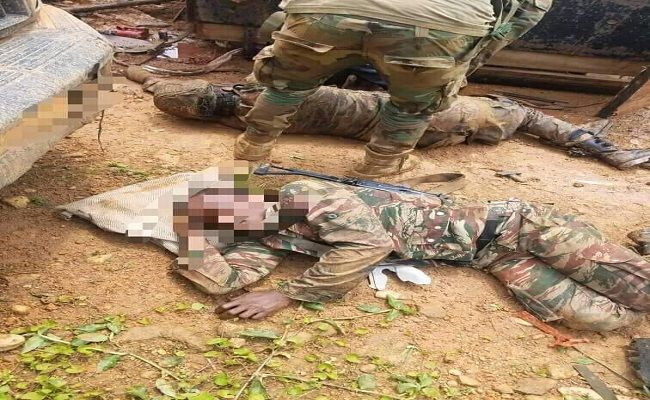
Since 2016 Cameroon’s Northwest and Southwest regions have been riven by conflict between English-speaking separatists and the government.
Many Cameroonian English-speakers say they face systemic discrimination in the majority French-speaking country.
But what began as a civil rights protest quickly descended into armed insurrection.
According to the latest estimates by Human Rights Watch, the fighting has killed at least 6,000 civilians so far.
Separatist groups have carried out kidnappings and attacks on civilians and officials, while the army and police are accused of launching raids aimed at punishing alleged separatist sympathisers.
All the while Boko Haram jihadists have been sowing terror at the other end of the country in the Far North region, where the group has been active since 2009.
The various security crises have uprooted many Cameroonians from their homes and pose a challenge to the peaceful conduct of the elections.
Beyond the fighting out in the open, Cameroon also faces the more insidious menace of ethnic rivalry.
Fractures along identity lines have deepened, while at times the political debate has regressed to an ethnic mud-slinging match.
“In election periods, stereotyped rhetoric resurfaces, pitting the ‘Bamileke’ often considered to be economically dominant against the ‘Beti’, the group which President Paul Biya comes from,” said Baba Wame, a professor at the University of Yaounde II.
“These narratives are sometimes amplified by anonymous accounts or local influencers,” Wame added.
The official line, which Biya has taken to social media to repeat, is that ethnic discrimination must be fought.
But, although Cameroon has had a law against hate speech and tribalist rhetoric on the books since 2019, its enforcement has only ever been hesitant, while perpetrators never face prosecution in the courts.
As Cameroonians prepare to head to the polls, the nation’s economic difficulties will have hit many voters in the wallet.
Many are unemployed, including nearly three-quarters of the country’s young people, according to Gabriel Fandja, who heads the National Assembly’s education commission.
Inflation, which according to official statistics hit five percent in 2024, has eaten away at their purchasing power.
Access to safe drinking water, healthcare and decent education remains out of reach for many.
Those tensions have worried Cameroon’s households and the country’s international financial partners alike.
Whether on social networks or during televised debates, ordinary Cameroonians have raised their voices to criticise the cost of living and the lack of basic services.
Increasingly vented in the open, the frustrations reflect a profound social malaise in the run-up to the presidential ballot.
Culled from AFP