
19, February 2020
Southern Cameroons Massacre: Inner City Press says it is UN Secretary General’s genocide 0
As more and more civilians have been killed by the Cameroon government of Paul Biya, absentee president for 37 years, UN Secretary General Antonio Guterres has been silent.
Inner City Press was informed by sources in Guterres’ own 38th floor office that Guterres had made a deal with Biya’s UN Ambassador Tommo Monthe as chair of the UN Budget Committee for administrative favors in exchange for silence on the slaughter or “subduing” of the Anglophone minority.
When Inner City Press asked about it, Guterres used UN Security to rough up Inner City Press right after it interviewed Monthe, and to ban it from entering the UN, 595 days now. UN “Human Rights” Commission Michele Bachelet as she came into the job picked by Guterres was contacted by Inner City Press about Biya’s killing spree in Cameroon and relatedly about Guterres’ ban on Inner City Press, has done little to nothing on either.
In her September 2019 speech name-checking 35 countries, Bachelet did not even mention the slaughter in Cameroon, here. In June 2019, Biya’s government praised Bachelet.
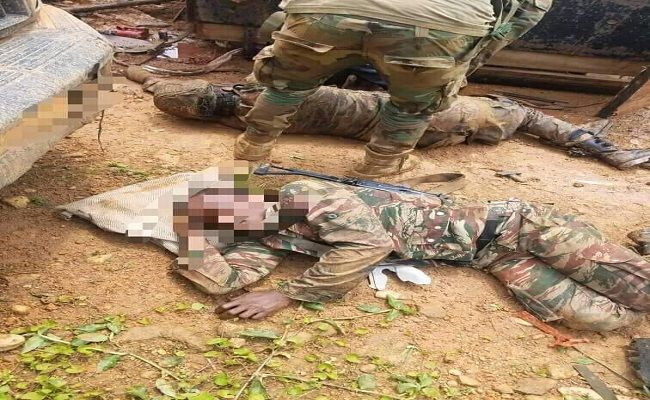
On February 16, 2020 Inner City Press from its sources in Cameroon reported on the killing of more than two dozen civilians including children in Ngar in NW Cameroon.
Before 10 am on February 17 Inner City Press in writing asked Guterres, his spokespeople Stephane Dujarric and Eri Kaneko about the killings.
There was no answer, and with Dujarric on vacation in Orlando, Florida, Eri Kaneko fielded only two questions at a ten minute long noon briefing on February 17 that Inner City Press was banned from entering and asking at.
Now on February 18, not Bachelet but her spokesman who has refused countless written questions from Inner City Press, about Cameroon and Yemen and Sri Lanka and Honduras, to name a few, has belatedly issued a statement which reminds that Bachelet’s wan visit to Cameroon “welcomed” Biya’s efforts:
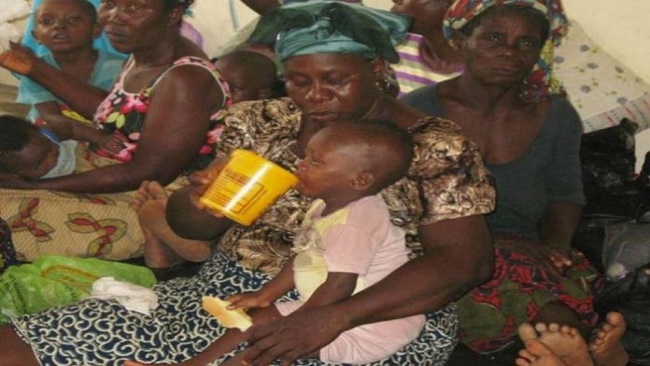
“The attack on 14 February on a village in Cameroon that left 23 people dead, the majority of them children, is a shocking episode in the ongoing crisis that has afflicted the country’s North-West and South-West regions for the past three years. We note that the Cameroon Government announced on 17 February that there would be an investigation into the killings and that the findings would be made public. We urge the authorities to ensure that the investigation is independent, impartial and thorough, and that those responsible are held fully to account. Witnesses said some 40 armed men, including members of the security and defence forces, attacked the village of Ngarbuh, in the department of Donga Mantung in North-West Cameroon, opening fire on people and burning down houses. The authorities said defence forces and gendarmes came under attack from people inside the village with the exchange of shots igniting a fire that affected several dwellings. According to information from UN colleagues on the ground, among the 23 people killed were 15 children, nine of whom were under the age of five. The victims also included two pregnant women, one of whom died of her injuries in hospital. This attack is the latest deadly incident in Cameroon’s North-West and South-West regions where hundreds of thousands of people have been displaced by clashes between security and defence forces and armed separatist groups. We call on the Government to ensure that the security forces abide by applicable international law norms standards during the conduct of their operations. We similarly remind armed separatist groups of their responsibilities under international law and call on all parties to refrain from deliberate attacks on civilians. The UN Human Rights Office has been following developments in the North-West and South-West regions as an already tense situation worsened ahead of parliamentary and municipal elections held on 9 February. The Government deployed some 700 additional troops in the North-West and South-West where armed separatists reportedly kidnapped dozens of candidates, most from the Social Democratic Front which is one of the country’s biggest opposition parties. Most of the candidates were subsequently released. The UN Human Rights Office also received information that voting centres and the houses of those involved in the election campaign were attacked by separatists. In May 2019, at the end of a visit to Cameroon, UN High Commissioner for Human Rights Michelle Bachelet welcomed the Cameroon Government’s openness to work with the UN Human Rights Office, and the rest of the UN, to seek solutions to the major human rights and humanitarian crises in the country. In light of the latest violence, we urge the Government of Cameroon to take concrete steps to implement recommendations made last year by the UN Human Rights Office. We reiterate our readiness to help the Government to protect the human rights of people all across Cameroon.”
Yeah right, UN Human Rights – it’s become an oxymoron, and Bachelet’s and Rupert Colville’s collusion even with outright censorship in UNHQ is a telling and indelible example. They did nothing, and said nothing, as Inner City Press was banned even from their “Human Rights Day” event, here.
Past 5 pm on February 17 from inside the corrupt UN headquarters, this: “The Secretary-General is deeply concerned over reports about the killing of civilians, including children, in an attack on the village of Ngarbuh in the North-West Region of Cameroon on 14 February. He extends his deepest condolences to the families and calls on the Government of Cameroon to conduct an investigation and to ensure that those responsible are held accountable.
The Secretary-General calls on armed actors to refrain from attacks against civilians and to respect international humanitarian and international human rights law. He reiterates the readiness of the United Nations to work with all stakeholders towards a political solution to the crisis in the North-West and South-West Regions of Cameroon through meaningful dialogue. Stéphane Dujarric, Spokesman for the Secretary-General New York, 17 February 2020.”
It is a fraud. This is Guterres’ genocide
Culled from Inner City Press














19, February 2020
After counterfeit twin poll, women on the front line to hold Cameroon together 0
When Gladys Mbuya spoke at the African Peer Review Mechanism meeting in Kigali, her voice shook. She described her life as an internally displaced person in the violence ravaging her country, Cameroon. Her pre-conflict status in life stands in sharp contrast.
Mbuya is the Queen Mother of Alatening village, and head of the women’s traditional village council of the village Tekumbeng, a throne inherited from her mother.
The contradictions continue — Mbuya is national president of the International Federation of Women Lawyers (FIDA Cameroon) and Vice secretary of the Cameroon Bar Association.
Of the 10 regions making up Cameroon, eight are French speaking and two are English speaking. After the First World War, Cameroon, previously a Germany colony, Kamerun, was given as war spoils to the French and British. The British had northwest region and southwest regions, collectively known as Southern Cameroons. The French had the rest. At independence, Southern Cameroons voted to join francophone Cameroon to become one united country. Since then, the minority Southern Cameroons have been marginalised socially, economically and politically.
Cameroon’s national assembly elections happened last week, for the first time in seven years. A series of controversial decisions saw them moved twice. Paul Biya has ruled Cameroon for 37 years courtesy of a constitutional amendment removing presidential term limits in 2008. The main opposition leader Maurice Kanto who ran for president, subsequently spending nine months in jail in 2018, is abroad.
In 2016, teachers and lawyers in the English-speaking regions started a peaceful protest against the use of French in schools and courts. The government reaction of using lethal force against peaceful protesters created separatists who declared independence and named the Southern Cameroons “Ambazonia.” The government conducted a violent military crackdown and detained separatist leaders.
Mbuya narrowly escaped arrest as the military dragged lawyers and teachers out of homes and taxis. Non-state armed groups and military clashes in her home forced her to seek temporary shelter. War has continued unabated in the Southern Cameroons with an estimated 3,000 lives lost and 700,000 fleeing their homes as internally displaced persons.
A number of leaders arrested include lawyers’ President Agbor Balla, Mimi Mefo, a popular Cameroonian journalist arrested over a Facebook post, and Michele Ndoky an opposition party lawyer who was shot and survived four bullets. Agbor Balla was detained for nine months. Women leaders, Mimi Mefo and Michele Ndoky were eventually released.
In all the above cases, fiery Mbuya appeared as pro-Bono defence counsel, defending the right to freedom of opinion, assembly, association and freedom of peaceful protest. The releases were through presidential pardon, with cases discontinued by the head of state without the courts hearing and handing down judgement.
Women have now organised themselves in conversations in markets and roadsides seeking solutions. Mbuya also leads intercommunity dialogues with women across the divides particularly through radio Buea “Voices for Women.”
The separatists boycotted last week’s elections and government predictably reacted with renewed violence. The separatists abducted English-speaking candidates, saying they do not see themselves in a government carrying out extra judicial killings.
President Biya, recognising the rising power of women, directed electoral positions in his party be split evenly among women and men. His directive to prioritise the young was however met with calls for 87-year-old Biya to lead by example.
The women want mediation more inclusive than the Grand National Dialogue announced by Biya last year. Separatists boycotted the dialogue, demanding release of political prisoners and withdrawal of the military from Ambazonia. The bar council has submitted proposals for peaceful resolution to the Government.
The women want the African Union involved.
Source: The East African