27, May 2026
The situation of people sentenced to death in Cameroon 0
In 2016, Cameroon handed down the highest number of death sentences. Although the death penalty has not been carried out in the country since 1997, nearly 300 death sentences were handed down in 2015 and 2016. Together Against the Death Penalty, Droit et Paix and the Network of Cameroonian Lawyers Against the Death Penalty (RACOPEM) have published a fact-finding mission report highlighting the human tragedy that the death penalty represents. Through the stories of those sentenced to death, as well as their families and lawyers, it highlights their experiences in the criminal justice system and their harsh conditions of detention.
This report is the result of a fact-finding mission carried out in Cameroon between March and October 2025 by the Cameroonian association Droits et Paix, the Network of Cameroonian Lawyers Against the Death Penalty (RACOPEM) and ECPM. The teams of investigators visited 10 prisons, met with 45 people sentenced to death and 6 prison staff members.
The death penalty as a political tool since Independence
This report traces the key stages in the history of the death penalty in Cameroon, showing how, since independence, this punishment has been used as an instrument of political control and legitimisation.
Assessing trends in the use of the death penalty in Cameroon remains difficult due to the authorities’ marked lack of transparency on the issue. This opacity, which seems to reflect a resolve to maintain secrecy around death sentences, severely limits access to reliable data. During the examination of Cameroon’s state report at the 67th ordinary session of the African Commission on Human and Peoples’ Rights in 2023, the authorities nevertheless indicated that as of 31 October 2020, 120 people were sentenced to death, including 80 Cameroonian men, 36 foreign nationals and 4 women. According to monitoring by Droits et Paix and RACOPEM, 105 people are believed to be sentenced to death in Cameroonian prisons by the end of 2025, including at least one woman.
The criminal justice system of Cameroon: a chain of black holes
From the moment of arrest through to the exhaustion of legal remedies, the criminal justice trajectory of those sentenced to death unfolds in a context where investigations are frequently conducted under duress, legal assistance remains largely illusory, challenging the charges is often impossible, and cases remain unaddressed for years. Some die in detention, having waited decades for legal remedies that never materialised.
The report examines in detail the structural failings of Cameroon’s criminal justice system, drawing on a number of testimonies and case studies documenting breaches of the right to a fair trial.
Precarious and unfair detention conditions
“Here, if you have no money, you’re not entitled to anything.” Kelvin, sentenced to death in Buea.
There are no prisons specifically designated for individuals sentenced to death. Although the Cameroonian authorities provide no official data on where such people are held, civil society estimates they are scattered across approximately 50 of the country’s 76 prison facilities. During visits to ten prisons in both French- and English speaking areas, the fact-finding mission was able to confirm the presence of people sentenced to death in eight of them.
In these prisons, overcrowding, unsanitary conditions, food shortages and very limited access to healthcare – including psychiatric care – create an environment where suffering becomes a daily experience, marked by depletion, distress and abandonment. The testimonies gathered from people sentenced to death reveal constant fear, persistent physical and mental harm, and a widely shared feeling of having been forgotten by the state.
Culled from ecpm.org
























28, May 2026
Vatican declares Cameroonian religious brother Jean-Thierry Ebogo “Venerable” 0
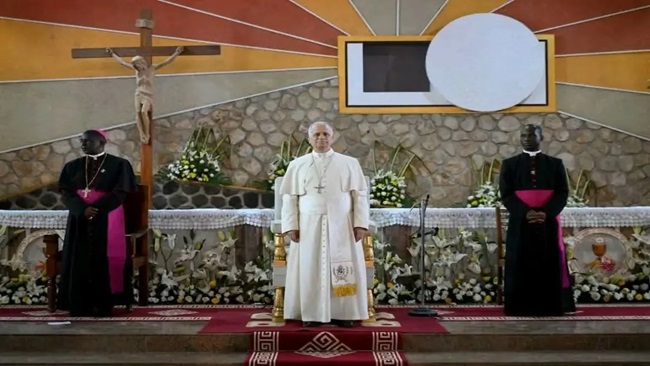
The Catholic Church has taken a new step in recognizing the spiritual legacy of Brother Jean-Thierry Ebogo after the Vatican officially declared the young Cameroonian religious figure “Venerable.”
In a letter dated May 25, 2026, the Apostolic Nunciature in Cameroon informed President Paul Biya that Pope Leo XIV had granted the title to the member of the Discalced Carmelite order, who until now had held the status of “Servant of God.” The decision marks an important stage in the Catholic canonization process.
Within the Church, the title “Venerable” is granted to individuals whose “heroic virtues” have been formally recognized by the Vatican. It comes before possible beatification and eventual canonization. Born in Cameroon on February 4, 1982, Jean-Thierry Ebogo joined the Sainte-Thérèse Carmel of Nkoabang, on the outskirts of Yaoundé.
He became known for his strong involvement with youth groups, prayer communities, and Catholic movements. Church officials and faithful often described him as deeply committed to spiritual and community life. His story, however, took on greater significance after he developed bone cancer.
In an attempt to save his life, doctors amputated one of his legs. According to testimonies relayed by the Apostolic Nunciature, the young religious brother transformed his suffering into a spiritual offering and lived through illness with profound Christian faith.
He was later transferred to Italy for medical treatment and died on January 5, 2006, in Legnano, near Milan, at just 23 years old. Over time, his journey — marked by suffering, faith, and self-sacrifice — drew growing emotion and admiration within Catholic communities in Cameroon and beyond.
With this recognition, Jean-Thierry Ebogo becomes the second Cameroonian officially declared “Venerable” by the Roman Catholic Church after Simon Mpeke, widely known as Baba Simon, the missionary figure closely associated with evangelization efforts in northern Cameroon.
Following the Vatican’s announcement, several faithful and religious leaders traveled to the Edith Stein Monastery of the Discalced Carmelites in Nkolbisson, where the young religious brother is buried.
During a pilgrimage held there on May 25, 2026, Yaoundé Archbishop Jean Mbarga praised the spiritual depth of Jean-Thierry Ebogo’s life. “He gave everything to the Lord, transcending the sufferings of this world and of his own body as he gradually rose toward heaven,” the archbishop said. “May this place truly be recognized as a sanctified site through his story, and may we always find comfort there in our faith.”
The declaration has further strengthened the emotional and spiritual significance surrounding Jean-Thierry Ebogo’s memory. For many Catholic faithful — especially young believers — he represents a figure of courage, resilience, and spiritual surrender in the face of suffering.
The Vatican’s decision also comes at a time when the African Catholic Church increasingly seeks to highlight local figures of holiness whose lives closely reflect the continent’s social and human realities. For many observers, the journey of the young Cameroonian Carmelite fits squarely within that movement.
Source: Business in Cameroon