25, May 2026
Senegal parliament speaker El Malick steps down as political crisis deepens 0
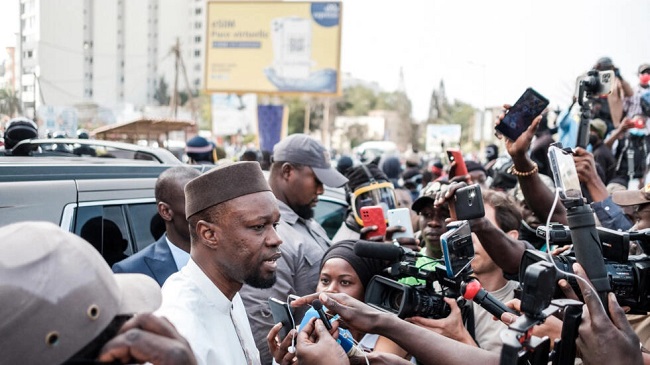
The speaker of Senegal’s parliament said Sunday he was resigning, two days after his close ally was fired as prime minister, deepening a political crisis in the debt-laden West African country.
The move by speaker El Malick Ndiaye clears the way for sacked premier Ousmane Sonko to run for the post of head of parliament, where his Pastef party holds a strong majority, in a challenge to President Bassirou Diomaye Faye.
Deputies have been summoned to a full session of the assembly on Tuesday morning to reinstate Sonko as a member of parliament and vote for a new speaker, said an official document published late Sunday.
That could further complicate reform efforts by Faye, who sacked his former ally Sonko on Friday after months of tensions.
Faye owed his presidency in large part to Sonko, who would almost certainly have taken the top job had he not been barred from running in the last presidential election due to a defamation conviction.
Their Pastef party comfortably won the 2024 elections on a promise of a profound political shake-up, vowing to fight corruption and inheriting an economy mired in debt.
Sonko had generated a passionate following among Senegal’s disaffected youth ahead of the 2024 presidential election. Despite Sonko’s popular appeal however, Faye held all the real power as president.
But in recent months, relations had soured between Faye and his one-time mentor. And as the discord between the president and prime minister became increasingly public, their governing alliance crumbled.
Sonko had become vocal in his criticism of his former protégé, accusing Faye of a “failure of leadership” for not backing him against his critics.
He also regularly denounced what he said was the slow pace of legal action for corruption against senior figures in the previous government of former president Macky Sall.
The two also disagreed on the crucial question of how to tackle Senegal’s high debt.
A difficult cohabitation
Hours after Sonko’s dismissal, hundreds of his supporters gathered outside his Dakar home to show their support for him – and it is Sonko who is the uncontested leader of Pastef, with its large parliamentary majority.
Sonko’s departure as premier raised the question of how Faye can govern the country when he cannot be assured of the support of the ruling party.
“One can imagine that it is going to be complicated to cohabit with this majority of the Pastef party in the Assembly,” said Babacar Ndiaye, research director of the West African Think Tank (WATHI).
Faye has to name another prime minister to replace Sonko – and that choice will have to be approved by parliament within three months of his nomination, said Ndiaye.
“If the deputies decide to table a motion of censure or no confidence, they are capable of doing so,” he added.
The president cannot dissolve parliament itself until November – two years after the last parliamentary election.
And a reform of the electoral code approved by parliament a few weeks ago means that Sonko is now eligible to run for the presidency.
That raises the possibility that the two former political allies might at some point run against each other for the top job.
Source: AFP
















25, May 2026
Atanga Nji’s Samuel Eto’o comment: Cameroon does not need bombastic declarations 0
As a chartered member of the ruling CPDM crime syndicate wanted by the Special Criminal Court in Yaoundé, the Minister of Territorial Administration Paul Atanga Nji has every right to dream big for Cameroonian football. Cameroonians are entitled to ambition and Cameroonian football fans are entitled to hope. But asking the President of the Cameroon Football Federation Samuel Eto’o to “give Cameroon two more Africa Cup of Nations titles and a FIFA World Cup semi-final place” is not leadership. It is political theatre wrapped in football romanticism.
Paul Atanga Nji’s statement collapses under the weight of its own absurdity.
Soccer in today’s world is not governed by charisma, nostalgia or individual football legend. It is governed by systems namely: youth development, coaching structures, domestic league investment and sports medicine including governance stability, scouting networks, infrastructure and institutional competence. No football federation president in the world, not even a global icon like Samuel Eto’o can wave a wand and manufacture continental dominance and World Cup semi-finals on command.
To frame Cameroon’s football destiny as the personal responsibility of one man is to fundamentally misunderstand how elite football works in 2026. We of the Concord Group are extremely shocked by Minister Paul Atanga Nji’s low sense of judgment.
Cameroon’s greatest football moments were not created by slogans from corrupt government ministers. The 1990 FIFA World Cup quarter-final run was the product of a golden generation, tactical discipline and an era in which African football was beginning to break psychological barriers. The 2000 and 2002 AFCON triumphs came from a deep reservoir of talent, organization and continuity. Even then, success was difficult, fragile and fiercely contested.
Today, the landscape is even harsher. Morocco reached the World Cup semi-finals in 2022 not because King Mohammed VI publicly demanded it, but because the country spent years building academies, modernizing football administration, investing in facilities and creating a coherent football ecosystem. Senegal’s rise was similarly institutional, not mystical. Egypt’s consistency did not emerge from reckless and tactless ministerial declarations. Serious football nations build patiently.
Cameroon continues to struggle with recurring administrative disputes, inconsistent domestic league structures, coaching instability and tensions between the Minister of Sports and Physical Education and football establishments. Mindful of the current situation, demanding “two more Africa Cup of Nations titles and a FIFA World Cup semi-final” sounds less like a strategic vision and more like a headline designed for applause in Yaoundé.
Even more troubling is the dangerous personalization of Cameroon’s football. Samuel Eto’o is not Cameroon’s entire football machinery. Eto’o is not the youth academies. Eto’o is not the league. Eto’o is not the tactical execution on the pitch. Eto’o is not the ministry of finance. Eto’o is not the infrastructure budget. Elevating one man into both savior and scapegoat is intellectually lazy and politically convenient.
If the Indomitable Lions fail, will Atanga Nji and his gang acknowledge structural dysfunction? Or will they simply recycle blame onto Eto’o?
Cameroon football development cannot continue to operate on plain fiction, superstition and celebrity worship. It requires accountability across government, federation leadership, clubs, coaches, schools and private investment. President Biya and his corrupt cabinet ministers should be talking about pitches, academies, referee standards, grassroots competitions, sports science and transparent governance not casually handing out World Cup semi-final ultimatums as though football were a ring road campaign promise to the people of the North West region.
There is also an arrogance hidden inside the Atanga Nji declaration. Winning the Africa Cup of Nations is extraordinarily difficult. Reaching a World Cup semi-final is historically monumental. Only one African nation has ever done it. To speak about these achievements as obligations rather than aspirations trivializes the scale of the challenge. Cameroon does not need bombastic declarations. It needs seriousness deep within government circles.
Samuel Eto’o should be judged on tangible administrative progress: improving football structures, stabilizing FECAFOOT operations, supporting grassroots football, attracting investment and creating long-term competitiveness. Those are measurable standards. Those are rational expectations.
But demanding “two AFCON trophies and a World Cup semi-final” as though football history can be summoned by political rhetoric is, quite simply, nonsensical nonsense.
By Soter Tarh Agbaw-Ebai