25, June 2026
Biya regime test new approach to keep urban roads in better condition 0
Cameroon is looking to change how it maintains urban roads and drainage systems, shifting from a system focused on construction work to one centered on long-term performance.
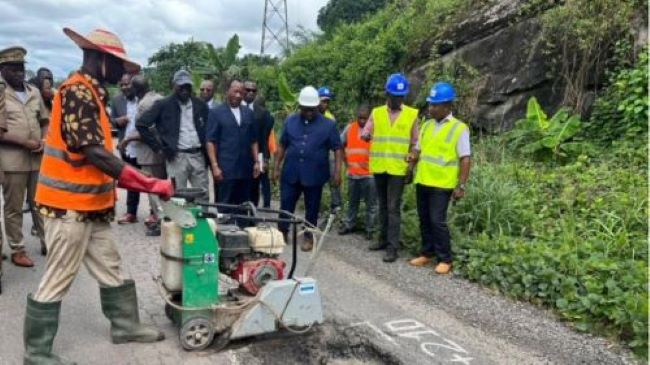
The Sustainable Cities and Land Management Project (PVGFD), with support from the World Bank, is preparing to introduce a new generation of road maintenance contracts known as Results-Based Road Contracts (MROR). On June 17, public works companies, engineering firms, local governments, and urban development stakeholders gathered in Yaoundé for a workshop dedicated to the new model. More than 100 participants attended the event, both in person and online.
The approach represents a significant departure from traditional public works contracts. Under the current system, companies are paid primarily for carrying out specific works. Under the proposed model, a larger share of compensation depends on the condition of the infrastructure over time and the quality of service delivered to users. “Unlike traditional contracts, MRORs focus on results and the long-term quality of infrastructure for the benefit of citizens. Expected benefits include better-maintained roads, more effective drainage systems, smoother mobility, and more efficient use of public resources,” the Ministry of Housing and Urban Development said.
A Focus on Long-Term Performance
The goal is no longer simply to repair a road or clear a drainage channel. Contractors would be responsible for keeping infrastructure in good working condition throughout the life of the contract. As part of pilot projects planned for Douala and Yaoundé, selected companies could be required to meet specific performance standards. Failure to maintain those standards could result in financial penalties.
Several countries already use similar contracts to improve road maintenance and reduce the cost of recurring repairs. The model also encourages contractors to adopt durable technical solutions rather than relying on repeated short-term fixes. The initiative comes at a time when urban infrastructure is under growing pressure. Rapid urban growth, heavier traffic, and intense rainfall continue to strain roads and drainage networks in both Douala and Yaoundé.
The effects are visible across both cities: roads deteriorate quickly, flooding remains common in some neighborhoods, traffic congestion worsens, and transportation costs increase for residents and businesses.
Improving Returns on Public Spending
For many residents, the issue is not simply building new infrastructure but ensuring that existing infrastructure remains functional. Several urban roads rehabilitated in recent years showed signs of deterioration shortly after completion, raising questions about the effectiveness of current maintenance practices. Authorities also see an economic benefit in the new approach. By linking payments to measurable performance, they hope to generate better returns from public spending on urban infrastructure.
The challenge is particularly important given the scale of infrastructure needs and the limits of available public resources. For local governments, every franc spent on maintenance must produce visible and lasting results. The pilot projects in Douala and Yaoundé will serve as a real-world test. If successful, the model could be expanded to other cities across the country.
Its success, however, will depend on several factors, including clear contract specifications, reliable performance indicators, effective monitoring by local authorities, and enforceable penalties when contractors fail to meet their obligations.
Without those safeguards, the shift toward results-based maintenance could remain more of a policy objective than a meaningful change in how urban infrastructure is managed.
Source: Business in Cameroon



















25, June 2026
Who is the African World Cup goalscorer older than Ronaldo and Messi? 0
Cristiano Ronaldo may have scored at a record sixth Fifa World Cup, but there is one piece of history which still eludes both him and Lionel Messi, who celebrated his 39th birthday on Wednesday.
When Ronaldo broke the deadlock against Uzbekistan in Portugal’s second group match he became the second-oldest scorer in the history of the tournament, finding the back of the net at the ripe old age of 41 years and 138 days.
But the former Manchester United and Real Madrid man still sits behind Cameroon great Roger Milla on the all-time list.
Milla first featured at the 1982 finals in Spain but found global fame aged 38 with four goals as the Indomitable Lions reached the quarter-finals at Italia 90 – the first African team to make it that far – marking his efforts with a dance by the corner flag which became his trademark.
Four years later, Milla was back on the scoresheet at USA 94, slotting in from eight yards against Russia. The corner flag wiggle was back again, but Cameroon lost the game 6-1 and went out at the group stage.
However, Ronaldo will no doubt take some pride in the fact he bumped Messi down from third to fourth on the list after the Argentina forward had netted aged 38 years and 363 days in his side’s win over Austria.
Messi could also be overtaken by Bosnia-Herzegovina striker Edin Dzeko or Croatia midfielder Luka Modric, both 40, should either bag a goal.
Japan centre-back Yuto Nagamoto is also nine months older than the Argentine legend but is yet to make an appearance.
Or could a veteran goalkeeper turn themselves into an unlikely hero? Six are older than Messi, including Germany’s Manuel Neuer, Cape Verde’s Vozinha and Uruguay’s Fernando Muslera – but no keeper has ever scored in 22 editions of the World Cup stretching back to 1930.
Austria’s Marko Arnautovic, 37, has entered the top 10 at this tournament thanks to his late penalty in the win over Jordan.
But Milla’s record looks set to stand for some time unless, that is, Ronaldo or Messi fancy the idea of playing on home soil when the 2030 World Cup hosts games in both Portugal and Argentina.
You wouldn’t rule it out, right?
The World Cup’s top 10 oldest goalscorers
1. Roger Milla – Cameroon vs Russia (28 June 1994) – 42 years, 39 days
2. Cristiano Ronaldo – Portugal vs Uzbekistan (23 June 2026) – 41 years, 138 days
3. Pepe – Portugal vs Switzerland (6 December 2022) – 39 years, 283 days
4. Lionel Messi – Argentina vs Austria (22 June 2026) – 38 years, 363 days
5. Gunnar Gren – Sweden v Germany (24 June 1958) – 37 years, 236 days
6. Cuauhtemoc Blanco – Mexico v France (17 June 2010) – 37 years, 151 days
7. Felipe Baloy – Panama vs England (24 June 2018) – 37 years, 120 days
8. Marko Arnautovic – Austria v Jordan (17 June 2026) – 37 years, 58 days
9. Obdulio Varela – Uruguay vs England (26 June 1954) – 36 years, 279 days
10. Martin Palermo – Argentina vs Greece (22 June 2010) – 36 years, 227 days
Culled from the BBC