
16, July 2018
Russia 2018: A United Nations of football talent led France to glory 0
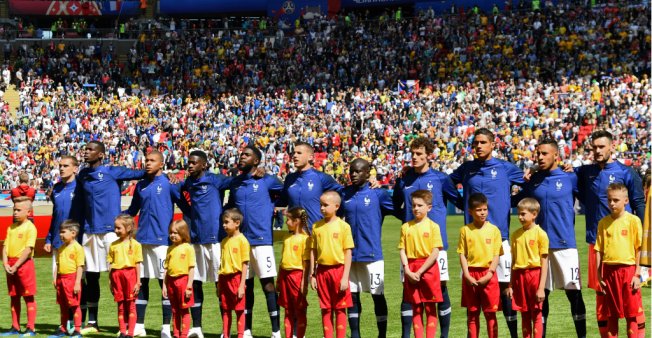
Antoine Griezmann’s father emigrated from Germany and the France forward’s mother is of Portuguese descent. Paul Pogba’s parents arrived from Guinea. Kylian Mbappe’s dad is from Cameroon, his mum Algerian.
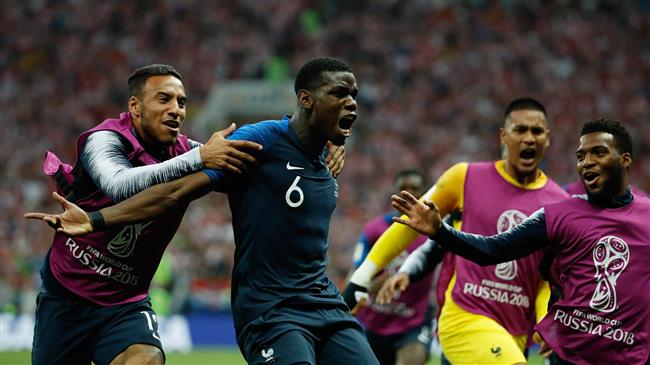
Immigrants, sons of immigrants and grandsons of immigrants bonded together with scions of families that have been French for generations, all for the rouge, blanc et bleu. And for only the second time, France is the World Cup champion.
About two-thirds of Les Bleus’ roster included players with immigrant backgrounds, a mini-United Nations of soccer talent. “That is the France that we love,” Griezmann said through a translator after Sunday’s 4-2 victory over Croatia ended the most exciting World Cup final in decades. “It’s beautiful to see it.”
Mbappe’s speed led to the third goal in the 59th. He added a goal of his own in the 65th, at 19 becoming the second-youngest scorer in a World Cup final behind 17-year-old Pele in 1958.
Vive la diversite!
A day after Bastille Day, the party was on.
“The diversity of the squad is in the image of this beautiful country that is France,” midfielder Blaise Matuidi, whose parents are from Angola and Congo, said through a translator ahead of the match.
France won on a humid night in Russia, with thunderclaps during play and a downpour during the trophy presentation. Quite different from that indelible summer evening at Stade de France in 1998, when fans in the arena and throughout Paris sang “La Marseillaise” until dawn and young teenagers drove cars while their intoxicated parents sat in passenger seats.
People called that team “Black, Blanc, Beur,” noting how black, white and North African players came together.
Zinedine Zidane, a son of Algerians, headed in a pair of first-half corner kicks against heavily favored Brazil. Patrick Vieira, born in Senegal, fed Normandy-born Emmanuel Petit for the third in the 3-0 win.
This year’s team was perhaps even more diverse.
Defender Samuel Umtiti was born in Cameroon and backup goalkeeper Steve Mandanda in Zaire. Others descended from Algeria, Mali, Mauritania, Mococco and Senegal, plus Germany, Italy, Portugal and Spain.
“There may be players who come from different origins, but we do have the same state of mind,” Griezmann said. “We all play for the same jersey, the cockerel. For our country, we give everything we have. As soon as you wear the jersey, we do everything for each other.”
He scored the go-ahead goal after the first video review-created penalty kick in a World Cup final. During a delay of about four minutes that might have unnerved less-composed players, Griezmann told himself to pretend it was a league match.
“Carry on and do the same thing as I normally do,” he remembered thinking.
At 27, he is in his prime but in the penumbra of Spanish soccer powers at Atletico Madrid, toiling in a league that Barcelona and Real Madrid dominate. He led the 2016 European Championship with six goals and tied for second with four at this World Cup, three on penalty kicks, earning the Bronze Ball as third-best player behind Croatia midfielder Luka Modric and Belgium forward Eden Hazard.
Griezmann kissed the trophy, knowing his generation will be revered in the same way Zidane, Petit, Thierry Henry, Lilian Thuram and Fabien Barthez remain renowned from Calais to Cannes.
“From tonight on, I’m sorry for them, but they are going to be different,” coach Didier Deschamps said. “Those 23 players will be linked forever, forever. Whatever happens – they might follow different paths, but they will be marked forever and they will be together thanks to this event.”
Griezmann, man of the match in a World Cup final, will be on posters throughout the republic, asked for endorsements, a mainstay of commercials. He will be pestered for autographs for the rest of his life.
“I’m going to be in the history of French football with my team,” Griezmann said. “We don’t quite realize it yet. Our children will be very proud to have our names.”
(AP)















16, July 2018
Roger Milla tried to persuade Umtiti to play for Cameroon 0
Before having picked France as his national team, Samuel Umtiti was approached by Roger Milla, who tried to persuade the player to don Cameroon’s colours.
The African legend even travelled to France in 2015 to convince the current Barcelona defender to join his national team.
“The president of the French Federation told us that Umtiti will have to wait four years to make his way up the ladder because there are many players in his position,” Milla said at the time.
“If he wants to play in a World Cup, he has to decide for Cameroon, now or never.”
Three years later, Umtiti scored France’s first goal in the semi-final against Belgium, to lead Les Bleus to Sunday’s final against Croatia.
The 24-year-old defender already won the U20 World Cup in 2013, having been part of a team that also consisted of players such as Paul Pogba, Alphonse Areola and Florian Thauvin.
Umtiti, who was born in Cameroon but moved to France at the age of two, has explained his decision to play for Les Bleus.
“I have family [in Cameroon], but I’ve only been there twice,” he told ESPN. “It’s part of my roots, but I don’t remember what it was like to live there and my decision has been thought through.
“I wanted to defend French colours from the beginning and it’s logical and natural, as I grew up here. “I had my training here and I played with Les Bleus in all the lower categories.”
Source: Marca.com