
30, January 2023
Douala: Archbishop Kleda links journalist Zogo’s death to 2017 slaying of the Bishop of Bafia 0
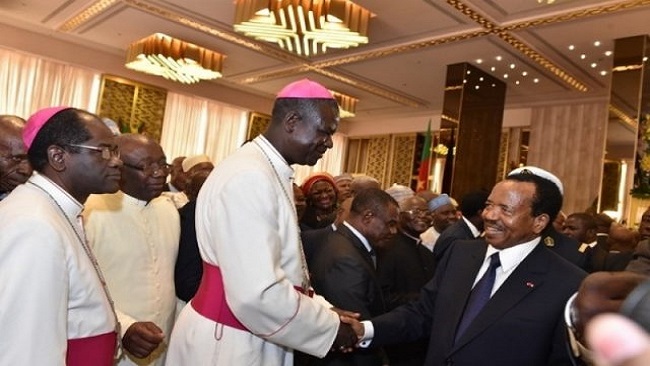
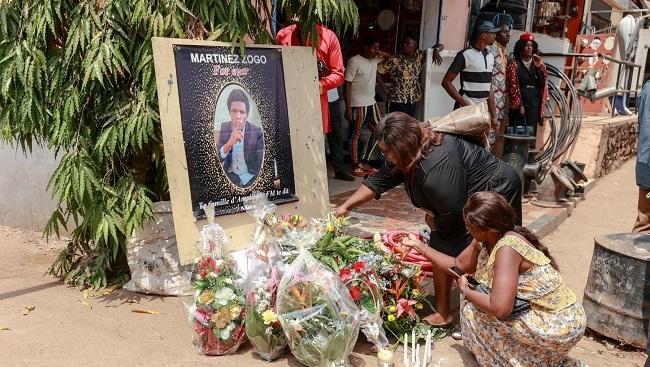
Catholic leaders in Cameroon have condemned the Jan. 22 murder of a local journalist, comparing the slaying to the 2017 assassination of Bishop Jean-Marie Benoît Balla of Bafia.
The lifeless body of Martinez Zogo, 51, was found along the road to Soa, nine miles from the capital city. His remains were in an advanced state of decomposition, but preliminary investigations reportedly showed signs the journalist, who was also the director general of the urban radio station Amplitude FM, had been tortured, sodomized, and mutilated.
Zogo went missing on January 17. Reports say that he was running toward a local police station to evade a threat when he was grabbed by unidentified men and carted off in a black, unmarked car.
His death has generated national and global condemnation.
“The assassination of this journalist has shocked everyone,” said the Archbishop of Douala, Samuel Kleda, in a Jan. 26 statement.
“A journalist isn’t a thief,” Kleda said. “A journalist who is only doing his job is kidnapped. He is tortured, and he is killed and then dumped in the bush near a village, as if he were a highway robber.”
“It shouldn’t be so in a country worth its salt, in a country of laws where human rights are respected,” he said. “We strongly condemn the assassination of this journalist.”
Kleda then drew parallels between the assassination of Martinez Zogo and that Balla six years ago.
“It’s almost the same scenario. When I look at the way this journalist was killed, I think about the disappearance and the assassination of the Bishop of Bafia, Jean-Marie Benoit Balla.”
“He too, like Martinez Zogo went missing [and] was tortured before being killed,” Kleda said.
Balla disappeared on the night of May 30-31, 2017, and his corpse was discovered floating on the Nyong River on June 2. The country’s bishops indicated that he had undergone significant torture before being murdered.
“Who is killing Cameroonians?”, Kleda asked.
“They tell us that investigations will be conducted, but the results of such investigations are never made public,” he said.
Kleda said he was at a loss to understand why a journalist who ran for safety to a police station could be taken away and the security personnel wouldn’t pursue the kidnappers.
“It’s horrible! It’s inadmissible! There is a serious problem if a citizen can’t be protected by Gendarmes,” he said.
“Why did the police not seek to find the journalist after learning about his disappearance? The police and the gendarmerie could have done everything possible to find the journalist alive. They didn’t do that,” Kleda charged.
He said it was incomprehensible that nobody has been suspected or arrested in connection with the murder.
“It’s curious,” Kleda said. “There is a need to find the killers of this journalist. Those who committed this odious act must be found and punished in accordance with the law.”
He said he couldn’t understand why the President of the Republic, Paul Biya, won’t make at least a statement concerning the assassination the of the journalist, and wondered if the lives of Cameroonians really matter to him.
“When Bishop Balla was brutally assassinated, I said it was one more death too many. I have to make the same statement today after the brutal assassination of the journalist. Cameroonians aren’t protected. Cameroonians don’t feel secure. We can’t understand why the President of the Republic has remained silent in the face of such a grave issue,” Kleda said.
The National Union of Journalists of Cameroon said they were dismayed by the “heinous assassination” of their colleague.
The International Press Institute, a Vienna-based press freedom organization, has urged Cameroonian authorities to “promptly investigate the horrific murder of journalist Martinez Zogo and ensure that those responsible are brought to justice.”
Jean-Michel Nintcheu, a lawmaker from the opposition Social Democratic Front, said in a press statement that it was “a crime’ that should never go unpunished.
The Director-General of UNESCO, Audrey Azoulay ,has also condemned the killing and called on the government “ not to let this crime go unpunished. Journalists play an essential part in nurturing and upholding democratic governance. They deserve every necessary protection.”
The head of Reporters Without Borders’ Sub Saharan Africa Desk, Sadibou Marong, said there are “many gray areas regarding the circumstances of his brutal abduction.”
“The authorities must launch a rigorous, thorough and independent investigation to establish the full chain of responsibility and the circumstances that led to this sad event,” he said.
Cameroonian novelist Calixthe Beyala said she was “dejected, saddened. I knew he was dead as soon as it was announced he had been kidnapped. One can ask the question: Whose turn it is? Each of us can find ourselves in this situation for something that we might have said.”
Zogo’s brutal murder casts a long shadow on freedom of the press in Cameroon, and adds to the growing number of attacks on journalists in Cameroon.
In August 2019, journalist Samuel Wazizi was arrested by security forces in Buea in Cameroon’s South West region. After ten months without access to his lawyers or family, authorities finally announced he had died in detention. An investigation carried out by the military police has never been made public.
According to statistics from the Committee to Protect Journalists,17 journalists have either been killed or imprisoned in Cameroon over the last ten years. The largest number of journalists being jailed took place in 2020 when 9 journalists were imprisoned.
Some local observers believe Zogo might have been murdered for investigating and reporting on corruption scandals, some involving senior figures in the country’s political life.
Culled from Crux












30, January 2023
French FA chief Le Graet ‘no longer has legitimacy’ to stay in post 0
Noel Le Graet, the scandal-hit president of the French Football Federation under investigation for sexual harassment, “no longer has the necessary legitimacy to run and represent French football”, according to a report into governance failings at the body seen by AFP on Monday.
The report follows an audit of the FFF ordered by France’s Sports Ministry after allegations made against the 81-year-old Le Graet, who was forced to step down earlier this month pending its outcome.
“Considering his conduct towards women, his public comments and the governance failings of the FFF, Mr Le Graet no longer has the necessary legitimacy to run and represent French football,” the report said, adding that the body’s handling of cases of sexist and sexual violence was “neither effective nor efficient”.
Le Graet is currently under investigation by Paris prosecutors for sexual and psychological harassment following accusations against him made by football agent Sonia Souid.
The report stated that his attitude towards women “can be described at the very least as sexist”, and said that there was evidence his behaviour was “likely to be considered as criminal”.
He denies any wrongdoing.
Despite already stepping down and being replaced on an interim basis by vice-president Philippe Diallo, Le Graet is still officially recognised as president by world governing body FIFA.
The report also targeted the “brutal” management practices of the body’s director general Florence Hardouin, who has also been suspended from her role.
The FFF’s directors have been given until February 13 to respond to the conclusions of the report.
Le Graet’s mandate runs until 2024 but the organisation’s executive committee can decide to hold an extraordinary general assembly where it could vote to depose the standing president.
The affair has cast a cloud over French football barely a month after they reached the World Cup final in Qatar, losing on penalties to Argentina to just fall short of retaining the title they won in 2018.
Le Graet, who has been president of the FFF since 2011, had already faced calls to resign, including from Sports Minister Amelie Oudea-Castera, after dismissive remarks in a recent radio interview about France legend Zinedine Zidane’s potential interest in coaching the national team.
Didier Deschamps recently extended his contract to stay as coach through to 2026, having been in charge since 2012.
Source: AFP