
16, March 2021
Family wants answers after Cameroonian woman in Quebec posts video begging for help in hospital, dies 2 days later 0
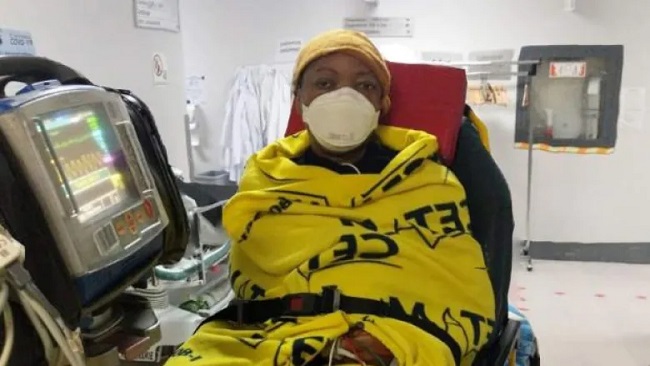
The Quebec coroner is investigating the death of Mireille Ndjomouo, who posted a video on social media two days before she died claiming staff at a hospital on Montreal’s South Shore had ignored her allergies.
Ndjomouo, a 44-year-old single mother of three from Cameroon, posted a video to social media last Sunday.
She repeatedly said staff at Charles-Le Moyne Hospital in Longueuil had treated her with penicillin, even though she said they knew that she was allergic.
In the video, Ndjomouo begged anyone watching to help her get transferred to another hospital.
Ndjomouo repeatedly said in the video that she was having trouble breathing, had pain all through her body and that her stomach was swollen.
She also said she was injected with penicillin over the course of three days.
Ndjomouo said the injections stopped when a nurse noticed that her lips were swollen and said the reaction wasn’t normal.
After seeing the video online, members of the Cameroonian community in Montreal went to the hospital with Ndjomouo’s sister and arranged to have her transferred to the Jewish General Hospital.
Ndjomouo died there on Tuesday. The cause of her death is not yet known.
The regional health authority that oversees the Charles-Le Moyne Hospital, the CISSS de la Montérégie-Centre, told CBC in an email that it can’t comment on the case due to confidentiality, but did say that the quality department is looking into it.
The Jewish General Hospital would not give details about Ndjomouo, citing patient confidentiality.

On Saturday, friends and family of Ndjomouo held a demonstration outside of Charles-Le Moyne Hospital, demanding answers.
“She’s gone, but many questions still remain about what happened to her,” said Christine Ndjomouo, Mireille’s sister.
“I keep hearing her voice saying, ‘Come and save me. Come and save me, they’re going to kill me. I’m all puffed up. Get me out of here.’ That’s what I hear every day since it happened,” she said.
Christine said her sister lost faith in the personnel at the hospital and wanted to leave. She said it took five hours of negotiation before the hospital agreed to transfer her sister.
Friends have started an online fundraiser for the family, to help support Ndjomouo’s children and repatriate her body to Cameroon.
Culled from CBC






















16, March 2021
Return of the god: Ibrahimovic is back in Sweden squad 0
Zlatan Ibrahimovic will return to Sweden’s squad after an almost five-year hiatus to play in World Cup qualifiers at the end of March, head coach Janne Andersson said on Tuesday.
The player, known for his not-so-humble ways, also announced his return himself by posting a picture of himself on Instagram in the Swedish team kit with the caption “The return of the God”.
The 39-year-old AC Milan striker retired from the Swedish squad after the 2016 European Championship after winning 116 caps and scoring 62 international goals.
Media had speculated about Ibrahimovic’s possible return to the national team, but the Swedish Football Association had refused to comment until Tuesday, when he was announced among the players selected for the qualifiers against Georgia on March 25 and Kosovo on March 28, as well as a friendly against Estonia on March 31.
Ibrahimovic has been nursing a muscle injury lately but hopes to return to the pitch on Thursday when Milan face his former club, Manchester United, in the Europa League round of 16.
The Swede has made headlines over the years with cheeky hints that he could be returning to the Swedish team.
But things took a more serious turn last autumn when he told media in the Scandinavian country that he missed playing for the team.
Ibrahimovic and coach Janne Andersson then met for talks.
Without “Ibra”, Sweden reached the 2018 World Cup quarter-finals and qualified directly for Euro 2020, which have been postponed to June-July 2021 due to the Covid-19 pandemic.
Source: AFP