
22, June 2021
Ambazonia War Casualty Report: Southern Zone 0
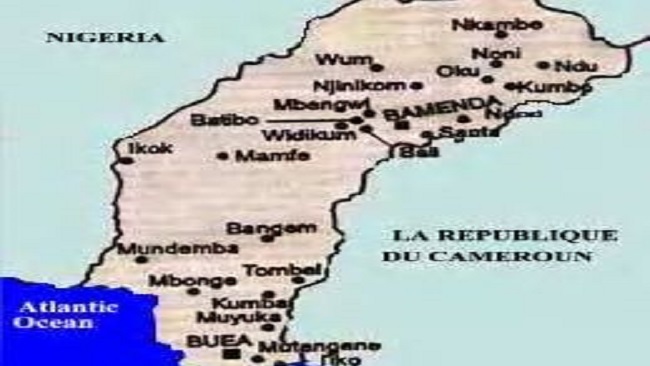
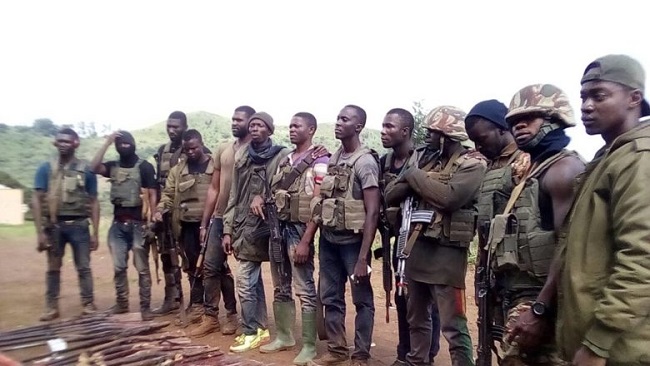
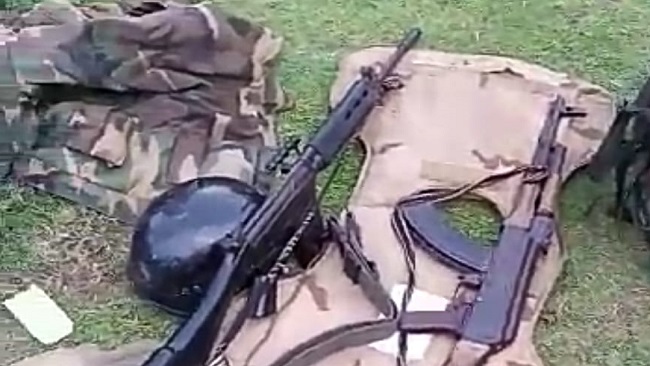
The French Cameroun Senior Divisional Officer for Kupe-Muanenguba, Jean-Marie Tchakui has confirmed the Amba attacks that claimed the lives of two Cameroon government army soldiers and a civil servan in Southwest.
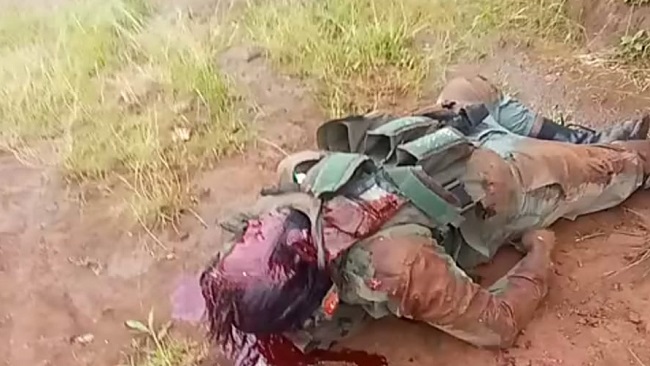
The troops were killed in one incident, in Nguti on Friday, Mr. Jean-Marie Tchakui, told journalists during a press briefing.
“There were three soldiers. Two were killed on the spot,” said Tchakui. “And one was able to escape although he was wounded”,
“Our two soldiers died while on their way back from guarding a factory shut down due to threats by secessionists,” he added.
In the second attack, a delegate from the economy ministry in neighbouring Ndian Division was killed.
“What is certain is that he was murdered. His body was found,” Lawrence Nwafua, Senior Divisional Officer for Ndian Division was quoted as saying during Friday’s situation report.
The War in Ambazonia has already claimed at least 40 000 lives, almost all of them civilian children, men and women, murdered by Cameroun troops in a series of targeted killings, organized massacres, and killings by fire in over 400 villages burnt down to ashes across Ambazonia. Over half a million people have been forcibly displaced as refugees living in various countries and especially in refugee camps in Nigeria. Over another half a million people have become IDPs hiding in forests, caves and hills due to forced displacement. Additionally, over 1.5 million people are facing a humanitarian disaster.
Republique du Cameroun uses not only arson and the destruction of food, livestock, and crops in the fields as weapons of war. It also uses rape. Rape of Ambazonian women and girls by Cameroun government troops is systematic and widespread. This agonizing situation is compounded by the fact that a high percentage of Cameroun troops are HIV positive and also has other STDs. When they rape they infect the women and girls. This appears to be part of the genocide agenda of Cameroun. Reports are now emerging of scores of school girls raped, impregnated and infected by Republique du Cameroun’s troops. This poses a nightmare not only of the HIV and STD infections but also of rampant teenage pregnancies. Cameroun troops have burnt down health facilities and killed health workers in rural and semi-urban areas. Accessing health facilities or health practitioners is a huge challenge for rural and semi-urban folks.
By Chi Prudence Asong

















22, June 2021
WHO to establish first vaccine tech transfer hub in South Africa 0
South Africa will host the continent’s first Covid-19 vaccine production facility, as President Cyril Ramaphosa said Monday Africa now understood that doses would “never come” from elsewhere in time to save lives.
Ramaphosa joined the World Health Organization (WHO) and French President Emmanuel Macron in announcing the new hub for Messenger RNA coronavirus vaccine technology.
But as the project will take time to get off the ground, no vaccines are expected from it until next year.
At tech transfer hubs, the technology is established at industrial scale, while interested manufacturers can receive training and any necessary licences to the technology.
“The ability to manufacture vaccines, medicines and other health-related commodities will help to put Africa on a path to self-determination,” Ramaphosa told a WHO virtual press conference via video-link.
“It’s been shown now that we just cannot continue to rely on vaccines that are made outside of Africa because they never come. They never arrive on time and people continue to die.”
Hub seen as combating inequality
The hub is seen by the Geneva-based WHO as a way to combat the vast inequality in access to vaccines between the world’s wealthiest and poorest nations.
WHO chief scientist Soumya Swaminathan said it could take nine to 12 months before Covid-19 vaccines could be produced in South Africa using tested and approved processes.
Under the tech transfer hub system, the WHO and its partners bring in the production know-how, quality control and necessary licences to enable a rapid roll-out.
At the South African hub, the bio-pharmaceutical company Biovac will act as developer; the Afrigen biotechnology firm will be the manufacturer; and a consortium of universities will provide the scientific know-how.
Messenger RNA genetic technology — as used in the Pfizer-BioNTech and Moderna coronavirus jabs — trains the body to reproduce spike proteins similar to those found on the coronavirus. When exposed to the real virus later, the body recognises the spike proteins and is able to fight them off.
The WHO said it would “continue its assessment of potential mRNA technology donors and will launch subsequent calls for other technologies, such as viral vectors and proteins, in coming months”.
Kate Stegeman of Doctors Without Borders (MSF) said that “Moderna and Pfizer/BioNTech must immediately share their mRNA technology with the hub so that many more mRNA vaccines can be produced independently by manufacturers in South Africa and more broadly on the African continent”.
‘Great day for Africa’
During a visit to South Africa last month, Macron said he was pushing for the faster transfer of technology to allow poorer countries to start manufacturing their own Covid-19 jabs.
It was a “great day for Africa,” said Macron.
“Each continent must be able to develop and produce its own vaccines, its own medicines,” he added.
“Action for global public goods is the fight that this century must uphold and the fight that cannot wait.”
South Africa accounts for more than 35 percent of Africa’s total recorded Covid-19 cases, and is currently suffering a third wave of infections.
South Africa, along with India, has been pushing for a temporary waiver of vaccines’ intellectual property rights in order to speed up production.
More than 2.6 billion doses of Covid-19 vaccines have been injected in at least 216 territories around the world, according to an AFP count.
In the highest-income countries, accounting for 16 percent of the global population, 74 doses have been injected per 100 inhabitants.
Source: AFP