
15, January 2021
Southern Cameroons War: Explosions at Limbe stadium days before Tanzania opener 0
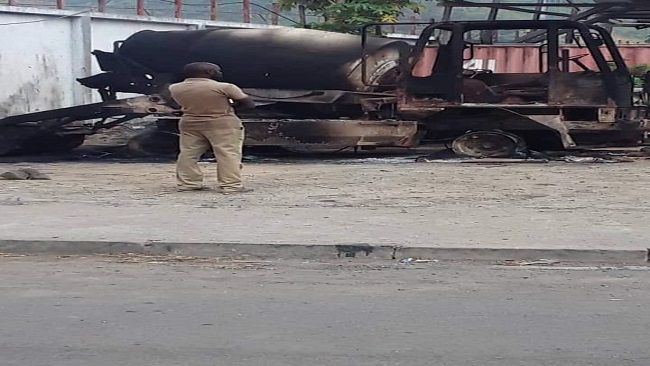
Several vehicles were photographed in flames in an assault that has been reportedly claimed by a group called The Fako Action Forces
Explosions were reported outside the Limbe Omnisport Stadium on Thursday, just two days before the highly anticipated African Nations Championship starts in Cameroon, in an attack apparently linked to a local separatist group.
Heading into the Chan tournament, Cameroon have faced criticism for using a host stadium in the South-West region against a backdrop of local instability.
Zambia, Tanzania, Guinea and Namibia, who are in Group D, are expected to play at the Omnisport Stadium during the tournament, which is reserved for home-based African players. The first game at the stadium is scheduled to be between Tanzania and Zambia next Tuesday.
Although the attack did not have any fatalities, several cars were destroyed, amidst ongoing concerns about the safety of the region due to separatist tensions.
The reported terrorist act was claimed by ‘Fako Action Forces’, according to local source Journal du Cameroon. The explosion reportedly took place on the ‘perimeter’ of the Limbe Stadium, just one of the venues designated to host Chan matches.
Referencing Radio Equinox, Camer Press Agency reported the explosion was caused by a homemade bomb, with the shadow government from the Ambazonia State in Cameroon having released the following reminder and warning in the days preceding the attack.
Images circulating on social media have also appeared to show evidence of the explosion.
Apart from the Group D games, the quarter-finals and semi-finals of the tournament are expected to be held in the volatile region.
Cameroon’s security department has been battling reported insurgents in the region since 2016. Zambia, Uganda, Cameroon and Niger organised a mini-tournament in the host country between January 1 and 7 ahead of the actual competition.
The three visiting nations set up camps since then and are waiting to start their respective Chan campaigns. Cameroon will start the event by playing Zimbabwe at the capital on January 16.
Apart from the Omnisport Stadium in Limbe, other stadiums that will be used are the Ahmadou Ahidjo Stadium in Yaounde which will host Group A games. Group B fixtures will be played at Japoma Stadium in Douala, while Group C participants will be playing at the Douala Reunification Stadium.
Source: Goal.com


















15, January 2021
Football: PSG coach Pochettino positive for Covid-19 after just two weeks in job 0
Paris Saint-Germain boss Mauricio Pochettino has tested positive for Covid-19, the French champions said Friday, just two weeks after taking up his job.
The 48-year-old Argentine will “respect isolation and is subject to the appropriate health protocols”, PSG said on Twitter.
His assistants Jesus Perez and Miguel D’Agostino will take charge of the team for Saturday’s trip to Angers.
Three PSG players had already tested positive for the virus in the last week — Brazilian Rafinha, Germany’s Thilo Kehrer and French youth international Colin Dagba.
Former Tottenham coach Pochettino has overseen three PSG games so far, notably winning the Champions Trophy in Lens on Wednesday thanks to a 2-1 win over bitter rivals Marseille.
Pochettino took over from Thomas Tuchel and signed a contract until June 30, 2022 with an option for an additional year.
Tuchel was sacked on December 24, reportedly for comments viewed as critical of the Qatari owners despite having led the team to a maiden appearance in the Champions League final last season.
Pochettino also played for the Parisians from 2001 to 2003.
France has reeled from more than 2.8 million Covid-19 infections and 69,313 deaths, according to official figures.
From Saturday, a nationwide curfew, starting at 6pm, will be introduced.
Meanwhile, relegation threatened Lorient’s home game against fellow strugglers Dijon was cancelled on Friday after a virus outbreak in the Breton side.
The postponement of Sunday’s game is the first in Ligue 1 since Marseille’s meeting with Nice on November 17 was called off.
“Following advice from the national Covid commission, it was decided to postpone the match due to the absence of more than 10 of 30 Lorient players after positive RT-PCR tests,” the French Football Federation announced.
Under protocols agreed at the beginning of September, matches are postponed if a team does not have 20 players with negative tests available.
Lorient also confirmed their training centre would close for a minimum of 10 days after positive tests from youth players and management.
There are fears the virus may have spread after the Lorient youngsters played a recent friendly against Nantes.
Lorient sit 19th in Ligue 1, are winless in five games, and are two points and one place behind Dijon.
Strasbourg’s match with Saint-Etienne, scheduled for Sunday at the same time as the Lorient v Dijon game, is also under threat of postponement.
Several players and members of the management team at Saint-Etienne have tested positive, said the club.
“The PCR tests carried out Tuesday and Thursday revealed many positive cases for Covid-19 among the players and members of the management of the squad,” said the club in a statement.
Saint-Etienne are currently in 16th place in the table, five points off the drop zone with Strasbourg a place and a point better off.
Source: AFP