

2, May 2021
Southern Cameroons Crisis: Yerima registers for Ambazonia’s Interim Government Vote 0
Southern Cameroons exiled Vice President Dabney Yerima reportedly signaled his intention to continue in his capacity as deputy to President Sisiku Ayuk Tabe and to intensify efforts to defeat Ambazonia’s adversaries and restore calm and security in Southern Cameroons.
Vice President Yerima hinted the Interim Government War Cabinet of his decision to forward his request to the Ambazonia Restoration Council.
Dr Patrick Ayuk, a senior Yerima aide confirmed this and noted that “Just as Vice President Yerima and Southern Cameroons Self Defense Groups have managed to confront French Cameroun occupational forces in the Federal Republic of Ambazonia, each and every Southern Cameroonian should rally behind the Interim Government and resist the French Cameroun regime.”
Dabney Yerima was made Vice President after the disgraced Samuel Ikome Sako and Chris Anu siphoned huge amounts of money contributed by Ambazonians to fund the struggle for independence and Yerima has retained the capacity by winning the hearts of the people of Southern Cameroons.
In a telephone conversation with our correspondent in Holland, Comrade Dabney Yerima said that registering for the Ambazonia Interim Government Vote is simply a process to assure Southern Cameroonians that once we get to Buea, the Interim Government will pass legislation enabling the creation of a multi-party political system in the country.
By Isong Asu
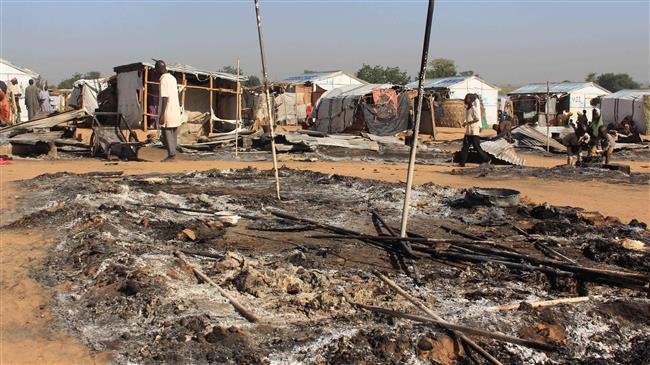
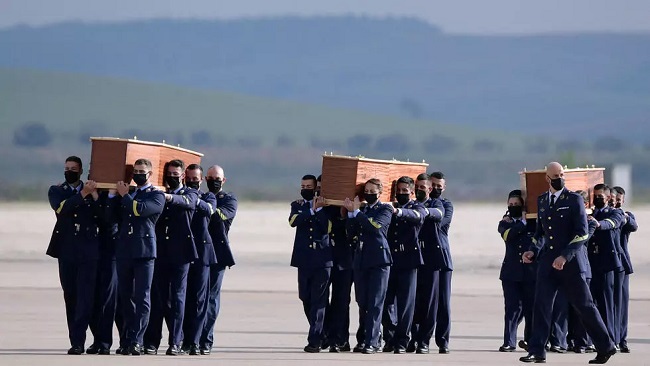

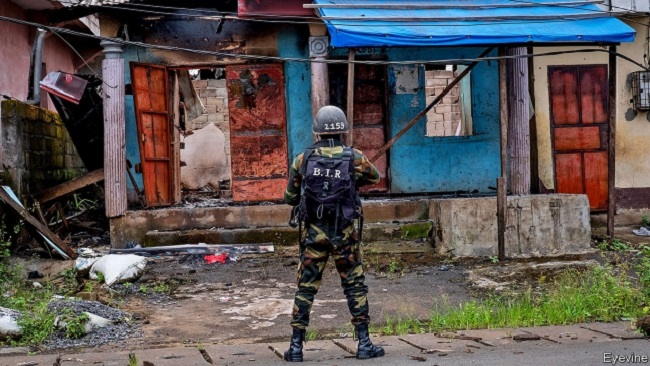
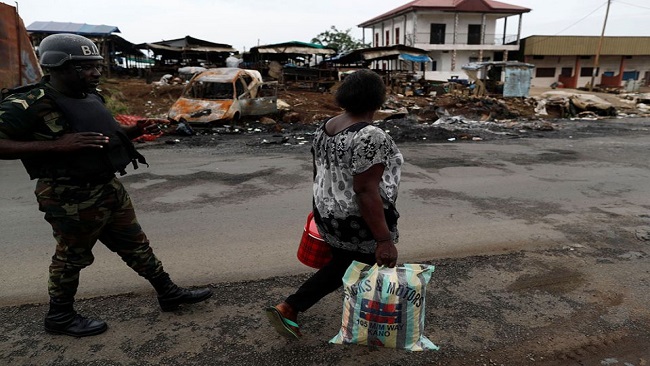
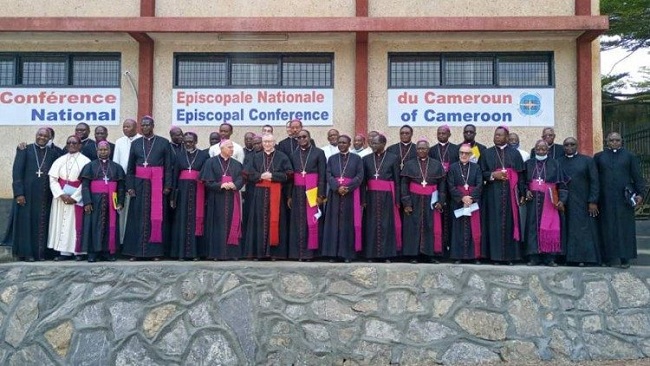
 The conflict had erupted in Cameroon’s Northwest and Southwest regions earlier in 2017 when protests against new government-appointed judges in the regions turned violent. As government forces responded with lethal force, tensions mounted and many English speakers in the predominantly French-speaking country started asking for independence. The ensuing conflict between separatist fighters and government forces has killed at least 3,000 civilians, according to Human Rights Watch. The Internal Displacement Monitoring Centre estimates that at least 460,000 have been forced to flee the affected areas, with tens of thousands seeking refuge in neighboring Nigeria. The Catholic bishops said the government has been too violent in its response to those seeking to form an English-speaking state. Esua said Biya’s 2017 pledge effectively made clear that “anybody who identified himself with the Anglophone cause was considered a terrorist.” After two years of fighting between the two sides, Biya called for a one-week “Major National Dialogue,” held Sept. 30-Oct. 4, 2019. However, the president said the dialogue would not only consider the insurgency but also “issues of national interest such as national unity, national integration and living together.” Bishop George Nkuo, who has headed the Kumbo Diocese in the Northwest Region since 2006, said that approach was wrong because it didn’t address the urgency of the Anglophone problem. Nkuo said the forum should have been used to discuss the Anglophone problem and not all the problems of the nation. He said it was necessary to use that dialogue to revisit the root causes of the conflict as the only possible way of bringing forth a sustainable solution. And the causes of the problem, he said, are rooted in Cameroon history. Initially colonized by Germany in 1884, Cameroon would be divided between Britain and France after the defeat of the Germans in World War I. Britain got one-fifth of the formerly German territory, which it administered as part of Nigeria until 1961 — when through a plebiscite, the British Southern Cameroons (as the British administered entity of Cameroon was then called) voted to reunite with the part formerly administered by France (which had gained its independence in 1960). The two entities went into a federal structure of government, with each entity allowed to freely run its affairs in line with the systems inherited from the colonial powers. But in recent years, some people in the English-speaking regions had accused the central government of trying to quash their traditions.
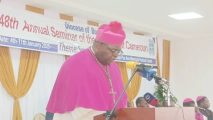
 A view of the Catholic cathedral of Kumbo, in Cameroon’s English-speaking Northwest Region In 2016, four Catholic bishops in the English-speaking regions accused Biya’s government of trying to strangle their culture. “Anglophone Cameroonians are slowly being asphyxiated as every element of their culture is systematically targeted and absorbed into the Francophone Cameroon culture and way of doing things,” they wrote at the time. Nkuo said the 2019 dialogue should have revisited these historical perspectives to come up with the right answers to the problem. The current archbishop of Bamenda, Andrew Nkea Fuanya, criticized the format of the dialogue, saying it didn’t involve the appropriate representatives of the English-speaking regions. “That wasn’t a dialogue at all,” Fuanya told NCR. Esua was invited to participate in the dialogue. “To be frank, it was a monologue,” he said. “In a dialogue, you take two people to dialogue. And in a dialogue, you have different opinions. You have to listen to the other person and the other person listens to you, and gradually you come to an agreement.” “Ninety percent of the participants at the National Dialogue were all government people, or people with government allegiance, but the real persons with whom you had to dialogue were not there,” said Esua. Separatist leaders weren’t part of the dialogue. Sesseku Ayuk Tabe, the recognized leader of the movement to form a new country of Ambazonia, was arrested in 2018 and is now serving a life sentence. “You couldn’t talk of a dialogue if these people weren’t there,” Esua said of the separatist leaders’ absence at the negotiating table. Nevertheless, the dialogue came up with a number of recommendations, including the adoption of a special status for the two Anglophone regions, the immediate relaunch of certain airport and seaport projects in the regions, the rapid integration of ex-combatants into society, and a hastening of decentralization of power away from the central government.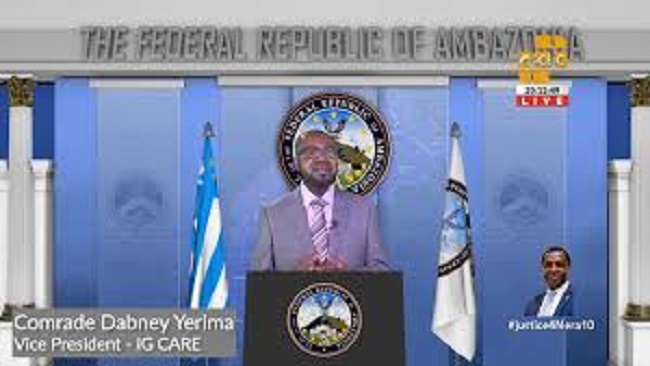










3, May 2021
German police bust darknet child porn network ‘with 400,000 members’ 0
German police said Monday they had shut down “one of the biggest darknet child pornography platforms in the world” and arrested four of its members in a series of raids in mid-April.
The platform, named as “Boystown”, had existed since 2019, counted over 400,000 members and was “set up for the worldwide exchange of child pornography”, federal police said in a statement.
The darknet forum allowed users to communicate with others and share graphic image and video content which included “serious sexual abuse of toddlers”, the statement said.
Three men between the ages of 40 and 64 were arrested in seven raids in Germany, while a further suspect was detained in Paraguay on the request of German authorities.
The suspect in Paraguay’s Concepcion region, also a German citizen, is to be extradited back to Germany on the basis of an international arrest warrant issued by a court in Frankfurt.
Three of the men are accused of having managed the platform as administrators, providing technical support and advice to members on how to avoid being discovered by the authorities, while another was “one of the platform’s most active users”, police said.
Investigators added that the months-long, German-instigated operation had been coordinated by Europol and supported by law enforcement in the Netherlands, Sweden, the United States and Canada.
Both “Boystown” and other chat platforms were taken offline following the raids.
(AFP)