
23, July 2020
China launches first-ever mission to Mars in space race with US 0
China launched its most ambitious Mars mission ever on Thursday in a bold attempt to join the United States in successfully landing a spacecraft on the red planet.
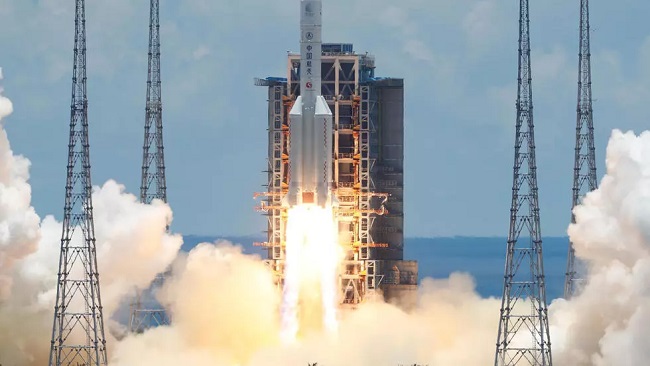
The Tianwen-1 was launched on a Long March-5 carrier rocket from a launch site on Hainan Island.
It marked the second flight to Mars this week, after a United Arab Emirates orbiter blasted off on a rocket from Japan on Monday. And the U.S. is aiming to launch Perseverance, its most sophisticated Mars rover ever, from Cape Canaveral, Florida, next week.
China’s tandem spacecraft — with both an orbiter and a rover — will take seven months to reach Mars, like the others. If all goes well, Tianwen-1, or “quest for heavenly truth,” will look for underground water, if it’s present, as well as evidence of possible ancient life.
This isn’t China’s first attempt at Mars. In 2011, a Chinese orbiter accompanying a Russian mission was lost when the spacecraft failed to get out of Earth’s orbit after launching from Kazakhstan, eventually burning up in the atmosphere.
This time, China is going at it alone. It also is fast-tracking, launching an orbiter and rover on the same mission instead of stringing them out.
China’s secretive space program has developed rapidly in recent decades. Yang Liwei became the first Chinese astronaut in 2003, and last year, Chang’e-4 became the first spacecraft from any country to land on the far side of the moon.
Joining elite club
Conquering Mars would put China in an elite club.
“There is a whole lot of prestige riding on this,” said Dean Cheng, an expert on Chinese aerospace programs at the Heritage Foundation in Washington.
Landing on Mars is notoriously difficult. Only the U.S. has successfully landed a spacecraft on Martian soil, doing it eight times since 1976. NASA’s InSight and Curiosity rovers still operate today. Six other spacecraft are exploring Mars from orbit: three American, two European and one from India.
Unlike the two other Mars missions launching this month, China has tightly controlled information about the program — even withholding any name for its rover. National security concerns led the U.S. to curb cooperation between NASA and China’s space program.
In an article published earlier this month in Nature Astronomy, mission chief engineer Wan Weixing said Tianwen-1 would slip into orbit around Mars in February and look for a landing site on Utopia Planitia — a plain where NASA has detected possible evidence of underground ice. Wan died in May from cancer.
The landing would then be attempted in April or May, according to the article. If all goes well, the 240-kilogram (530-pound) golf cart-sized, solar-powered rover is expected to operate for about three months, and the orbiter for two years.
Though small compared to America’s hulking, car-sized 1,025-kilogram (2,260-pound) Perseverance, it’s almost twice as big as the two rovers China has sent to the moon in 2013 and 2019. Perseverance is expected to operate for at least two years.
Mars-launching season every 26 months
This Mars-launching season — which occurs every 26 months when Earth and Mars are at their closest — is especially busy.
The UAE spacecraft Amal, or Hope, which will orbit Mars but not land, is the Arab world’s first interplanetary mission. NASA’s Perseverance rover is up next.
“At no other time in our history have we seen anything like what is unfolding with these three unique missions to Mars. Each of them is a science and engineering marvel,” the Space Foundation’s chief executive officer Thomas Zelibor said in an online panel discussion earlier this week.
China’s road to Mars hit a few bumps: A Long March-5 rocket, nicknamed “Fat 5” because of its bulky shape, failed to launch earlier this year. The coronavirus pandemic forced scientists to work from home. In March, when instruments needed to be transported from Beijing to Shanghai, three team members drove 12 hours to deliver them.
While China is joining the U.S., Russia and Europe in creating a satellite-based global navigation system, experts say it isn’t trying to overtake the U.S. lead in space exploration.
Instead, Cheng of the Heritage Foundation said China is in a “slow race” with Japan and India to establish itself as Asia’s space power.
Source: AP

























23, July 2020
Asamor’s “Dr. Coro Coro”, An Ode to Human Resilience 0
Music has been one of man’s most trusted companions throughout history. In times of adversity as in times of joy, in tranquility and in excitement, the human soul is always in search of a beat rhythm, or melody to connect with, synchronize and find orientation. It is not strange that in times of uncertainties as the world is facing now due to the COVID-19 pandemic, music becomes one of the most readily available agents used by humans to rationalize the grippling suffering.
Having contracted COVID-19 and gone into quarantine, Germany based Cameroonian artist, Asamor, refused to be beaten by the vermin. He fought against it with all his might and tools at his disposal. He was physically isolated from the rest of humanity. But he kept himself connected through the power of social media with daily updates on his Facebook page. Even while in quarantine, he had already envisioned the day he would emerge victoriously. Thus, he composed the song “Dr. Coro Coro” which was released soon after his recovery to critical acclaim and rave reviews.
The artist holds that the song is meant “to sensitize, sympathize, give courage, and bring joy and comfort to all loved ones during this challenging moment of total lockdown and after.” Indeed, one can only call it “An Ode to Human Resilience”.
Who is Asamor?
Born and raised in Fontem, Lebialem Division of the South West of Cameroon, Asamor’s romance with music began right from childhood. As a prince, he grew up already exposed to many of the traditional music and dance forms of his native Lebialem. In Lebialem, princes and princesses are known for their performance skills. It is then no doubt that Asamor is a consummate dancer and an adept player of various traditional instruments.
Though enrolled at the University of Bonn to study agricultural science, Asamor could not help responding to the musical rhythms hissing within his soul. He listened to his inner muse and began experimenting with a blend of his native Bangwa rhythms and the already established makossa music rhythms. This gave birth to a hybrid form of music that he called Abanda Kossa.
His first album was released in 2002. In 2004, Asamor released his second album which featured the prolific Cameroonian musician Petit Pays in the lead song. This collaboration was ground-breaking because it was the first act that Petit Pays had ever done with any musician other than the members of his Sans Visa band. In 2008 Asamor released his third album and subsequently had a string of singles (five in number) between 2013 and 2018.
Asamor has received the KAMA Award (Germany), the African Diaspora Living Legend Award, and twice voted among the 100 most influential Africans in Germany. Yet, during all those years, Asamor was doing music mostly as a pastime, even as he had returned to school and studied Sound Engineering and opened a recording studio.
Even though Asamor has not released many albums, he still a very prolific music maker. He has a collection of unreleased songs from which he has committed to releasing between three and five songs per annum.
“Dr. Coro Coro” has become an Afrobeat anthem not just for its rhythms but also for the message. He sings about the danger and deadliness of COVID-19, its precautions, and protective measures.
The hundreds of social media impressions and dance sequences inspired by the song are testimony to the profound ways in which the audience has connected with the song. It is a sign that even as COVID-19 seems to have cornered humanity we shall surely emerge the winner.
Written by the manager
Asamor Music