
9, July 2020
German Chancellor Merkel says Covid-19 has exposed the limits of ‘fact-denying populism’ 0
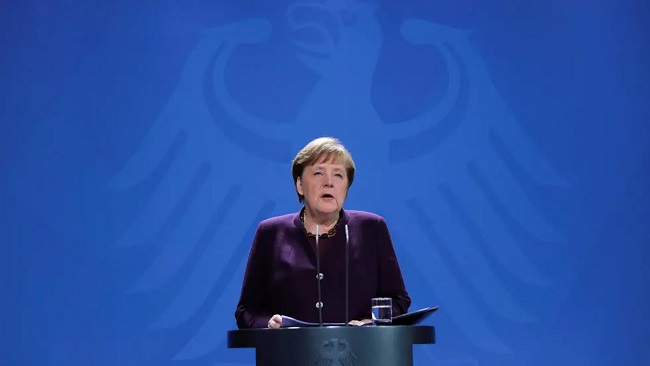
Chancellor Angela Merkel presented Germany’s priorities for its six-month term at the helm of the EU presidency on Wednesday, urging swift action to shore up economies in the wake of the coronavirus pandemic while underscoring that the crisis had exposed the limits of “fact-denying populism”.
The coronavirus pandemic is showing the limits of “fact-denying populism,” German Chancellor Angela Merkel told the European Parliament on Wednesday as she set out her country’s plans for its six-month presidency of the European Union.
Germany took over the task of chairing EU meetings on July 1 and faces the challenge of seeking a compromise on a coronavirus recovery fund for the 27-nation bloc as well as the EU’s budget for the next seven years as the continent faces up to the task of pulling out of a deep recession.
Merkel ‘has no illusions about how tough it will be’
“The depth of the economic decline demands that we hurry,” Merkel told lawmakers. “We must waste no time – only the weakest would suffer from that. I very much hope that we can reach an agreement this summer. That will require a lot of readiness to compromise from all sides – and from you too.”
“We must not be naive: In many member states, opponents of Europe are just waiting to misuse the crisis for their ends,” she said. “We must show them all where the added value of cooperation in the European Union lies. We must show that a return to nationalism means not more, but less control.”
Without explicitly naming any countries or politicians, Merkel pointed to cautionary examples elsewhere.
“We are seeing at the moment that the pandemic can’t be fought with lies and disinformation, and neither can it be with hatred and agitation,” she said.
“Fact-denying populism is being shown its limits,” she added to applause. “In a democracy, facts and transparency are needed. That distinguishes Europe, and Germany will stand up for it during its presidency.”
Merkel and French President Emmanuel Macron in May proposed creating a one-time 500 billion-euro ($563 billion) recovery fund that would be filled through shared EU borrowing. That is a big step for Germany, breaking with its long-standing opposition to any kind of joint borrowing.
The EU’s executive Commission expanded on the proposal, putting forward plans for a 750 billion-euro fund made up mostly of grants. It faces resistance from countries dubbed the “Frugal Four” – Austria, Denmark, the Netherlands and Sweden – that oppose grants and are reluctant to give money away without strings attached.
“It is right and important for the regions particularly hard hit by the crisis, and above all the people who live there, to be able to count on our solidarity,” Merkel said Wednesday. “It is in our very own interests – but at the same time, that also means the effort that is necessary for the good of all must not overburden the economically strong member states in a one-sided way.”
Source: AP


















10, July 2020
French Cameroun: Dion Ngute to open up Camair-Co to private capital in 2021 0
Joseph Dion Ngute, the Prime Minister of Cameroon, has told the Ministry of Finance to open up ailing state-run companies to the capital and management of the private sector next year, the African economic news agency Ecofin reported.
During a special cabinet meeting held to examine the budget and economic plan for the period 2021 to 2023, the prime minister presented guidelines to finance minister Louis-Paul Motazé on the viability of certain public companies in need of fresh financing.
Neither official named the enterprises concerned, but according to the 2019 report of the country’s Technical Commission for the Rehabilitation of Public Enterprises (Commission Technique de Réhabilitation des Entreprises du Secteur Public et Parapublic), a number of companies are in need of private capital and the comparative dynamism that comes with private management.
The report named Camair-Co (QC, Douala) as being one of them, alongside the National Refining Company (Sonara), the Cameroon Aluminium Company (Alucam), chemicals giant Cicam, the Chantier Naval shipyards, and the national telecommunications and postal services.
The prime minister instructed the finance minister to prioritise partnerships “by identifying those public enterprises whose capital can be opened to the private sector to relieve the public treasury and increase their performance,” a statement released after the meeting said.
Presenting the main points of the 2021-2023 plan before the parliamentary budget committee on July 5, Motazé explained that to remedy the unsustainable outflow of state revenue and avoid over-indebting the country, “public enterprises may be subject to measures aimed at improving their productivity and profitability,” as this would “help the state to increase its budget revenue, improve its job provision performance, and boost economic activity in the sectors in which these enterprises operate.”
Source: Ch-aviation.com