
1, July 2020
Germany assumes EU presidency as Merkel pushes for massive bloc-wide recovery plan 0
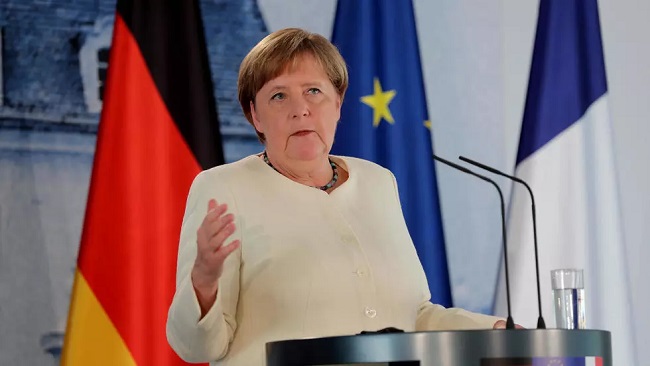
Germany takes over the European Union’s six-month presidency Wednesday, with outgoing Chancellor Angela Merkel staking her legacy on a massive economic recovery plan to help the bloc cope with the coronavirus fallout.
Merkel’s last major role on the international stage comes as the 27-member club faces its deepest recession since World War II, triggered by a pandemic that has killed more than 500,000 people globally.
The crisis has galvanised Europe’s most powerful leader who, with just over a year left in her final term, has ditched her usual wait-and-see approach to call for “extraordinary measures” to weather the storm.
“Europe’s future is our future,” Merkel said Monday as she stood beside French President Emmanuel Macron to push for a 750-billion-euro ($843 billion) coronavirus recovery fund.
The proposed fund would controversially be financed through shared EU borrowing and marks a stunning U-turn for Germany after years of opposition to debt pooling.
The EU’s rotating presidency is Merkel’s “last chance” to make her mark as one of Europe’s great leaders, Der Spiegel weekly wrote, adding that it was time for Germany to shoulder more responsibility as the bloc’s biggest nation and top economy.
“For years the chancellor put off dealing with the chronic problems of the EU and the euro. Now, towards the end of her political career, she has the opportunity to make up for past mistakes,” Spiegel wrote.
There will be no shortage of challenges to tackle in the months ahead.
Post-Brexit negotiations, a more assertive China, rocky transatlantic ties, climate change and the conflicts in Libya and Syria will all be jostling for attention, even if the pandemic promises to dominate the agenda.
‘Extraordinary solidarity’
Germany kicked off its EU custodianship by projecting the words “Together for Europe’s recovery” onto Berlin’s iconic Brandenburg Gate late Tuesday.
After 15 years in office, Merkel is the bloc’s longest-serving leader and held the EU presidency once before, in 2007.
But the stakes are higher this time.
A first major test will come at a July 17-18 EU summit, where Merkel hopes leaders will reach an agreement on the 750-billion-euro rescue fund put forward by European Commission president Ursula von der Leyen — Merkel’s former defence minister.
The money is expected to come mainly in the form of grants for countries hardest hit by the pandemic, such as debt-laden Italy and Spain.
But so-called frugal nations including Austria and the Netherlands want to reign in the spending and are insisting on loans rather than grants.
Merkel has urged holdout nations to “engage in an extraordinary act of solidarity”, warning that an uneven recovery could undermine the EU single market and end up harming stronger economies too.
“We hope we can find a solution, even if the road is still long,” Merkel said at the press conference alongside Macron.
Brexit warning
The fund is based on an idea unveiled by the French-German duo in May, in which the European Commission would raise money on the financial markets to help pay for the post-pandemic recovery in poorer member states.
If accepted, the rescue fund would be a milestone for EU unity.
It would also be a big win for Berlin, and could ease some of the lingering resentment from the eurozone debt crisis a decade ago when Merkel’s government insisted on harsh austerity for struggling nations like Greece.
Another contentious issue that could define Germany’s EU presidency is Brexit.
After weeks of standstill, Britain and the EU have resumed negotiations about the country’s divorce deal with the bloc — which could still result in a hard Brexit at the end of the year.
In an interview with several newspapers last week, Merkel warned that Britain would “have to live with the consequences” of having weaker economic ties with the EU.
Source: AFP














1, July 2020
UN adopts resolution calling for pandemic-related halt to conflicts 0
The UN Security Council on Wednesday unanimously adopted a resolution calling for a halt to conflicts to facilitate the fight against the COVID-19 pandemic, after more than three months of painstaking negotiations, diplomats said.
The resolution, drafted by France and Tunisia, calls for “an immediate cessation of hostilities in all situations” on the Security Council’s agenda.
It is the Security Council’s first statement on the pandemic and its first real action since the outbreak started.
Tunisia’s ambassador to the UN, Kais Kabtani, hailed it as a “historic achievement” but experts questioned whether the text would have any impact and say the paralysis undermined the Council’s credibility.
Repeatedly blocked by China and the United States, which opposed a reference in the text to the World Health Organization (WHO), the resolution aims to support an appeal in March by UN Secretary General Antonio Guterres for a global ceasefire.
It “calls upon all parties to armed conflicts to engage immediately in a durable humanitarian pause for at least 90 consecutive days, in order to enable the safe, unhindered and sustained delivery of humanitarian assistance.”
Fighting against jidhadist insurgent groups is excluded.
The new text makes no reference to WHO, which the US has criticized for its management of the crisis. Washington opposed any mention of WHO back in May.
The body’s paralysis for more than three months has been widely criticized, including by some members who have described their “shame” over its inaction.
During the negotiations, the United States and China, the two largest financial contributors to the UN, had both threatened to veto resolutions.
According to diplomats, Indonesia, a non-permanent member of the Security Council, helped broker a compromise that saw a reference to a General Assembly commitment to supporting the World Health Organization added to the preamble.
The vague reference was deemed satisfactory to China, which wanted to emphasize the importance of WHO, and the US, which broke away from the UN body over its handling of the pandemic.
On Thursday, Guterres welcomed the fact that his ceasefire request was supported by nearly 180 countries and more than 20 armed groups, but he acknowledged that it had not been followed up with concrete action.
“It seems unlikely that the ceasefire call will actually have much impact in many war zones,” said Richard Gowan of the International Crisis Group think-tank.
“The Council missed the opportunity to boost the Secretary-General’s Global Ceasefire in April or May, when a resolution could have made a significant difference.
“This feels like a belated face-saving device following months of difficult diplomacy,” he added.
A second meeting on the pandemic is scheduled for Thursday.
Source: AFP