13, December 2023
Developing Countries Paid Record $443.5 Billion on Public Debt in 2022 0
Amid the biggest surge in global interest rates in four decades, developing countries spent a record $443.5 billion to service their external public and publicly guaranteed debt in 2022, the World Bank’s latest International Debt Report shows. The increase in costs shifted scarce resources away from critical needs such as health, education, and the environment.
Debt-service payments—which include principal and interest—increased by 5 percent over the previous year for all developing countries. The 75 countries eligible to borrow from the World Bank’s International Development Association (IDA)—which supports the poorest countries—paid a record $88.9 billion in debt-servicing costs in 2022. Over the past decade, interest payments by these countries have quadrupled, to an all-time high of $23.6 billion in 2022. Overall debt-servicing costs for the 24 poorest countries are expected to balloon in 2023 and 2024—by as much as 39 percent, the report finds.
“Record debt levels and high interest rates have set many countries on a path to crisis,” said Indermit Gill, the World Bank Group’s Chief Economist and Senior Vice President. ‘Every quarter that interest rates stay high results in more developing countries becoming distressed—and facing the difficult choice of servicing their public debts or investing in public health, education, and infrastructure. The situation warrants quick and coordinated action by debtor governments, private and official creditors, and multilateral financial institutions—more transparency, better debt sustainability tools, and swifter restructuring arrangements. The alternative is another lost decade.’’
Surging interest rates have intensified debt vulnerabilities in all developing countries. In the past three years alone, there have been 18 sovereign defaults in 10 developing countries—greater than the number recorded in all of the previous two decades. Today, about 60 percent of low-income countries are at high risk of debt distress or already in it.
Interest payments consume an increasingly large share of low-income countries’ export, the report finds. More than a third of their external debt, moreover, involves variable interest rates that could rise suddenly. Many of these countries face an additional burden: the accumulated principal, interest, and fees they incurred for the privilege of debt-service suspension under the G-20’s Debt Service Suspension Initiative (DSSI). The stronger US dollar is adding to their difficulties, making it even more expensive for countries to make payments. Under the circumstances, a further rise in interest rates or a sharp drop in export earnings could push them over the edge.
As debt-servicing costs have climbed, new financing options for developing countries have dwindled. In 2022, new external loan commitments to public and publicly guaranteed entities in these countries dropped by 23% to $371 billion—the lowest level in a decade. Private creditors largely abstained from developing countries, receiving $185 billion more in principal repayments than they disbursed in loans.
That marked the first time since 2015 that private creditors have received more funds than they put into developing countries. New bonds issued by all developing countries in international markets dropped by more than half from 2021 to 2022, and issuances by low-income countries fell by more than three-quarters. New bond issuance by IDA-eligible countries fell by more than three-quarters to US$3.1 billion.
With financing from private creditors drying up, the World Bank and other multilateral development banks stepped in to help close the gap. Multilateral creditors provided $115 billion in new low-cost financing for developing countries in 2022, nearly half of which came from the World Bank. Through IDA, the World Bank provided $16.9 billion more in new financing for these countries than it received in principal repayments—nearly three times the comparable number a decade ago. In addition, the World Bank disbursed $6.1 billion in grants to these countries, three times the amount in 2012.
The latest International Debt Report marks the publication’s 50th anniversary. It highlights key insights from the World Bank’s International Debt Statistics database—the most comprehensive and transparent source of external debt data of developing countries. The new edition also features an expanded analytical framework, one that goes beyond the latest data to examine near-term outlook for debt as well. It also includes an overview of the Bank’s debt-related activities and an analysis of emerging trends in debt management and transparency.
“Knowing what a country owes and to whom is essential for better debt management and sustainability,” said Haishan Fu, Chief Statistician of the World Bank and Director of the World Bank’s Development Data Group. “The first step in avoiding a crisis is having a clear picture of the challenge. And when problems arise, clear data can guide debt restructuring efforts to get a country back on track towards economic stability and growth. Debt transparency is the key to sustainable public borrowing and accountable, rules-based lending practices which are so vital to ending poverty on a livable planet.”
The report notes that IDA-eligible countries have spent the last decade adding to their debt at a pace that exceeds their economic growth—a red flag for their prospects in the coming years. In 2022, the combined external debt stock of IDA-eligible countries hit a record US$1.1 trillion—more than double the 2012 level. From 2012 through 2022, IDA-eligible countries increased their external debt by 134%, outstripping the 53% increase they achieved in their gross national income (GNI).


15, December 2023
Cocoa price surge boosts incomes of Cameroon’s farmers 0
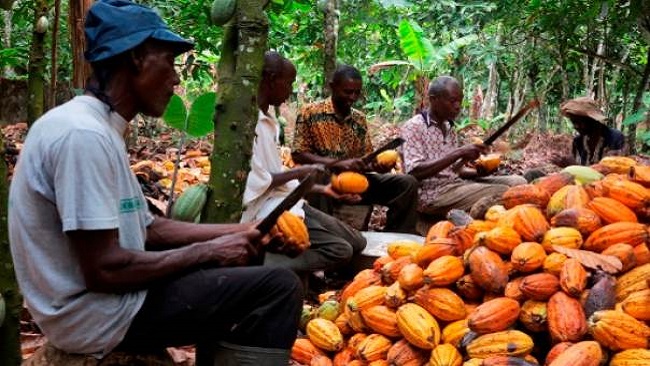
A sharp rise in the price paid for cocoa beans has boosted the incomes of farmers in Cameroon as top global producers Ivory Coast and Ghana suffer a supply shortage this season.
Several farmers told Reuters that they have been selling their beans at prices ranging from 2,000 to 2,200 CFA francs ($3.67) per kilogram, up from 750 to 1,290 CFA francs/kg last season.
New York cocoa futures rose to a 46-year high on Monday as crop problems in West Africa tightened global supplies. Ghana cocoa port arrivals are down around 50% year-on-year so far this season, while Ivory Coast’s are down more than 35%.
Cameroon is not expecting a similar drop in production. It targets around 300,000 metric tons of cocoa annually, making it the world’s fourth biggest producer in recent years.
“I have made much more money from cocoa sales, which has enabled me to clear an overdue loan,” said Susan Itoe, a cocoa farmer near Konye in the South West region.
Cameroon’s guaranteed cocoa farmgate price for the 2023/24 season was set at 1,500 CFA francs/kg. But the actual prices paid to farmers are flexible depending on the market and have risen even higher.
In Ivory Coast and Ghana, by contrast, prices are fixed for the entire season.
“Cameroon is benefiting from the malaise of Ghana and Ivory Coast following flooding and cocoa swollen shoot virus,” said Epie Promise Ngolepie, a cocoa consultant at agri-tech company Help Farmers Cameroon, who told Reuters that prices were expected to fall by 2025 as production picks up again in West Africa.
The high cost of inputs and high cost of transporting the produce due to bad roads were, however, eroding the gains, he added.
“Price has always been our problem… So this increase is well appreciated especially as we have improved the quality of our cocoa,” said Esapa Patrick Enyong, president of the South West Farmers’ Cooperative Union, which groups thousands of farmers in the country’s largest cocoa production basin.
Cameroon was recently added to Annex ‘C’ of the International Cocoa Agreement, which places it on the list of countries producing fine flavoured cocoa.
The liberalisation of the country’s cocoa trade since the 1990s has also contributed to the higher prices, said Michael Ndoping, General Manager of the National Cocoa and Coffee Board (NCCB).
“All these factors put together make the cocoa trade these days very encouraging and we hope this will last for some time,” Ndoping said.
Source: Reuters