
24, October 2018
Cameroon’s Republican Institutions: How credible are they? 0
When the Southern Cameroonian problem started, the general thinking in East Cameroon was that Anglophones could not change the form of the state without following the proper procedure which implied that the country’s so-called republican institutions must be used.
The Southern Cameroons problem was born out of frustration. The government, in its arrogance, had forgotten that the English-speaking minority had its own culture which needed to be respected. The government’s failure to get it right for half a century resulted in strikes by teachers and lawyers which, unfortunately, snowballed to become a civil war that has consumed more than 3,000 lives.
For long, the Yaounde government stayed mute about the gruesome film that was playing out in the two English-speaking regions. In the president’s mind, those who had protested and finally taken up arms were terrorists who had to be neutralized and dealt with according to the “law”. The Yaounde government has always believed that all issues must be dealt with militarily. It holds that killing a few citizens will intimidate the population into silence.
Unfortunately, it had not had the full extent of the frustration of the English-speaking minority. A lot had transpired over the last three decades that the Yaounde government had not noticed. The Southern Cameroons Diaspora had grown in number and many of its members had become wealthy and could help those on the ground to give the government a run for its money.
At its height, the Southern Cameroons crisis had become a millstone around the necks of the country’s politicians. Many questioned the government’s ominous silence. Their concerns had grown exponentially as many young Cameroonians were being mowed down by their own government. They felt that the conflict was unnecessary and could have been averted through inclusive dialogue, as urged by the international community.
It was on this ground that parliamentarians of the Social Democratic Front (SDF), the country’s leading opposition party, felt that it would be immoral and unethical for them to continue looking the other way while other Cameroonians were being slaughtered by a government whose conflict resolution tool of choice is the gun. They therefore decided to take the matter to the parliament where they thought the problem could be laid to rest once and for all.
But ruling party parliamentarians and their allies made sure the crisis was never discussed at the parliament. Despite efforts by SDF parliamentarians to force their way, they were unfortunately pushed to the wall by a government whose objective has never been to address the crisis using the country’s so-called republican institutions.
While the lower house had proven that it was not independent enough and could not address an issue that was putting the country in the spotlight for all the wrong reasons, the upper house, the Senate, for its part, also refused to address this issue that has made its way to the global political arena as Southern Cameroonians across the globe worked very hard to influence global public opinion.
The Southern Cameroons crisis has not only proven that the government is ineffective and its objective is not to improve upon the people’s well-being, it has also proven that the country’s so-called republican institutions are toothless bulldogs that are being used and misused by the executive branch of the government for its personal purpose.
Of course, many French-speaking Cameroonians felt at the time Southern Cameroonians could still take their issues to the parliament even when the parliament was refusing to act. The parliament is supposed to be the place wherein the people’s problems should addressed, but in Cameroon, this august institution is simply there to do one person’s bidding.
French-speaking Cameroonians will, however, come to realize that their faith in their institutions was totally misplaced. They had lambasted Southern Cameroonians for choosing the war path without seeking to know why. They simply failed to understand that nobody in his right mind will prefer war to peace. They had refused to look into the mirror of history to understand that most human disasters are usually manufactured by politicians and the arrogance and power of these politician are usually to blame for the collapse of law and order in any country.
If the killings in Southern Cameroons could not change the minds of French-speaking Cameroonians, something else would. It was just a matter of time for them to realize that their country’s institutions were designed to meet the needs of their leader. Southern Cameroonians have taken the heat for two years and they have proven to the world that when a people is determined to liberate itself from the yoke of dictatorship, it will stop at nothing to achieve that goal. With their hunting rifles, the fighters have given the government a true run for its money.
It is estimated that some 1,300 army soldiers have met their death in the jungles of Southern Cameroons and the number is growing by the day. Southern Cameroonian fighters, who are supported by the Diaspora, have clearly sent home a message to whoever wants to hear. The fighting in that part of the country will never be won through the barrel of the gun, but through dialogue; genuine and inclusive dialogue that will create the right atmosphere for peaceful co-existence.
Today, French-speaking Cameroonians know that they have nominal republican institutions. They know that going to those institutions to seek redress is a sheer waste of time. The 2018 presidential election has simply come to underscore that true political change will not come through those hollow paper tigers in the name of institutions that are being run to make a single person more important than the nation.
Right from the beginning, it was clear that beating the incumbent through the ballot box will be a Herculean task. The electoral code is beautifully written to ensure that the incumbent is maintained in power. Even the election organizing body, ELECAM, is replete with members of the ruling party and this makes it hard for real impartial elections to be held in a country like Cameroon that lacks basic infrastructure.
ELECAM is just another wing of the ruling CPDM (Cameroon People’s Democratic Movement), a party considered by many Cameroonians are a crime syndicate due to the type of people who are its members. This party’s membership comprises ex-convicts, hardened criminals, murderers, business-people evading taxes, people who are seeking protection against the population they have exploited and embezzlers.
ELECAM, by its very nature, cannot organize free and fair elections in Cameroon and this explains why there were many irregularities in this year’s presidential election, a fact recognized by the American government which clearly indicated in its congratulatory message to the contested winner of the rigged poll.
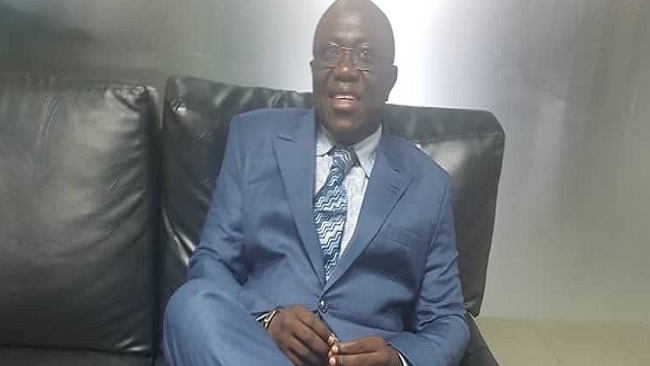
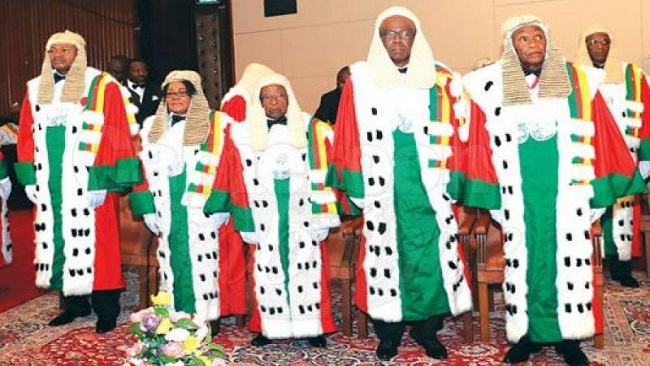
But the greatest drama that actually exposed the ineffectiveness of Cameroon’s so-called “republican” institutions played out in the Constitutional Council whose members were all members of the ruling party. The president of the Constitutional Council, Clement Atangana, a retired Supreme Court judge, who was struggling with life while on retirement, had clearly indicated that he was there to serve the president’s interest. His appointment was indeed a resuscitation for him as this could be seen in a video in which he was rejoicing after hearing the “good news”. Of course he knew from the beginning that one good turn deserved another and this was obvious during the Constitutional Council’s deliberations.
Other members of the Constitutional Council who did not inspire hope were Florence Arrey, a long-time girlfriend of the country’s justice minister, Laurent Esso; Foumane Akame, a one-time minster under Mr. Biya whose wife is also a ruling party parliamentarian; Joseph-Marie Bipoum woum who was also a minster under the current president; Paul Nchoji Nkwi also a former minister and Jean-Baptiste Baskouda who has also served under the same president.
The Constitutional Council, whose decision is final and irreducible, had been set up to ensure the incumbent stayed in power. Despite attempts by the opposition during post-electoral fraud hearings in Yaounde to have the Constitutional Council members to recuse themselves because of several conflicts of interest, their appeals clearly fell on deaf ears. Members of this body are eternally indebted to the country’s president who is mockingly known by the public as the “monarch” for his haughty attitude and incompetence.
Not only was that application thrown out by the Constitutional Council for lack of any law to support the opposition’s claim of conflict of interest, all other applications by the opposition were also thrown out after a five-day deliberation. The presidential poll results that had been making the rounds on social media two weeks prior to the proclamation of the results by the Constitutional Council were simply confirmed and Mr. Biya who has been in power for 36 years, will be in power again for seven more years; a time many Cameroonians believe will bring more death and destruction to a country that is not only at war, but gradually heading to the bottom of the abyss.
With the Constitutional Council having delivered its verdict, French-speaking Cameroonians have now come to terms with the fact that they do not have reliable institutions. They now understand that Southern Cameroonians were not wrong when they showed clear contempt for those institutions.
French-speaking Cameroonians have been given a dose of their own medicine and many of them are incapable of swallowing it. They have been grumbling, but that is all they can do as they are not made of the stuff that makes brave people. The presidential election was not only a test of their institutions, it was also a trial of the oral bravery and intellectualism that they have been professing over the last two years.
Prof. Kamto might have won the election on paper, but Mr. Biya will be at the Unity Palace for seven more years as French-speaking Cameroonians lick their wounds and accept their tag of cowards. Cameroon’s “republican institutions” are, at best, talking workshops. They have been designed to keep the monarch in power and anybody who holds that issues in Cameroon will be addressed by those institutions is simply living in the past. The truth is out and Cameroonians must start looking for new ways to address their issues. Their institutions are not for the people. They belong to the ‘monarch’.
By Joachim Arrey, Ph.D
Toronto, Canada

















25, October 2018
Homage to Ambazonia: The battle over language has begun in Cameroon 0
Simon Ngwa is a gentle and polite man, and he apologised to me first for what he was about to say. ‘I’m sorry if this upsets you, but we in Cameroon are very bitter towards Britain,’ he said. ‘As a child, I was taught to look up to the British Crown as a symbol of fair play and the Queen as a guarantor of moral values. But Britain is doing nothing to stop this genocide.’
Mr Ngwa and I had our conversation in a shabby refugee centre in the Nigerian town of Calabar, on Cameroon’s western frontier. Despite his impeccable manners, Mr Ngwa is a wanted man back home in Cameroon. His crime? To have been a member of the Southern Cameroons National Council, a group campaigning for independence for Cameroon’s English-speaking minority.
Compared with Boko Haram, the Niger Delta Avengers and some of the other outlaw crazies rampaging round this corner of West Africa, the council doesn’t sound like a very scary bunch. But right now, standing up for the rights of English-speakers in Francophone Cameroon can get you killed.
Did you even know there were English speakers in Cameroon? Most people don’t. They think of it as a French-speaking place that sends us the odd good football player. I suspect that most Britons are unaware that we even left a colonial footprint there, let alone a forgotten tribe of Anglophiles like Mr Ngwa. All that may be about to change. After half a century as one of Africa’s most stable states, Cameroon is sliding into a vicious, though largely unreported, civil war.
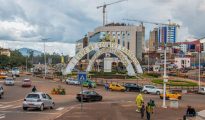
The majority English-speaking South West province capital Buea (Photo: Getty)
On one side are the five million Anglophones. Their region, they say, is under-developed, with all the best jobs in government hogged by French speakers. On the other side, meanwhile, is Cameroon’s strongman, President Paul Biya, who has clung to power since 1982, and who absolutely refuses to countenance any Anglophone demands for a fairer deal. The fissures in ‘La République’ first opened up in 2016, when Anglophones protested against plans to impose French-speaking judges on them. The government responded with a violent crackdown on protestors and the troubles began.
Some of the horrors are carried out by Mr Biya’s feared Battalion d’Intervention Rapide, a US-trained military force known by Anglophones as ‘The Beer’. Others are the work of Anglophone ‘self-defence’ groups, which have sprung up by the dozen in the past year. They’re not armed with much more than machetes, clubs and Dane guns — homemade muskets first brought in by Nordic colonial traders. So usually all they can manage is to kidnap, kill and occasionally behead the odd Beer member. They also organised a widespread Anglophone boycott of the recent presidential elections which did nothing to stop Biya winning again.
So where does Britain come into all this? Speak to any Anglophone activist, and you’ll soon find out. It all goes back to the end of the first world war, when what was then German-run Kamerun was divvied up into a big French chunk and a smaller British chunk, known as British Cameroons.
The latter was brought to life in the writings of Gerald Durrell, who spent much of his time downing gin there with the Fon of Bafut, a bibulous Anglophone chief who helped him collect green-leaf vipers and flying mice.
The British Cameroons ceased to exist in 1961, when there was a referendum and Anglophones had to decide whether to become part of Nigeria or join up with their French brethren. Many wanted self-rule instead, including the Fon, who famously described the referendum as a choice between ‘the Fire and the Deep Sea’. But independence was ruled out by Foreign Office mandarins, who traditionally frowned on plucky little statelets wanting to go it alone.
Times, though, have changed. With Brexit Britain now seen around the world as the champion of the go-it-alone cause, Cameroon’s separatists think they deserve our support. They dream of a breakaway state called Ambazonia, which, they point out, would have the same population as Scotland and even bigger oil reserves. ‘If Scotland can have independence, why can’t we?’ asked Mr Ngwa.
In practice, all Britain is likely to do is join forces with America and France to prod Mr Biya into giving some devolved powers, though he has not shown much interest so far, which is why ‘Ambazonians’ think their only option is to carve out a homeland by force. This plan doesn’t look very promising either, if their military field-craft is anything to go by.
‘Robert’, a fighter with an Anglophone group called the Red Dragons, told me that his unit had relied mainly on magic charms when fighting Mr Biya’s troops. By abstaining from sex and wearing no metal zips or studs in their clothes, they could make themselves bullet-proof, he told me. Then he added: ‘In my first battle, seven of my comrades died. Nearly every time we fight them, they win.’
Still, rather like the impasse in Catalonia, the heavy-handedness of the government response has all but ruled out a return to the status quo. And judging by the way Anglophones now spit out the word ‘La République’, there’s every chance the war will worsen.
True, it’s not yet at the stage of Rwandan-style communal violence. Day to day, Anglophones and Francophones still get on. But it’s hard to see a way back. A younger, internet-mobilised generation wants a better hand than history has dealt it, but Mr Biya, a throwback autocrat, sees compromise as weakness.
And this is one colonial legacy that Britain might feel a prick of conscience about. British student radicals might prefer to concentrate on lobbying Cambridge to return its Benin Bronzes but in Cameroon people are dying because they were lumped half a century ago into a state that didn’t fit them. Where’s the #BiyaMustFall campaign on the campuses? When Mr Ngwa told me how sad he was to be abandoned by the Crown, I couldn’t think of much to say in our defence.
Culled from The Spectator