
3, January 2018
Deaths and detentions as Biya Francophone regime cracks down on Southern Cameroonians 0
Felix Agbor Nkongho looked over his shoulder at a secluded Yaoundé cafe. As a leader of Cameroon’s growing anglophone rights movement, he had reason to be on his guard. A month previously he had been in prison in the capital, waiting to be tried under the country’s new anti-terrorism laws.
A prominent lawyer and activist, if convicted Agbor Nkongho would have faced the death penalty for his part in organising peaceful protests. The arrest of anglophone activists was part of the Cameroonian government’s attempt to quash discontent emanating from its English-speaking regions.

What began as a simple request for English to be used in the courtrooms and public schools of the country’s two anglophone regions has escalated into a crisis in which dozens of people have died, hundreds have been imprisoned and thousands have escaped across the border to Nigeria.
If the situation is not defused through dialogue, the entire country could be destabilised ahead of elections in the autumn, according to the International Crisis Group.
A number of anglophone activists are calling for secession and the creation of a new country, which they want to call Ambazonia.
“The anglophone crisis is the biggest timebomb in Cameroon,” said Agbor Nkongho, who was released by presidential decree seven months after his arrest. “If it’s not addressed, it could break the country.”
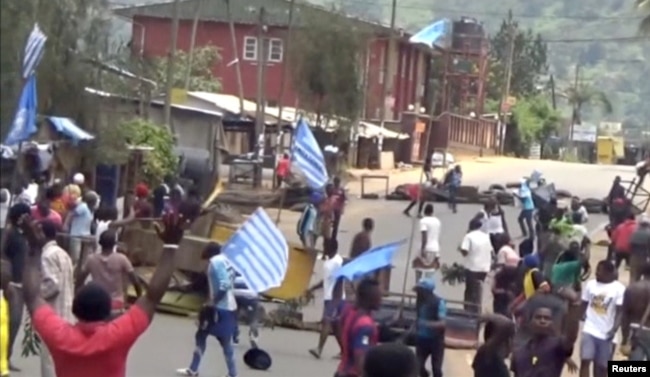
A year ago, after French-speaking staff were appointed to anglophone courts, lawyers in Bamenda, the capital of one of the anglophone regions, took to the streets in protest. They were soon joined by teachers, who said francophones with little English were being hired in their public schools.
“As usual our government, which has no idea how to resolve conflict, turned to repression,” said Ngo Mbe.
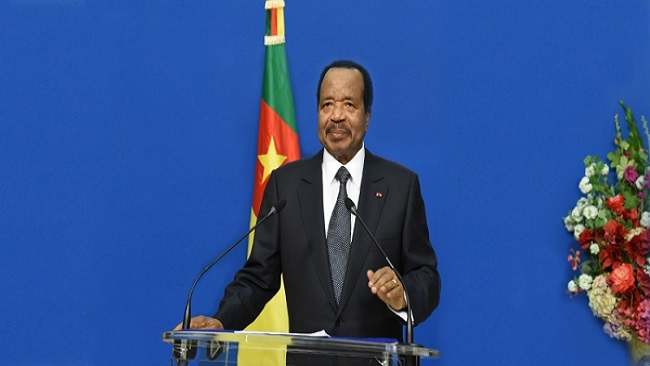
After months of bellicose rhetoric, Cameroon’s long-time president, Paul Biya, appeared to hold out something of an olive branch to the anglophone regions in his new year’s address, saying dialogue was the best way of resolving the crisis and promising to decentralise power so that people could manage their own affairs.
However, he added: “All those who have taken up arms, who perpetrate or encourage violence should be fought relentlessly and held accountable for their crimes,” before congratulating the security forces for their “bravery, determination, restraint and professionalism.”
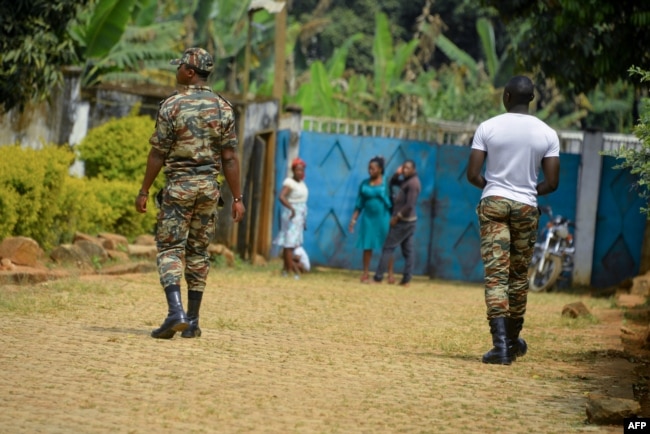
He made no mention of the 40 people killed and 100 injured surrounding the peaceful protests of 1 October, when activists from the Southern Cameroonian United Front symbolically declared the two anglophone regions the independent republic of Ambazonia. The government closed borders to the anglophone regions before deploying the army’s Rapid Intervention Brigade, a unit that is normally found fighting Boko Haram in another of the country’s crises, that of the northern Lake Chad region.
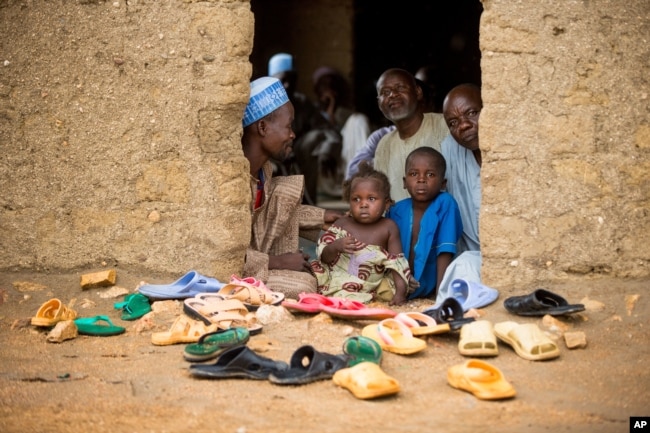
The October crackdown in towns and villages along Cameroon’s border with Nigeria caused at least 7,000 people and possibly as many as 20,000 to flee into Nigeria’s Cross Rivers state, where the UN refugee agency is bracing itself for the arrival of 40,000 more.
“Our fear, however, is that 40,000 people might actually be a conservative figure in a situation where the conflict might continue,” said the agency’s Babar Baloch in a recent briefing.
The latest high-profile figure to be detained, the writer, poet and professor Patrice Nganang, was released last week and repatriated to the US after three weeks behind bars. Police had arrested him at Douala airport shortly after he published an article criticising the government’s handling of the crisis.
Accused of posting a death threat against Biya, Nganang was told he would not get another visa for Cameroon, in effect meaning he would not be allowed to return.
Cameroonian authorities said 10 security officials were killed in November, and announced that four more were killed last week by separatists “using perfidy”.
The UN’s secretary general has called for a halt to the violence and for dialogue, but the opposition accuses 83-year-old Biya, who has been in power since 1982, of not being interested.
In some ways, however, international pressure seems to have had an effect. Two weeks ago Ahmed Abba, a journalist who had been jailed for 10 years for terrorism, had part of his sentence quashed, just as the Commonwealth’s secretary-general, Patricia Scotland, met opposition politicians and representatives of civil society to discuss “moving forward”.
Cameroon has a long history of conquest and subjugation. When the colonial scramble for Africa began, Germany managed to grab what it named Kamerun, but after the first world war the territory was confiscated and the French and British carved it up between them, the French taking the larger part.
At independence in 1961, the UN held a referendum giving anglophone Cameroonians the choice of joining either Nigeria or francophone Cameroon. With no option to become an independent state, they chose their francophone neighbours and together became a federal republic. But the anglophones soon found it was not a marriage of equals.
Talk of an independent Ambazonia has been around since the 1980s but has gained traction in the past few months.
When Agbor Nkongho was released, he found that while he had been in jail the “murderous repression” had led to some anglophone activists on the outside becoming more radical.
Demands for decentralisation of power have been quickly followed by demands for a return to a federal republic, and calls to split from Cameroon. Agbor Nkongho does not think this is a good idea. “We can still live as one; unity in diversity,” he said.
Culled from The Guradian















3, January 2018
Boko Haram says it carried out Christmas attacks in Nigeria 0
A leader of the militant group Boko Haram has released a video claiming it carried out a series of attacks in north-east Nigeria over the Christmas period.
Abubakar Shekau, the head of one of Boko Haram’s three factions, declared the group active and operational a day after the Nigerian president said the militants had been defeated.
“We are in good health and nothing has happened to us,” he said in the video released on Tuesday. “Nigerian troops, police and those creating mischief against us can’t do anything against us, and you will gain nothing.
“We carried out the attacks in Maiduguri, in Gamboru, in Damboa. We carried out all these attacks.”
There has been a surge in violence in recent months, with dozens of people killed in suicide bombings and attacks on military bases in the region. Authorities have put this down to desperate insurgents trying to find food, weapons and ammunition.
Three people were reportedly burned to death on Christmas Day in Molai, a village near Maiduguri, the birthplace of Boko Haram. On Saturday 25 loggers were killed 13 miles from the state capital.
It is unclear to which Gamboru attack Shekau was referring, but he may have meant an ambush of an aid convoy on the Gamboru road in which four people were killed.
His declaration that the self-styled Islamists are alive and well contradicted the Nigerian president’s new year message which was broadcast the day before.
“We have since beaten Boko Haram,” said Muhammadu Buhari. “Isolated attacks still occur, but even the best-policed countries cannot prevent determined criminals from committing terrible acts of terror.”
In mid-December the government announced it was releasing $1bn from its excess oil account to pay for military equipment and training to fight the insurgency. Later it said not all the money would be spent on fighting Boko Haram alone.
Nigeria has recently announced a plan to combat Boko Haram by making villagers living in insecure areas move to garrison towns – although this was in effect how the military operated for most of 2017.
It is unclear how villagers who have always made their living farming, herding and fishing will be expected to survive when they are living on lands not their own and are not permitted to leave.
It is impossible to build up a clear picture of what exactly is happening in north-east Nigeria and across its borders in Cameroon and Chad.
According to a security tracker set up by the Council on Foreign Relations to monitor deaths reported in the media, more than 30,000 people have died in the conflict since May 2011. There are thought to have been large numbers of unreported deaths in inaccessible regions.
For the past two years, the Nigerian government has insisted it is winning or has won the war. According to the Nigerian army’s latest pronouncement, 700 Boko Haram captives recently escaped to Monguno, one of the local government areas of Borno state, after military operations in the region.
Pouring scorn on declarations of his death or capture, Shekau periodically releases video messages aimed at the government, the Nigerian people or a global audience. In the most notorious of these, he paraded the Chibok girls, a group of 300 schoolgirls kidnapped by his men, and vowed he would “sell them in the market”.
Culled from The Guardian