11, February 2018
Ambazonia: Acting President declares ‘era of self defense’ 0
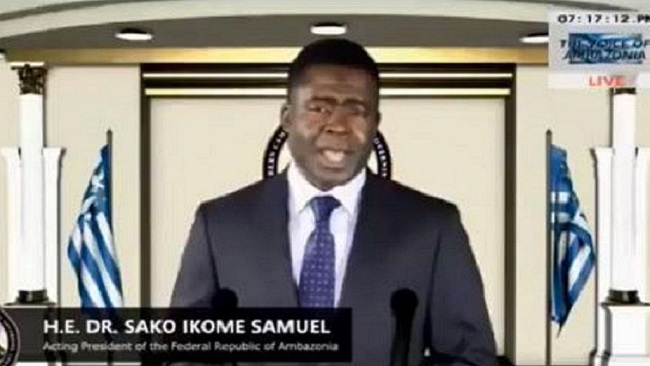
Southern Cameroonians under the ‘Republic of Ambazonia’ have named a new leader in the person of Sako Ikome Samuel.
The new development comes in the wake of the arrest and deportation of Julius Ayuk Tabe, the group’s known leader. Tabe and 46 others were handed over to Cameroon from Nigerian authorities after they were arrested in an Abuja hotel in January 2018.
In his first address to the nation, Ikome Samuel in his capacity as Acting President of the Federal Republic of Ambazonia declared that the movement had now entered an era of individual and communal self defense.
“Now is the era of self-defense. From effective personal self defense to legitimate Ambazonia community protection programs to stop the wanton destruction of lives and our property in Ambazonia.
“We are therefore going to work to accredit and embrace all self defense and security groups that will endorse our IG rules of engagement. I will be reaching out to all in the days ahead,” he stressed in the over 21 minutes address.
He described the stage of the separatist struggle as at a precipice. He blamed the arrest of Tabe and 11 others as a planned effort by Nigeria, Cameroon and the French government. According to him, he will continue to serve British southern Cameroonians against French Cameroon.
Cameroonian authorities in November 2017 issued international arrest warrants for fifteen leaders of the Anglophone separatist consortium known as the Southern Cameroon National Council (SCNC).
According to a local website, the main target was Sisiku Ayuk Tabe who is being held by authorities in Yaounde awaiting trail.
The government accuses the group of being behind rising violence in the northwestern and southwestern regions. The two areas known as ‘Anglophone Cameroon’ has been at the heart of clashes between pro-government forces and secessionists.
According to him, the Ambazonia nation was birthed in October 2017 when the group were met with forces by security elements in a move to declare symbolic independence. Deaths were reported, scores were injured and hundreds others arrested in raids.
An ensuing guerilla style of attacks on security forces – police, soldiers, gendarmes, led President Paul Biya to declare war on the group. Reprisal attacks have led to thousands fleeing the region into the forest and into Nigeria.
The United Nations and Cross River State of Nigeria continue to receive thousands of people streaming into communities. The U.N. refugee agency, UNHCR, says the numbers continue to increase.
Source: Africa News
















12, February 2018
More than 2,200 Filipino citizens in Kuwait seek repatriation 0
The Philippine labor minister says over 2,200 Filipinos are ready to take up an offer by President Rodrigo Duterte to repatriate workers from Kuwait amid reports of abuse.
Silvestre Bello III said on Sunday that almost 500 Filipino workers were due to arrive soon.
“We have been informed that as of Friday there were 2,200-plus Filipinos who are willing to go home,” the minister said.
He added that the government would also help repatriated workers find jobs.
“We are into a re-integration programme, we have a programme in place for them,” Bello said, adding, “They will be given a livelihood.”
“We are now in the process of looking for alternative markets. One of them is China and even Russia,” the minister said, without elaborating.
Bello said some of the Filipinos had overstayed their visas in Kuwait and applied for an amnesty.
The minister also stated that the airlines had arranged free charter flights to facilitate the repatriation.
Duterte asked Philippine Airlines and Cebu Pacific on Friday to provide flights for the Filipinos who wanted to leave Kuwait. The president has said that suspension would remain indefinitely.
A body of a Filipino worker was found in a freezer of an abandoned apartment in Kuwait recently.
Last month, the Philippines suspended sending workers to Kuwait after reports came out that abuse by employers had driven several to suicide.
Kuwait’s Deputy Foreign Minister Khaled al-Jarallah expressed “surprise and sorrow” at Duterte’s remarks in January, saying that legal proceedings had been taken in the four suicide cases mentioned by the president.
The Philippine Foreign Ministry estimates more than 250,000 Filipinos work in Kuwait, most of them as domestic helpers. There are also large numbers in the United Arab Emirates (UAE), Saudi Arabia and Qatar.
Arab monarchies of the Persian Gulf region have come under criticism by international organizations and rights groups due to mistreatment of foreign workers. Millions of poor Asians are working in the Persian Gulf states. Human rights groups say many of the workers suffer exploitation and abuse, including non-payment of wages.
Human Rights Watch and other rights organizations have also slammed mass deportations of migrant workers, which are fairly common in the kingdoms and sheikhdoms, saying they often involve physical abuse and detention in poor conditions.
Last month, a report by the Office of the UN High Commissioner for Human Rights (OHCHR) painted a grim picture of the human rights situation in the UAE, raising concern over the torture of prisoners, injustice against foreign workers and discrimination against women in the Persian Gulf state. The report argued that the justice system in the UAE is complex and impedes migrant workers and the stateless from bringing their grievances to justice.
Reports said in February 2017 that Saudi Arabia had expelled nearly 40,000 Pakistani migrant workers over the past four months.
Official statistics in Saudi Arabia indicate that 243,000 Pakistanis were expelled between 2012-2015.