
10, February 2018
Cameroon’s army denies alleged atrocities in Southern Cameroons 0
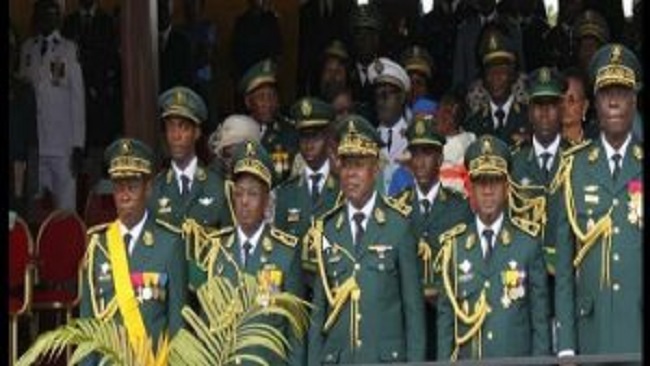
The Cameroonian army on Friday denied its troops were responsible for alleged atrocities against separatists in English-speaking regions after unverified footage apparently involving soldiers was posted online.
“These accusations of atrocities are dreamt up. We are victims of disinformation and fake news,” army spokesperson Colonel Didier Badjeck told AFP, just days after the appearance of the latest of a string of grisly video clips.
None of the clips could be independently verified by AFP, with Badjeck insisting the army had “a culture of respect for human rights” and accusing the separatists of being “skilled at disinformation”.
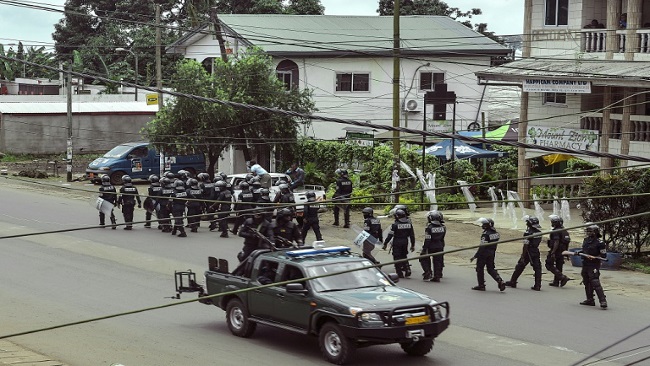
Since October, troops have staged a crackdown targeting activists in Cameroon’s restive western regions where the English-speaking minority has staged protests against the government in this predominantly francophone country.
In the absence of any formal acknowledgement of the toll among separatists, eyewitness accounts of brutality against civilians have proliferated on social media and in parts of the press.
On Wednesday, the European Union condemned the violence in Cameroon, referring to the recent deaths of three members of the security forces and a number of civilians as “unacceptable” and calling on the police and army to exercise restraint.
“It remains crucial for the security forces to be proportionate in their use of force while carrying out their duties,” it said in a statement which followed similar condemnation from the US State Department a day earlier.
But the Cameroon army spokesperson said they were at risk of falling foul of a campaign of disinformation.
“It’s important that the bodies with which we maintain good relations don’t just listen to one side,” he said.
‘We are harassed’
Cameroon’s Northwest and Southwest Regions are home to an anglophone minority that accounts for about a fifth of the country’s population and which has long complained of discrimination at the hands of the French-speaking majority.
In October, separatists issued a symbolic declaration of independence for the putative state of Ambazonia, prompting a crackdown by a government firmly opposed to secession.
Anglophone separatists have responded by escalating their own operations against state institutions. The spiralling violence has forced an estimated 30 000 Cameroonians to flee to neighbouring Nigeria.
Badjeck said a soldier had died on Thursday after being stabbed in the eye with a knife in the main western town of Bamenda, with his death raising the toll among the police and security forces to 23.
“Our soldiers are struck down every day. We are harassed. It may happen that there are reactions on the ground, that a soldier loses his self-control. But it hasn’t happened yet,” he said.
And last weekend, at least four civilians were shot dead by troops during several incidents in the Northwest Region, witnesses said. One told AFP that men “in military uniform came and started smashing up houses.”
Source: AFP

















10, February 2018
N Korea’s leader invites South’s president for visit amid Olympic rapprochement 0
In a major diplomatic overture to Seoul, North Korea’s leader, Kim Jong-un, invites President Moon Jae-in of the South for a visit after senior officials of the two Koreas held rare top-level talks on the sidelines of Winter Olympics.
A spokesman for the presidential Blue House in Seoul said on Saturday that the invitation, delivered verbally by Kim’s visiting sister Kim Yo-jong, expressed the North Korean leader’s willing to meet Moon “at the earliest date possible.”
The South Korean president made a rare appearance in the North’s official media Saturday, with four pictures of him in the Rodong Sinmun state newspaper, AFP reported.
The announcement came after Moon hosted talks with high-ranking North Korean officials, including Kim Yong-nam, the North’s 90-year-old nominal head of state, and the younger sister of the North’s leader, along with other officials at the presidential Blue House in the South Korean capital of Seoul.
The talks, which took place after the opening ceremony of the Pyeongchang Winter Olympics in South Korea, mark the most significant diplomatic encounter between the two countries in years.
The elderly Kim is technically the highest-level Northern official ever to go to the South and the North Korean leader’s sister is the first member of the ruling Kim family to cross the border into the rival South since the end of the 1950 to 53 Korean War.
Bearing a smile, Moon shook hands with each of the delegates ahead of their talks at the presidential palace and as and television footage showed, the 28-year-old Kim was carrying a blue folder emblazoned with a seal.
The South Korean president and the delegation from the North had their first face-to-face encounter at the Olympics opening ceremony on Friday and they cheered as athletes from the two neighbors entered the arena and marched under a unified peninsula flag.
Seoul hopes to use the games as an opportunity to restore regular communication with Pyongyang and resolve the standoff over its missile and nuclear programs.
Moon’s efforts received a boost when Kim called for improved ties in his New Year’s Day speech.
A delegation of US officials led by Vice President Mike Pence also attended the opening ceremony of the Winter Olympics in the South Korean city of Pyeongchang.
Pence, who was seated in the same box, had no interaction with the North Koreans at any point, according to US officials, and the VP did not shake hands with Kim Yong-nam while making a brief appearance at a leaders’ reception ahead of the ceremony.
North Korea’s official KCNA news agency had earlier cited a senior Foreign Ministry official as saying that Pyongyang had “no intention” of meeting with Washington’s officials during the Winter Olympic Games.
The two neighbors have been separated by a heavily-militarized border since the end of Korean War.
The situation on the Korean Peninsula has been tense due to Pyongyang’s development of its nuclear and missile programs, which the North views as a deterrent against potential foreign aggression by the South’s allies, particularly the US.
North Korea has been the target of harsh international sanctions for its military program.
The tensions have seen a sharp rise under US President Donald Trump, who initiated a war of words with the North Korean leader after taking office in January 2017.
Source: Presstv