15, May 2023
US: Cardinal O’Malley ordains first Cameroonian for the Archdiocese of Boston 0
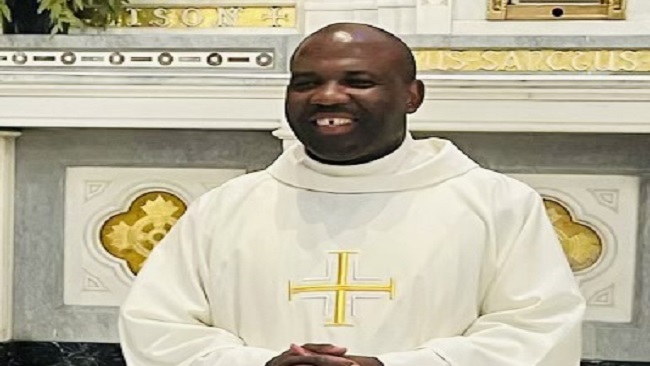
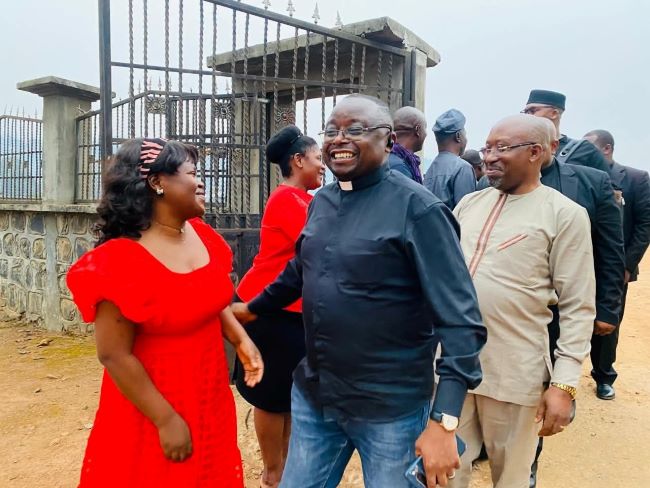
May 13, 2023, Feast of Our Lady of Fatima, was truly a historic day in the life of the Roman Catholic Archdiocese of Boston, USA, as His Eminence, Sean Patrick Cardinal O’Malley, OFM Cap., ordained the first Cameroonian in the person of the Rev. John Tanyi, as transitional deacon for the Archdiocese of Boston. In his homily at the Holy Cathedral of Boston that was filled to capacity especially by the Cameroonian crowd from all over Massachusetts and beyond that came to witness one of their own become a Catholic clergyman, Cardinal Sean paid glowing tribute to the Church in Africa as the most vibrant and growing part of the global Church. Rev. Tanyi’s mother, Mama Angela Bikele Tanyi, had travelled from Tiko, Cameroon, to be present for this history-making event. Other family members likewise travelled from Cameroon, Europe, Canada and other parts of the US, to be present.
Rev. John Tanyi, the Cardinal said, is an embodiment of the vibrant presence of African Catholics in the Archdiocese of Boston. The congregation burst into a sustained applause when the Cardinal reference the vibrant Church in Africa. It was a very moving scene when Rev. Tanyi knelt before Cardinal O’Malley and placing his hands in the hands of the Cardinal, promised obedience to him and his successors. This was preceded by Rev. Tanyi lying prostrate on the Cathedral floor, during which the saints of God, including St. John Paul II and the Uganda Martyrs – both dear to Rev. Tanyi, were invoked to come to the aid of Rev. Tanyi and the others being ordained. Another very moving sight for the Cameroonians present was witnessing Fr. Maurice Agbaw-Ebai vesting Rev. John Tanyi in the vestments of the deacon.
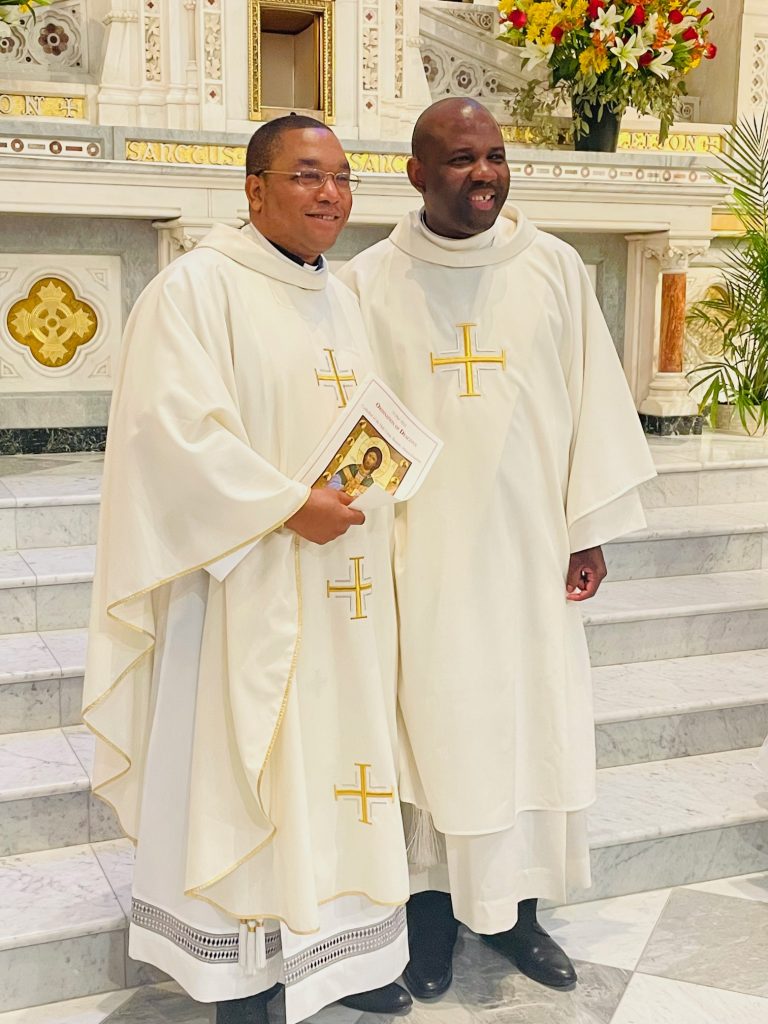
The ordination ceremony was followed by a Thanksgiving Mass and Reception that same Saturday evening at the Ste Anne Parish, Salem MA. Rev. John Tanyi delivered his First Homily as a Deacon at the Mass, in which he paid tribute to his family as his first house of formation. His has been a long road to the priesthood. In Rev. Tanyi’s own words:
“I was born into a large family in the small coastal town of Tiko in Anglophone Cameroon, Central Africa. I was raised in a traditional Catholic family, as my parents were devout Catholics. Papa was a headmaster in Catholic schools for close to fifty years. Mama was a laboratory technician. Attending Mass daily was a given. Mama woke us up at 5am for morning devotion. We would then walk forty-five minutes, praying the rosary, in the wee hours of the morning for Mass. We prayed together before going to bed and mama never got tired of her mantra, “A family that prays together stays together.”
My family was my first seminary since the values and virtues I uphold today originated from that domestic Church. My early attraction to the priesthood stemmed from seeing priests in white and black cassocks in the parish and at school. Mama said at the age of seven, I said to her “One day you will call me Rev. John Tanyi.” Even though we weren’t rich, my parents made tremendous sacrifices to send me to St. Joseph’s College Sasse, one of the elite schools in Anglophone Cameroon, established by the Mill Hill Missionary Society in 1939.
In 2002, I joined the Mill Hill Missionary Society for formation to the missionary priesthood. After a year of basic formation in Cameroon, I was sent to Uganda for philosophical studies in 2003. In 2006, I graduated with a Bachelor of Arts in Philosophy from Uganda Martyrs University, Nkozi. After first cycle formation, I was sent to the coastal region of Kenya for a two-year Missionary Experience Program (MEP). I left the Mill Hill Missionary Society upon completion of the MEP in 2008. After years of studies, I taught politics, international relations, and peace studies at the Catholic University of Eastern Africa and Mount Kenya University, Nairobi (2013-2018). The academic interactions I had with students are priceless. For my sabbatical in 2018, I enrolled for a Master of Arts in Theology and Ministry in Boston College, USA. I graduated with an MA in Theology and Ministry in 2020.
For the last fifteen years, I have been writing and talking about the faith of the Catholic Church. I thought I would serve God through my writings and teaching. But God works in mysterious and strange ways. Since childhood, my desire of becoming a priest has never been quenched. In February 2020, I attended a vocation retreat at Pope Saint John XXIII Seminary. I was touched by Cardinal Seán O’Malley’s perceptive remark that Jesus Christ called second career men for apostles. It was at that point that I decided to return to the seminary. I was admitted into the seminary in 2020 for the Archdiocese of Boston. It wasn’t an entirely easy decision considering the fruitful time I had as a university lecturer.
It has been a wonderful time of formation at Pope St. John XXIII National Seminary. The faculty, fellow seminarians, and people of God have made my desire for the priesthood grow even more. I am about to be ordained to the Transitional Diaconate for the Archdiocese of Boston. I remember with gratitude some great missionaries from the United States who evangelized us in Africa; Fr Jim Kelly, C.S.C., Russell McDougall, C.S.C., Fr. Peter Major, MHM, and Fr. Robert White, SJ. The tide has seemingly turned, as the evangelizers are now becoming the evangelized. The sons and daughters from mission territories like Cameroon are now taking the Gospel to established Christian lands. It will be a great honor for me to serve as a priest of the historic See of Boston.
Pope Saint John Paul the Great has been one of the great influences in my discernment to the priesthood. He was a priest par excellence and my study and writing of him has motivated me to follow in his footsteps to the Lord’s altar. More personally, Fr. Maurice Agbaw-Ebai played a major role in my return to the seminary. His love of Christ and the Church has made a big impact on me. I also cannot overemphasize the impact of the great Irish missionary to Africa, Fr. Anthony Murphy, MHM, on my vocation life. Fr. Murphy served the Church in Africa for over forty years. He was the pastor of my former home parish in Cameroon. On the day I reported to the seminary in Boston in 2020, Fr. Murphy described my vocation story, “John, this is very good news indeed, and I’m delighted for you. You have been circling around your vocation for a long time. You remind me of Francis Thompson’s famous poem, ‘The Hound of Heaven’. Jesus is the ‘hound’: patiently following his chosen one till the latter finally surrenders. Please God all will go well for you now.” I am just about to surrender, in a couple of days, when I will prostrate myself on God’s altar.”
The Cameroon Community of Boston and Ste Anne Parish under the leadership of Dr. Hilary Aroke and Dr. Judith Fokum organized a grand reception following the Thanksgiving Mass at Ste Anne Parish. The Sasse Old Boys spiced the reception, feeling very proud that a SOBAN has cut the ribbon as the First Cameroonian to become a cleric for the Roman Catholic Archdiocese of Boston. The CWA Mamas lived up to their reputation of delivering a great Cameroon cuisine for all present. God willing, and as we continue to pray, next year, Rev. John Tanyi will become a priest for the Roman Catholic Archdiocese of Boston. His ordination motto is taken from the words of St. John Paul II: “When a man says YES to the Lord, his YES is forever”. Let is keep Rev. Tanyi in our prayers, that he will continue to say YES to the Lord like his great mentor, St John Paul the Great.
Bertrand Etukeni Agbaw-Ebai
Cameroon Concord US Bureau Chief














15, May 2023
Measles cases in Cameroon rise to 4677 0
Cameroon’s Ministry of Public Health said on Sunday that measles cases in the country have risen to 4677, with 18 deaths recorded.
“The epidemiological situation of measles is becoming worrisome. A situation explained by inadequate vaccine coverage for the past few years, rising numbers of unvaccinated children resulting in, in part, vaccine hesitancy caused by Covid-19,” the ministry said in a statement.
To avoid the spread of the disease, a national vaccination campaign against measles and rubella will be organized from June 28 to July 2, according to the ministry.
Signs and symptoms include fever, rash, cough, red eyes, and runny nose, said officials, warning that measles complications are severe in malnourished children and infants less than two years of age.
Source: Xinhuanet