21, October 2022
“In Pope Benedict I felt the closeness of God in a way that I cannot fully communicate in words” Fr Agbaw-Ebai Maurice 0
Retired Pope Benedict XVI welcomed Revered Father Maurice Agbaw-Ebai in the Vatican on Thursday making him feel at home and showed great concern for the Catholic community in English speaking Cameroon that is facing difficulties.
Cameroon Concord News understands Fr Maurice Agbaw-Ebai was granted unprecedented access to Pope Benedict with no topic on theology off-limits. This remarkable meeting provided intimate insight into the Benedict XVI Institute for Africa.
Here is the most detailed conversation of Dr Maurice Agbaw-Ebai ever granted to a Cameroonian interviewer.
Cameroon Concord News: Fr Maurice, How did you react to the invitation to meet Pope Benedict XVI?
Fr Maurice Agbaw-Ebai: It was truly a deeply emotional moment for me. Joseph Ratzinger/Benedict XVI has really been the inspiration that has shaped my priesthood. If there is one person that has influenced and shaped me more than any other human being, it has been Benedict XVI. I have prayed for over twenty-one years to have the opportunity to meet with him. I have written over 1 million words on the life and thought of Benedict XVI. To finally meet him in person and spend time with him at his residence at the Vatican is a joy beyond all telling. And I must thank the following persons for this opportunity: Archbishop Andrew F. Nkea, Metropolitan Archbishop of Bamenda, Cameroon, who wrote to Benedict XVI requesting that I be granted an audience. He also personally contacted Benedict’s secretary on my behalf. My friend, George Weigel, the biographer of St. John Paul II, who did the same. And Dr. Christian Schaller of the Papst Benedikt XVI Institute in Regensburg, who too contacted Benedict XVI requesting for an audience for me. I think lots of people who know me prayed for this day. In God’s time, He has made it happen that I meet Benedict in this life. You will see me, and your joy will be complete, says Jesus. I think there is nothing else I want again, besides continuing the task of making the life and theology of Benedict known. I will never forget what he said to me today. My vocation has been confirmed. Being in the presence of Benedict is an experience of Neoplatonic ineffability. You cannot adequately describe it. In Benedict, I felt the closeness of God in a way that I cannot fully communicate or express it in words (Fr Maurice develops wet eyes).

Cameroon Concord News: How was the audience in the Vatican?
Fr Maurice Agbaw-Ebai: Again, it was an experience akin to the Transfiguration. Before going to meet Benedict today, I spent time praying with John 13, for Lectio Divina. It is the encounter of the Lord’s washing Peter’s feet! I knew I was going to meet the Successor of St. Peter. I wanted to immense myself in prayer, so that the Holy Spirit will help me to encounter Peter in Benedict, and by so doing, encounter the Lord who as the Risen One, says to Peter and His Successors, feed my sheep, feed my lamb. The audience was well prepared for. There was a Swiss Guard waiting at the Ste. Anne Gate that drove me and Fr. Blaise Njikang, a priest of Mamfe and a seminarian that worked with me at the Bishop’s House in Mamfe, to the Mater Ecclesiae Monastery, Benedict’s home at the Vatican. When we got there, the Holy Father was expecting us. Archbishop Georg Ganswein ushered us into the Holy Father’s Presence. It was truly moving to be in the presence of Peter’s Successor. You can imagine my thoughts. It was a truly deeply emotional moment for me. In Benedict XVI, I see the Face of Jesus Christ. He was truly happy to receive me. He was profoundly surprised at how much I had written about him. It was a time out of time.
Cameroon Concord News: Did you discuss the Joseph Ratzinger Institutive project for Africa with Benedict?
Fr Maurice Agbaw-Ebai: Yes, I did. And he was very happy with the initiative. In fact, he blessed a Memorial Plaque for the Benedict XVI Institute for Africa, which, following the decision of Archbishop Andrew Nkea of Bamenda, Chancellor of the Catholic University of Cameroon, Bamenda, and President of the Bishops Conference of Cameroon, will become, soon, a Constituent College of the Catholic University of Bamenda, Cameroon. He is very happy with the initiative and was deeply moved by this. He was also impressed by the quality of the Program. The Archbishop of Bamenda will have to do the formal declaration, but it is a great sign of hope for both Church and civil society that Africa now comes to Bamenda and Cameroon, for a theological institute regarding a theologian of a caliber of Joseph Ratzinger/Benedict XVI. I told Benedict that the Church in Africa loves him very much, and that his writings continue to form a generation of very enthusiastic African priests. He was deeply moved to hear that.
The Lord has not forgotten his people in the Ecclesiastical Province of Bamenda, socio-political challenges notwithstanding. The Lord will never abandon his people. That is what history teaches us. God never abandons His people. And I did mention to the Holy Father the kidnapped priests of Mamfe Diocese, my home diocese. That too, deeply moved him, and he promised to pray for them. And I ask the readers of Cameroon Concord to pray for these priests, the nun, the laity and their families, to pray for their release.
Cameroon Concord News: Our readers would like to know if Pope Benedict invoked anything on your book- Light of Reason, Light of Faith Joseph Ratzinger and the German Enlightenment?
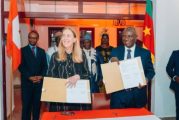
Fr Maurice Agbaw-Ebai: Yes, as you can see from the photos, he was very happy, because Light of Reason is a work dedicated to his inaugural lecture as a professor of theology. So, it made a deep impression to him that someone finally provided a theological engagement at a deeper level about a lecture he delivered in 1959. He was really happy about it.
Cameroon Concord News: Any Last word?
Fr Maurice Agbaw-Ebai: As a child born in Egbekaw New-layout and grew up in Small Mamfe in Mamfe Town, I can only thank God for God’s blessings. I come from a very humble background, growing up and schooling all along in Mamfe town. And when I look back, I feel so grateful to God for all what God has done in my life. And today’s audience with Benedict XVI is a milestone that captures everything about my life and God’s grace. Domine, Non Sum Dignus Est! (Lord, I am not worthy).
By Soter Tarh Agbaw-Ebai


21, October 2022
IMF Update: Estimating Financial and Fiscal Costs of the Global Food Crisis 0
As the global food prices continue to escalate, the International Monetary Fund (IMF) has been updating the world on the crisis playing out in every nook and cranny of the world. Here below is an update of the situation published by the global monetary fund.
Estimating Financial and Fiscal Costs of the Global Food Crisis Against the backdrop of rising global food insecurity, a recent International Monetary Fund (IMF) paper estimated that higher food and fertilizer import prices will add $9 billion in 2022 and 2023 to the balance of payments of the 48 most affected countries.
The war in Ukraine continues to affect food production and distribution amidst a worldwide food crisis already stressed by regional conflicts, climate shocks, and the pandemic. The IMF paper identifies 48 countries, primarily low-income countries in the Sahel and other parts of Sub-Saharan Africa, that are most affected because they face significant import price pressures or have portions of their populations experiencing acute food insecurity, as defined by the World Food Programme (WFP). From a fiscal perspective, the analysis suggests that $5 billion to $7 billion in further spending is needed to assist vulnerable households in these countries.
An additional $50 billion is required to end acute food insecurity over the next 12 months. Although estimating the cost of the food crisis is difficult in terms of data availability and the multiple factors driving price hikes, the report attempts to quantify costs using three approaches: the impact of the terms-of-trade shock on countries facing higher staple and fertilizer prices, the budgetary cost of supporting the poorest households, and the financial cost of eradicating acute food insecurity.
The first approach—approximating $9 billion in foreign exchange needs over 2022/23 for the 48 most affected countries—employs international price changes for five essential cereals and three fertilizers. The price differentials are applied to the latest (September) import volumes assumed to grow proportionately with real gross domestic product and compared to IMF end-of-2021 price forecasts as a baseline scenario. The analysis offers a few caveats, including that it is not assumed that import volumes respond to price changes in the short term but will react over time.
Furthermore, the $9 million in financing linked with higher food and fertilizer prices does not account for other balance-of-payments pressures such as commodity (particularly energy) price changes and rising interest rates on borrowing abroad. The second approach uses the most recent food inflation data to estimate the $5 billion to $7 billion needed to compensate households living on less than $1.90 per capita per day in the 48 countries identified. The methodology assumes 6-month compensation and unchanged household budget allocation for food. The range of total fiscal costs reflects cross-country variation in inflation and represents 0.15 percent to 0.30 percent of gross domestic product. Estimates do not include how other price hikes, such as for fuel for transport and cooking, would need to be factored into increases in social spending.
The third approach applies the WFP’s total annual operational cost of $22.2 billion to support 151.6 million people to the 345 million people now suffering from acute malnutrition or worse to arrive at the $50 billion figure associated with lifting people out of acute food insecurity for 12 months. The IMF report and accompanying blogs highlight that many of the 48 countries affected by the food crisis face several overlapping vulnerabilities and must receive further humanitarian assistance and concessional financing from development partners. Other policy responses include implementing effective public expenditure for emergency relief, facilitating regional trade and reducing food export bans, improving input access for food production and distribution, and investing in climate-smart agriculture.
In South Sudan, the high levels of acute food insecurity are causing a high level of hunger-related deaths as food insecurity reaches emergency (IPC Phase 4) outcomes, with famine (IPC Phase 5) outcomes likely by January 2023, driven by prolonged conflict and recurrent flooding (FEWS NET). A fourth consecutive year of flooding is expected to result in another year of livestock and crop losses as flooding continues based on forecasts for above-average rainfall amid already high river levels and highly saturated soils. Humanitarian food assistance deliveries continue to reach areas of great concern across South Sudan to mitigate widespread acute food insecurity, although they are reaching only 20 percent of people in need.
The Famine Early Warning Systems Network continues to assess a credible famine (IPC Phase 5) scenario given the high proportion of the population likely to face significant food consumption gaps and their vulnerability to new shocks. Fangak and Canal/Pigi are among the areas of most significant concern for this risk of famine (IPC Phase 5). If flood severity exceeds that of 2021 or if conflict intensifies, restricting household movement and humanitarian access, famine could occur. Emergency (IPC Phase 4) reflects an already high level of hunger-related mortality in South Sudan (FEWS NET).
Higher fertilizer prices could decrease cereal production by 16 percent during the 2022 cropping season (WFP). Fertilizer prices more than doubled from their levels a year ago in East Africa within 2 months of the onset of the war in Ukraine. This coincided with the 2022 primary season crop planting, disrupting farming operations. There have also been fertilizer price hikes region-wide, with fuel prices 17 percent to 75 percent higher in April 2022 than a year earlier.
The steepest increases have been observed in Burundi, Ethiopia, Kenya, Somalia, and South Sudan and have limited farmers’ ability to use farm machinery and transport and will further reduce their ability to grow sufficient crops this year. The WFP estimates that cereal production during the 2022 cropping year could be 16 percent lower than in 2021 because of high fertilizer and fuel prices. Total 2022 cereal production will be about 37.8 million tonnes, down from 45.2 million in 2021. The most significant declines in cereal production will be in Ethiopia (21 percent), Kenya (12 percent), and Sudan (12 percent).
Compiled by Alain Agbor Ebot