14, November 2022
US urges Ukraine to consider peace talks with Russia 0
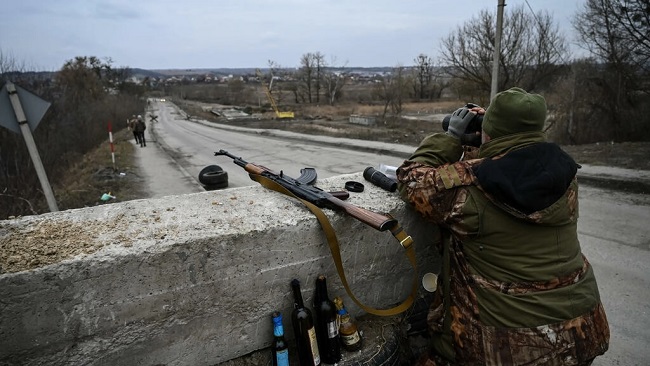
Senior US officials have reportedly begun prodding Kiev to consider peace talks with Moscow, fearing winter may stall its momentum after scoring a key victory in retaking Kherson in the persisting Ukraine war.
Despite continued pledges of support for Ukraine from the US and its allies, “top officials in Washington are beginning to wonder aloud how much more territory can be won by either side and at what cost,” major US daily The Wall Street Journal reported Sunday, noting that some European officials remain “more bullish” on Ukraine’s chances.
Pointing to the looming winter season as well as fears of inflation – impelled by surging energy and food costs, billions of dollars of weaponry already pumped into Ukraine, and the tens of thousands of casualties on both sides – the daily emphasized that top US officials are now talking about “a potential inflection point in the war.”
“There has to be a mutual recognition that military victory, in the true sense of the word, maybe not achievable through military means, therefore you need to turn to other means,” said the Chairman of the US Joint Chiefs of Staff Army Gen. Mark Milley in an address before the Economic Club of New York on Wednesday as quoted in the report. “There’s also an opportunity here, a window of opportunity, for negotiation.”
The US and some of its allies are concerned that their stockpiles of weaponry, including some ammunition, are being depleted at an unsustainable rate, it added, pointing out that US military aid for Ukraine stands at nearly $19 billion so far this year, far outstripping European assistance.
“We are seeing real, practical problems of making military progress, we are seeing shortages of munitions,” said another Western official as quoted in the report.
The prospect that Ukraine won’t make major battlefield gains in the weeks ahead has led the US and some European officials to wonder when public pressure would emerge to demand a settlement, according to the daily.
“We are saying to the Ukrainians that it is up to them to decide when to do it,” said a Western European official, referring to the potential for talks. “But it might be a good idea to do it sooner.”
Source: Presstv





















14, November 2022
Biden tries to ‘manage differences’ with Xi in first face-to-face meeting as president 0
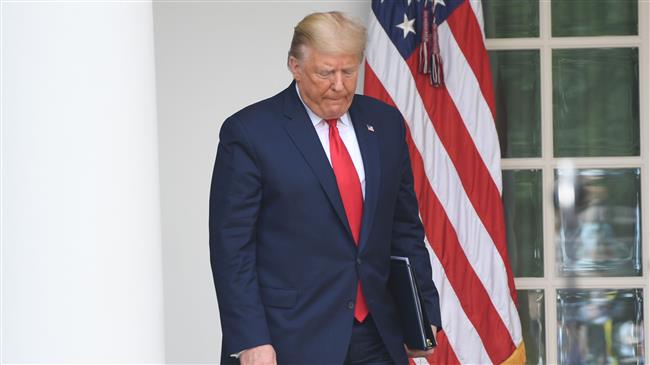
Chinese leader Xi Jinping and U.S. President Joe Biden met on Monday for long-awaited talks that come as relations between their countries are at their lowest in decades, marred by disagreements over a host of issues from Taiwan to trade.
The two, holding their first in-person talks since Biden became president, met on the Indonesian island of Bali ahead of a Group of 20 (G20) summit on Tuesday that is set to be fraught with tension over Russia’s invasion of Ukraine.
They smiled as they shook hands warmly in front of a row of Chinese and U.S. flags in a ballroom at the luxury hotel Mulia on Bali’s Nusa Dua bay.
“It’s just great to see you,” Biden told Xi as he put an arm around him, adding in remarks delivered in front of reporters that he was committed to keeping lines of communication open on a personal and government level.
“As the leaders of our two nations, we share responsibility, in my view, to show that China and the United States can manage our differences, prevent competition from … turning into conflict, and to find ways to work together on urgent global issues that require our mutual cooperation.”
He mentioned climate change and food insecurity as problems the world expected their two countries to address.
Responding to Biden, Xi said the relationship between their two countries was not meeting global expectations.
“So we need to chart the right course for the China-U.S. relationship. We need to find the right direction for the bilateral relationship going forward and elevate the relationship,” Xi said.
“The world expects that China and the United States will properly handle the relationship,” he said, adding he looked forward to working with Biden to bring the relationship back on the right track.
Neither leader wore a mask to ward off COVID though members of their delegations did.
Their main topics of discussion are expected to be Taiwan, Ukraine and North Korea’s nuclear ambitions, issues that will also loom over the G20 that is being held without Russian President Vladimir Putin in attendance.
Russian Foreign Minister Sergei Lavrov will represent Putin at the G20 summit – the first since Russia invaded Ukraine in February – after the Kremlin said Putin was too busy to attend.
Russia’s foreign ministry said a report that Lavrov was taken to hospital after arriving in Bali was fake news.
On Sunday, Biden told Asian leaders in Cambodia that U.S. communication lines with China would stay open to prevent conflict, with tough talks almost certain in the days ahead.
Relations have been roiled in recent years by growing tensions over issues ranging from Hong Kong and Taiwan to the South China Sea, trade practices and U.S. restrictions on Chinese technology.
But U.S. officials said there have been quiet efforts by both Beijing and Washington over the past two months to repair ties.
U.S. Treasury Secretary Janet Yellen told reporters in Bali earlier that the meeting was “intended to stabilise the relationship between the United States and China, and to create a more certain atmosphere for U.S. businesses”.
She said that Biden had been clear with China about national security concerns regarding restrictions on sensitive U.S. technologies and had raised concern about the reliability of Chine supply chains for commodities like minerals.
Nuclear ‘irresponsibility’
Biden and Xi, who have held five phone or video calls since Biden became president in January 2021, last met in person during the Obama administration when Biden was vice president.
Monday’s meeting was unlikely to produce a joint statement, the White House has said.
G20 summit host President Joko Widodo of Indonesia said he hoped the gathering on Tuesday could “deliver concrete partnerships that can help the world in its economic recovery”.
However, one of the main topics at the G20 will be Russia’s war in Ukraine and Biden will be “unapologetic” in his defence of the European nation, U.S. officials said last week.
Xi and Putin have grown increasingly close in recent years, bound by their shared distrust of the West, and reaffirmed their partnership just days before Russia invaded Ukraine. But China has been careful not to provide any direct material support that could trigger Western sanctions against it.
Chinese Premier Li Keqiang emphasised the “irresponsibility” of nuclear threats during the summit in Cambodia, suggesting China was uncomfortable with strategic partner Russia’s nuclear rhetoric, the Biden administration official said.
The West has accused Russia of making irresponsible statements on the possible use of nuclear weapons since its February invasion of Ukraine. Russia has in turn accused the West of “provocative” nuclear rhetoric.
Russia’s Lavrov said on Sunday the West was “militarising” Southeast Asia in a bid to contain Russian and Chinese interests.
Ukrainian President Volodymyr Zelenskiy has said he would address the G20 by videolink on Tuesday.
Source: REUTERS