22, August 2022
Wärtsilä to provide automation upgrade for an iconic power plant in Kribi 0
The technology group Wärtsilä will carry out an upgrading project of the electrical and automation systems to ensure optimal reliability of the Kribi power plant in the Republic of Cameroon. The 216 MW plant has been in operation for nearly ten years, operating with 13 Wärtsilä 50DF dual-fuel engines running primarily on natural gas. At the time of commissioning, it was the largest gas engine power plant in Sub-Saharan Africa. Wärtsilä will also support the customer’s operational and maintenance performance with a 10-year long-term service agreement.
The order with Wärtsilä was placed by Kribi power development company (KPDC), a subsidiary of Globeleq, an independent power producer (IPP) and the owner and operator of power generating facilities across Africa. The order will be booked in Wärtsilä’s order intake in Q3/2022.
“The Kribi power plant has a vital role within the African energy sector. It is still today supplying two-thirds of the thermal energy in Cameroon. Cameroon’s energy system relies heavily on hydropower, but has uncertain resources of water. The Kribi plant, therefore, plays a key role in ensuring a supply of safe, cheap, and reliable energy. For this reason we are keen to upgrade the power plant’s automation systems to the latest design to ensure optimal reliability, and to strengthen our cooperation with Wärtsilä, leveraging their competences on a continuous basis within the framework of the long-term service agreement,” commented Gionata Visconti, Chief Operating Officer, Globeleq.
Wärtsilä has a strong regional presence, which enables us to provide valuable technical support that optimises engine performance and maximises the production capabilities of this power plant which has such a significant role in Cameroon’s power supply. We are also in a position to ensure the availability of critical spare parts, and this is an essential element within the long-term service agreement between our companies. All in all, this is a very important project, both for the customer and for Wärtsilä,” said Markus Ljungkvist, Vice President, Services, Wärtsilä Energy.
The project is scheduled to commence in 2023. To ensure the continuity of the plant’s output, the work will be carried out on one engine at a time. The long-term service agreement includes remote operational support, maintenance planning, technical advisory and remote troubleshooting services, as well as spare parts.
Long-term service agreements are an integral part of Wärtsilä’s lifecycle services offering. They are based on utilisation of the latest digital technologies, and supported by the company’s extensive know-how and understanding of power generation installations.
Wärtsilä has altogether supplied 550 MW of generating capacity to the Republic of Cameroon, and 7.5 GW to the whole of Africa, of which more than 25 per cent are covered by Wärtsilä service agreements.


22, August 2022
Southern Cameroons Crisis: Bamenda where only the coffin trade is booming 0
Once a thriving city in Cameroon, Bamenda has been ripped of its soul by the five-year war between English-speaking secessionists and the mainly French-speaking government.
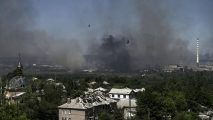
Bamenda is all but dead. Only the coffin trade is booming. Bodies are dumped regularly all over the city – in mortuaries, on streets and in rivers.
Council workers pick them up and give them a pauper’s burial.
“It is a blessing to be buried at all, let alone by family and friends,” says a cemetery worker as he comes to pick up 10 cheap coffins from a funeral parlour.
Demand has dropped for the once-popular elaborately designed coffins – shaped like bibles, cars or beer bottles to reflect the lifestyle, interests or last wishes of the dead.
“Coffins that used to sell for a million CFA francs [about $1,500, £1,270] are out of commission because nobody can afford them. Most people can only afford coffins for 50,000 CFA francs,” says an attendee at a funeral parlour.
The regular funerals for young men and boys are a brutal reminder of the conflict in Cameroon’s English-speaking regions of North-West and South-West.
In just five years, that conflict has claimed tens of thousands of lives, while forcing more than one million to flee to French-speaking areas and a further 80,000 to take refuge in next-door Nigeria.
The war has its roots in grievances that date back to the end of colonialism, when British-controlled territory was unified with French areas to create what is now Cameroon.
Many English-speaking Cameroonians have felt marginalised ever since and have opposed what they see as attempts by the government – dominated by the French-speaking majority – to force them to give up their way of life, including their language, history and education and legal systems.
Tensions boiled over in 2016 when tens of thousands of people in Bamenda and other English-speaking areas embarked on a series of protests against the use of French in their schools and courts, as well as the failure to publish government documents in English, even though it is an official language.
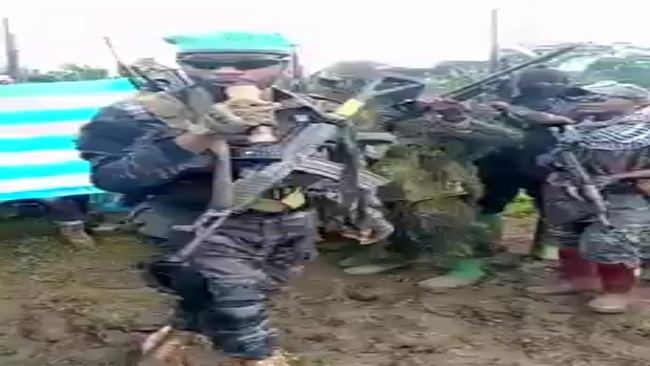
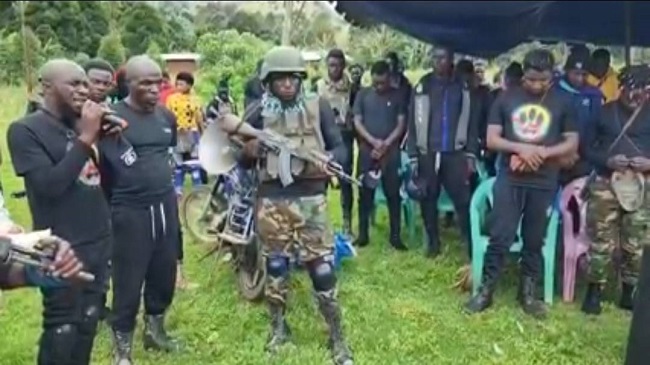
With the government ordering the security forces to crackdown on the protests rather than entering into talks to resolve their grievances, young men took up arms the following year to demand the independent state of Ambazonia, as they call the two English-speaking regions.
Now, military vehicles – including those with mounted machine-guns – constantly criss-cross Bamenda.
Residents say soldiers raid homes, make arrests, burn markets and even display the bodies of their victims, including commanders of militias, at major intersections to warn residents against joining the separatist fighters.
Government forces have also suffered heavy losses in the conflict, with the bodies of fallen soldiers removed from the military’s mortuary in the capital, Yaoundé, every Thursday and Friday.
Widows wail in front of the long lines of coffins draped in the Cameroonian flag, before the soldiers are buried amid the pomp and ceremony that mark military funerals.
Separatist fighters have also gained notoriety for atrocities against civilians, including beheadings and the torturing of women whom they denounce for “betraying the struggle”, calling them “black legs” – a term regularly bandied about now.
They circulate videos of these atrocities to warn people of the punishment they face if they are suspected of colluding with the security forces.
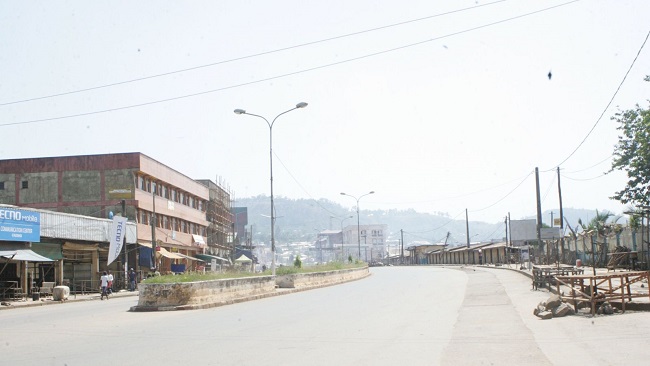
On Mondays, Bamenda becomes a “ghost town” with the roads empty and markets closed – part of a civil economic disobedience campaign dating back to before the armed struggle. These days, residents who dare ignore the lockdown order are either shot dead or see their shops go up in smoke.
The military and police also disappear from the streets, so that they do not become soft targets for separatists fighters who have a strong presence in the city.
The separatists even ordered the closure of all schools four years ago as part of their campaign. A few have bravely remain open, but children do not dare wear uniforms.
The military enforces a curfew virtually every night in the city, resulting in many of its restaurants, bars and clubs – once reputed to be the best in Cameroon – going out of business, not helped by the now-erratic electricity supply.
“The constant frying of popcorn has driven everybody away,” says a waitress using a metaphor to describe the never-ending sound of gunfire.
She says it has also prevented those who live abroad from coming home. Known as “bushfallers” – a Pidgin term for hunters (in this case seeking greener pastures) – those in the diaspora were responsible for Bamenda’s economic heartbeat, sending back money to invest in the once-mushrooming building trade and coming back at Christmas to share their largesse.
But the authorities accused them of bankrolling the Anglophone rebellion. Visiting returnees soon found themselves arrested – some are now in the maximum security prisons of Yaoundé or Douala – while others simply disappeared. Bushfallers’ money has dried up and none of them now visit.
Long-time resident Peter Shang, who once loved life in the city, says people now take one day at a time: “Life is a lottery. Too many things remind you about untimely death. You talk to someone today and tomorrow they are gone.”
For Marie Clair Bisu, there is a silver lining – she sees more of her husband, because he gets home before curfew.
“He has now discovered his children. This is a man who used to come back late sometimes drunk and would just head to bed. Now he can play with the kids and check their books. This conflict has reunited us,” she says.
“The only problem is that the gunshots always spoil our nights.”
And after a night of shooting, residents have to make several calls and listen out for traffic to check the situation is safe before venturing out. Even so, gunfire has become so common in Bamenda during the day that people no longer immediately flee at the sound.
“What would we eat if we keep running? I have children to feed,” a vegetable seller says.
“We simply dive for cover and get back to business when the gunshots stop.”
Another woman says her child has got so used to the sound of gunfire that she knows who is shooting.
“My daughter is seven and she can tell whether the sounds are from machine guns of the army or the AK-47 rifles of ‘The Boys’,” she says, referring to the separatist fighters.
Some nuns who I meet by a road in the city centre say they are waiting for a taxi to go to the Abangoh Orphanage.
The war has seen an explosion in unwanted teenage pregnancies, they say – with girls who have been forced to flee their homes becoming victims of sexual violence and exploitation by both sides. One angrily says: “Rape as a weapon of war is despicable.”
At every corner, there is evidence that the very fabric of this once-glitzy city, where piles of billowing rubbish now tumble, has been permeated by the stench and misery of what many here regard as an unnecessary war.
Cameroon – still divided along colonial lines: