
9, December 2021
Southern Cameroons Crisis: What is the rationale behind the burning of homes? 0
For some time now, there has been a de-escalation in the military violence playing out in the two English-speaking regions of the country where tens of thousands have been killed and hundreds of thousands displaced.
Many political analysts thought the government had understood that its collective punitive expedition was counter-productive and images emerging from some towns and villages in the conflict areas where government forces were working with the civilian population gave the impression that the government had understood that it could win this war more by wining hearts and minds than by counting on its questionable military might.
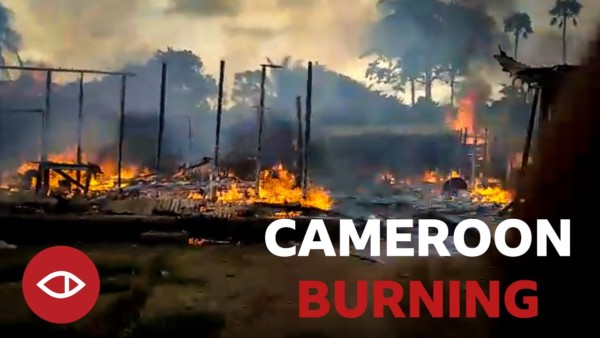
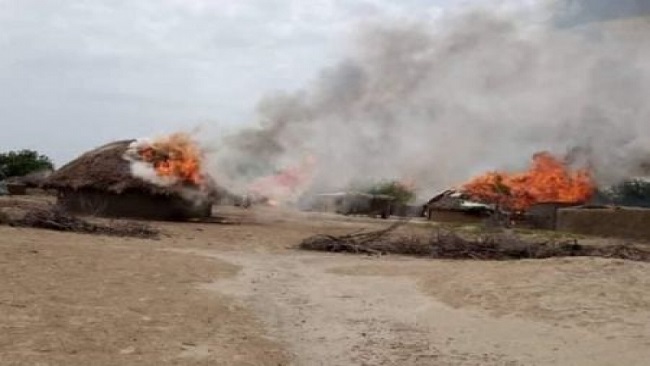
But yesterday’s images of soldiers burning down entire neighborhoods in the Northwest regional headquarters of Bamenda clearly revealed that government forces were walking back to their old bad ways. Old habits die hard, and the government’s demons are clearly rearing their ugly heads.
For close to five years, army soldiers have been burning homes in the two English-speaking regions in the hope that the population will submit, but this old and ineffective strategy is not delivering the desired results. Southern Cameroonians are determined to get this problem addressed once and for all and throwing in the towel is not an option.
As many people get robbed of their dignity and means of livelihood by the brutal military through such devilish ways, so too do these civilians look for ways to get their ‘pound of flesh’ and there is no better way than joining the ranks of the separatists who are only too willing to see their ranks swell.
The burning of homes did work in the early 1960s when the government of Amadou Ahidjo, the country’s first president, was facing a guerrilla warfare against a movement which was fighting the French-imposed government in East Cameroon (French-speaking Cameroon), but that strategy is, without a doubt, the least effective in modern times.
A lot has changed after more than six decades. Today’s fighters have more means than anybody would have imagined in the 1960s. There are millions of Southern Cameroonians living out of the country because of marginalization and poor governance and this huge Diaspora will continue to support the struggle until the Yaounde regime agrees to come to the negotiating table.
Burning homes and gunning down innocent civilians will only breed bitterness and this will lead to revenge and further killings. Within the Southern Cameroonian community out of the country, it is held that those burning homes and roasting people alive are young boys from the Center and South regions of the country whence the president hails, and this does not augur well for those who hail from these two regions, especially as the country’s president is on life support and his regime is steadfastly heading to a chaotic end.
There is revenge in the air. Southern Cameroonians will want to make the Betis, people from the dying president’s ethnic group, feel the pain they have gone through for decades. There are also the northerners who are hellbent on teaching the Betis the learns they learned shortly after the April 6, 1984 Coup d’Etat in Cameroon. More than a thousand northerners were summarily executed, and this unfortunate situation has left many northerners very bitter.
The government needs to ask itself if there is really any wisdom in the way it has conducted its crackdown against the country’s English-speaking minority. More than ten thousand lives have been lost in a war that could been avoided if a more diplomatic approach had been adopted.
The military, for its part, has also lost more than 4,000 soldiers in a senseless war and the burning of homes will only cause separatist fighters to continue killing soldiers. And most of those being killed are young men from the South region who have been deceived into thinking that power belongs to them, and that Southern Cameroonians want to claim what rightfully belongs to the Betis.
Power will always come and go, but human life is irreplaceable. Destroying property and other assets will not deliver the results expected. The only way is to get to the bottom of things and deal with the root cause of the dispute. There is simply no wisdom behind the burning of homes. Dialogue and negotiations will surely deliver better results and lasting peace.
By Soter Tarh Agbaw-Ebai


















10, December 2021
Thousands of French Cameroonians seek safety in Chad after clashes 0
Several thousand people have fled deadly inter-ethnic clashes in northern Cameroon, seeking safety across the border in Chad, the Red Cross said Thursday.
Cameroonian authorities say conflict between fishermen of the Musgum community and ethnic Arab Choa herders around the town of Kousseri has claimed at least four lives.
Thousands of people fleeing the violence have sought refuge by crossing the Chari river into Chad, near the capital N’Djamena.
“There are at least 3,000 refugees, and the number is likely to grow,” Khala Ahmat Senoussi, president of the Red Cross in Chad, told AFP.
A Chadian police source said that “refugees are still arriving, some of them by boat”.
Jean-Lazare Ndongo Ndongo, prefect in Cameroon’s northern Logone-Chari region bordering Chad, told CRTV state television that “despite the security provisions that had been made, a mob managed to enter the town… with around 20 shops looted and four people losing their lives.”
“What we saw was terrible,” said Rahma Ahmat, a 55-year-old woman wearing a black veil who had fled to the Farcha forest outside N’Djamena.
“I saw a person being burned, I was terrified”.
The local official said the Musgum fishermen attacked areas mostly inhabited by Choa Arab herders “from all sides”.
A senior aid worker told AFP that the Musgum used bows and arrows in their attack, drawing violent ripostes from the Arabs.
“I took part in the brawl with the Musgum community,” 35-year-old Hajim said.
“I ran from the fighting because I was soon overwhelmed and I couldn’t track down my child”.
Many refugees have brought only mattresses to wait out the violence in the forest outside N’Djamena, an AFP correspondent saw.
The leader of Chad’s military junta Mahamat Idriss Deby Itno said the situation was “worrying” in a statement Wednesday, calling for “solidarity and hospitality” for the refugees but also asking the international community for aid.
During a week in August in Cameroon’s Far North, 32 people were killed and dozens wounded in clashes between Musgum fishermen and Choa Arab herders, the United Nations said.
The authorities said the clashes were sparked by disputes over access to water.
Deadly inter-community clashes are relatively rare in Cameroon, but frequent in Chad and Nigeria — in particular between sedentary farmers and nomadic herders.
Source: AFP