13, April 2021
US officials head to Europe to shore up allied support on Russia, Iran, China 0
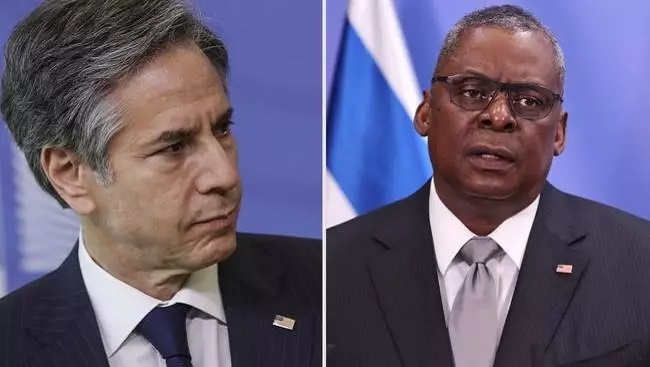
Top US officials are in Europe this week seeking to shore up allied support on countering Iran and China as well as recent Russian moves at the Ukraine border. U.S. Defense Secretary Lloyd Austin arrived in Berlin on his inaugural tour of Europe while Secretary of State Antony Blinken headed to Brussels on Tuesday for talks on Ukraine and NATO troops in Afghanistan.
Nearly a year after President Donald Trump ordered thousands of troops to leave Germany, capping a series of setbacks for U.S. relations with major allies, U.S. Defense Secretary Lloyd Austin began an inaugural tour of Europe to shore up partnerships that are a cornerstone of the post-World War II order.
Austin arrived in Berlin on Monday against the backdrop of a newly emerging crisis with Iran, which on Monday blamed Israel for a recent attack on its underground Natanz nuclear facility. Israel has not confirmed or denied involvement, but the attack nonetheless imperils ongoing talks in Europe over Tehran’s tattered nuclear deal.
Also at stake in Austin’s visit is the future direction of U.S. defense commitments in Europe at a time of growing concern about Russian military intervention on NATO’s periphery, including a buildup of Russian forces near Ukraine’s border. U.S. Secretary of State Antony Blinken was headed to Europe to discuss with U.S. allies the Ukraine situation as well as the administration’s thinking on further withdrawals of troops from Afghanistan.
The United States also seeks European support for its approach to countering China around the world and for efforts to restore an international agreement with limits on Iran’s nuclear program.
Austin arrived in the German capital on Monday night and will hold talks Tuesday with senior government officials. He will also visit NATO headquarters later this week in Belgium and meet with British defense officials in London. He began his trip Sunday in Israel, where he underscored U.S. defense support in meetings with Prime Minister Benjamin Netanyahu and Defense Minister Benny Gantz.
Austin, a former four-star Army general whose overseas military experience was primarily in Iraq, is likely to assure German officials of intentions by the Biden administration to keep troops in Germany, though the number is subject to discussion as part of a monthslong global review of the basing of U.S. troops. Last year, Trump ordered the number in Germany reduced by about 12,000, to about 24,000.
In his first visit to NATO headquarters in Brussels since taking office, Austin will meet with Secretary-General Jens Stoltenberg, who declared on President Joe Biden’s inauguration day that the arrival of a new administration marked “the start of a new chapter for the trans-Atlantic alliance.”
Trump’s departure from the world stage gave the Biden administration an opening to restore a more supportive U.S. approach to Europe and the NATO alliance, but complications will persist. For example, the NATO allies are anxious for Biden to decide whether to pull out of Afghanistan. NATO has more troo ps there than does the United States, and Biden’s indecision troubles them, not least because they count on U.S. military support for removing troops and equipment.
The attack on Iran’s Natanz nuclear facility further complicates U.S. efforts to draw Iran back into a nuclear deal. Austin was asked about this earlier Monday while in Israel, and he said only that he expects the administration’s diplomatic efforts with Iran will continue.
‘Pivot’ to Asia
On the broader horizon, the European allies remain uncertain how their defense and security relationship with the United States will be affected by Biden’s push to focus more on China as the chief threat to U.S. security. That shift in U.S. thinking began during the Obama administration, which announced a “pivot” to Asia that left Europeans thinking their U.S. ally was turning its back. Washington adjusted diplomatically and rhetorically, assuring the Europeans that it was just a “rebalancing.”
Then came Trump. His administration further emphasized China as the prime security threat, but of greater concern to the Europeans was his frequent, sometimes shocking, denigration of the trans-Atlantic partnership that had been the foundation of U.S. security policy for decades. He dismissed the NATO allies as freeloaders, and last summer he ordered the removal of about one-third of the U.S. force in Germany, as well as the move of U.S. European Command headquarters from Germany to Belgium.
“We don’t want to be the suckers anymore,” Trump told reporters last July, calling the Germans ingrates who don’t spend enough on defense but expect the United States to protect them from Russia.
Germany has been an anchor for the U.S. military presence in Europe since the early post-World War II years. In addition to hosting the headquarters for U.S. European and U.S. Africa commands, Germany’s Ramstein Air Base is headquarters for NATO air and missile defenses. The U.S. Army’s largest overseas hospital, the Landstuhl Regional Medical Center, is a few miles from Ramstein Air Base. The U.S. Air Force also has a substantial presence in Germany, including the 52nd Fighter Wing at Spangdahlem.
In his first speech to an international audience, Biden in February declared to the Munich Security Conference: “America is back, the trans-Atlantic alliance is back, and we are not looking backward. We are looking forward together.”
Biden suspended the Trump decision on a partial withdrawal of troops from Germany, which had not yet been implemented. It seems likely the administration will decide not to carry out the Trump order.
Jim Townsend, who served throughout the Obama administration as the Pentagon’s lead policy official on Europe and NATO, said in an interview that he sees lasting value in Austin’s touring of European capitals early in his tenure.
“It’s a better way to repair the torn fabric of that trans-Atlantic relationship,” Townsend said.
Even if the Europeans can put the Trump-era tensions behind them, they will still have questions about the Biden emphasis on China, which is not a front-burner issue for the Europeans. They largely view NATO as a bulwark against Russia, particularly since Moscow’s annexation of Crimea in 2014 and its intervention in eastern Ukraine, which is not a NATO member but aspires to join.
(AP)























13, April 2021
Europe’s Covid-19 death toll surpasses one million 0
Europe passed the grim milestone of one million coronavirus deaths on Monday, as the World Health Organization warned that infections are rising exponentially despite widespread efforts aimed at stopping them.
The death toll across Europe’s 52 countries, compiled by AFP from official sources, totalled at least 1,000,288 by 1830 GMT.
“We are in a critical point of the pandemic right now,” said Maria Van Kerkhove, the WHO’s technical lead on Covid-19.
“The trajectory of this pandemic is growing… exponentially.
“This is not the situation we want to be in 16 months into a pandemic, when we have proven control measures,” she told reporters.
The coronavirus has already killed more than 2.9 million people and infected nearly 136 million across the world.
But despite the sombre news in Europe — the world’s worst-hit region — Britain eased curbs for the first time in months on Monday, allowing Britons to enjoy a taste of freedom with a pint and a haircut.
The changes illustrate how fast-vaccinating countries are leaving other — mostly poorer — nations behind.
In South Africa, the president called for African-made vaccines as the continent lags behind, struggling with inadequate supplies as well as a lack of financing and logistical problems.
“Africa needs to harness its own continental capabilities and identify opportunities for collaboration,” Cyril Ramaphosa said.
Ramaphosa suggested India or Brazil could help after successfully developing their own generic pharmaceutical industries.
But both giants are battling severe Covid outbreaks, with India overtaking Brazil on Monday as the country with the second-highest number of infections after logging more than 168,000 new cases in a day.
Muslims prepare for second Covid Ramadan
Experts have warned that huge, mostly maskless crowds at political rallies and religious festivals have fuelled India’s caseload.
In the Himalayan city Haridwar, maskless Hindu pilgrims on Monday squeezed shoulder-to-shoulder on the banks of the Ganges River for a dip during the Kumbh Mela ritual.
Several Indian regions have tightened their coronavirus measures, with Maharashtra — India’s wealthiest state and current epicentre of its epidemic — imposing a weekend lockdown and night curfew.
Neighbouring Bangladesh has announced it will virtually seal itself off, shutting down both international and domestic transport starting Wednesday while shutting offices in an attempt to staunch its own spiralling outbreak.
Across the Muslim world, worshippers are gearing up for the start of their second Ramadan of the pandemic, with the holy fasting month due to kick off in many countries on Tuesday.
In Egypt, the Arab world’s most populous nation, the sanitary measures are less strict than a year ago when mosques were shut completely and a curfew was in force.
The mood in Cairo was relatively cheerful as the city prepared for special prayers on Monday night, with bright lights festooning the streets. Many of those rushing around the city shopping for last-minute supplies were maskless, however.
Saudi authorities have meanwhile said that only people immunised against Covid-19 will be allowed to perform the year-round umrah pilgrimage from the start of Ramadan.
Glimmers of hope
In Britain, despite one of the world’s highest Covid-19 death tolls, there were glimmers of hope Monday as pubs and restaurants were allowed to serve people outside — a move welcomed by the hard-hit hospitality sector, despite wintry temperatures.
“It’ll be great to see everybody again and see all the locals,” Louise Porter, landlady of The Crown Inn in Askrigg, northern England, told AFP.
“Our lives have just been turned upside down, just like everybody else’s,” she said, adding: “We’re still here to tell the tale.”
England’s hairdressers, indoor gyms and swimming pools also got the green light to reopen.
Once the worst-affected country in Europe, Britain launched a successful vaccination campaign coupled with lockdown measures that cut deaths by 95 percent and cases by 90 percent from January.
Italy has also been one of Europe’s hardest-hit countries, and on Monday, Rome saw the latest in a series of anti-lockdown demonstrations, with several hundred people turning out in protest against weeks of restaurant closures.
In France, now the European country with the most infections, an expansion of the vaccine rollout has buoyed optimism among lockdown-weary residents. Everyone aged over 55 years old is now eligible for a Covid vaccination.
And in other positive news, clinical trial results indicated that the Regeneron antibody treatment used to treat Covid-19 patients also helps prevent infections.
(AFP)