19, June 2025
Armenia’s PM accuses head of Church of fathering child 0
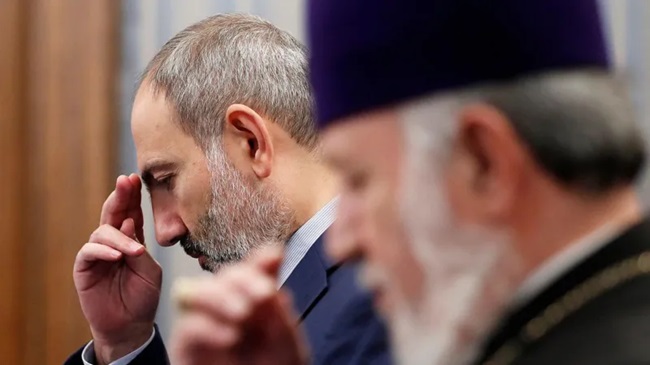
Armenia’s liberal government has never been an ally of the deeply conservative Armenian Apostolic Church (AAC), but when Prime Minister Nikol Pashinyan made extraordinary allegations against an unnamed senior clergyman, it blew open a deep divide.
“Your Grace, go fool around with your uncle’s wife. What do you want from me?” said Pashinyan.
He also accused the supreme spiritual leader – Catholicos Karekin II – of breaking his vow of celibacy and fathering a child, calling on him to resign. The BBC has approached the Church for comment but has not had a response.
Until now the Church and government had found a way to co-exist, but the row threatens to split an already polarised Armenian society still further – and affect the outcome of next year’s election.
It could also harm peace talks that have the potential to re-shape the entire region of the South Caucasus, after Armenia’s bitter defeat in a war against Azerbaijan.
Before their split, Pashinyan and the Catholicos attended public events and visited front lines together
Armenia is believed to be the first nation to make Christianity the state religion, after its king was baptised in 301AD. Although there is a separation of Church and state by law, the Armenian constitution recognises the AAC “as a national Church”.
The Church has not addressed the allegations but said the prime minister had sought “to silence its voice”. It has reiterated that the government has no say in the matters of Church governance.
If true, Pashinyan’s allegation would make the Catholicos unfit for office. Under the Church’s by-laws, only monks who took a vow of celibacy can be elected a Catholicos.
On these grounds Pashinyan now demands Karekin’s resignation, despite having no jurisdiction over the Church. He has presented no evidence but threatened to release it.
Pashinyan has also attacked other senior clergymen, including accusing one archbishop of having an affair, with the extraordinary allegation of “fooling around” with his uncle’s wife.
The opposition parties and two of Armenia’s former presidents, Levon Ter-Petrossian and Serzh Sargsyan, have rallied behind the Church and condemned Pashinyan’s move against it.
The government’s relationship with the Church deteriorated after the defeat in the 2020 war against neighbouring Azerbaijan, when Karekin II joined calls from various political factions for the prime minister to step down.
Pashinyan stayed in power, and the Church became a prominent anti-government voice.
Recently, Karekin II demanded the right of return for the Armenians who fled Nagorno-Karabakh, a region of Azerbaijan that it recaptured in 2023.
The prime minister’s allies are unhappy with such interventions, as they contradict the government’s position in the ongoing peace talks.
Pashinyan pushes for a swift peace treaty that would see both countries drop mutual claims. But Azerbaijani media seized on nationalist opposition demands as proof that Armenia is not ready for peace.
The Armenian Church has benefited from becoming a hub for dissent. With personal rivalries between the leaders of opposition parties, it is drawing in those disaffected with the authorities.
Political analysts in Armenia suggest this might be a real reason for the government’s sudden attack on the Church leader.
The next general election has been scheduled for June 2026, and the anti-Church campaign could be a pre-emptive strike against the stronghold of conservative opposition.
The prime minister himself has linked his position to politics: “We returned the state to the people. Now we must return the Church to the people.”
When a powerful benefactor spoke out in support of the Church this week, the government swiftly moved against him.
Russian-Armenian billionaire Samvel Karapetyan threatened to “intervene in the campaign against the Church in our own way” if opposition politicians failed to defend it.
Hours later, his residence was raided and on Wednesday he was charged with “making public calls to overthrow the government”. He denies the charge.
Source: BBC
















20, June 2025
Battle for Etoudi: Jean Nkuete accuses Maurice Kamto of inciting insurrection 0
On June 10, 2025, Jean Nkuete, Secretary-General of the Central Committee (SG/CC) of the Cameroon People’s Democratic Movement (CPDM), released an 11-point statement addressing the increasingly polarized national political climate in the run-up to the presidential election. In the document, the Deputy Prime Minister directly targeted the opposition, specifically the Cameroon Renaissance Movement (CRM), accusing it of escalating public tension.
Jean Nkuete wrote, “We are observing that, as the presidential election approaches, some political parties, several of which are grappling with their own internal contradictions, are feeding the public with false debates that create confusion.” His message became clearer as he denounced “calls for the preparation of a sacrificial and deadly insurrection,” referencing a third country whose situation, he argued, is incomparable to Cameroon’s.
The Shadow of the Paris Rally
This criticism is a thinly veiled attack on CRM leader Maurice Kamto, who delivered a controversial speech at a Paris rally on May 31. Kamto declared, “If we fail in 2025, it will be Cameroonians’ own fault.” The former Minister Delegate for Justice elaborated, “If we miss the opportunity for the change Cameroonians have been yearning for over decades, it will be our own fault. Don’t wait for anyone! Look at Senegal, what you saw there came after young Senegalese fought throughout 2023 and 2024, and there were nearly fifty deaths. Yes… Don’t think people just lie down and change happens. Transformation takes struggle.”
For Jean Nkuete, these remarks indicate a deliberate strategy to use confrontation as a political tool. He called for the rejection of all forms of violence, writing, “Cameroon is a mature nation, whose fundamentally republican people bear the scars of violence from the independence war, the dark years, and, more recently, the atrocities in the Northwest and Southwest regions.” He concluded by stating, “Cameroonians, who more than anyone know the cost and value of peace, will not allow personal ambition to endanger lives or jeopardize the peace, stability, and coexistence they have so dearly secured.“
CRM’s Response
In response to the accusations, CRM condemned what it called an attempt to criminalize political expression. According to barrister Désiré Sikati, a party member and lawyer at the Cameroon Bar, Kamto’s comments have been intentionally misrepresented. He asked, “Is it not legitimate and common in a democracy to call for public protests against illegality?” In his view, the May 31 speech should not be equated with a call for insurrection, but rather a lawful civic mobilization. He added, “Can a call to protest be interpreted as a call to die in a democratic state?“
The lawyer then reversed the accusation, implicitly pointing to the government’s suppression of political protests. He concluded in a pointed tone, “Should live bullets be fired at peaceful demonstrators in a democratic country?“
Source: Business in Cameroon