
20, May 2019
Cameroon, Kenya Militaries Fighting Terrorism Through Development 0
A delegation from the Kenyan military is sharing experience on how the Cameroon military engineering corps has taken over road construction projects in Boko Haram terrorism prone areas to use the example and develop areas of its territory threatened by Al-Shabab which they say is still a threat. The Kenyan delegation has been in Cameroon for several days.
A Cameroon military engineering corps compactor is constructing a portion of the road linking its northern border town of Kousseri to the Chadian capital Ndjamena and Borno state in northeastern Nigeria.
Colonel Jackson Kamgain, director of Cameroon military engineering corps, says they re-launched the World Bank-sponsored project in March 2018 after it had been abandoned for four years.
He said since independence in 1961, the Cameroon military engineering corps has participated actively in the development of all localities and insures that major projects in conflict zones are not abandoned unlike in many other countries where military engineering departments concentrate only on making access easy for troops in areas of war or conflicts.
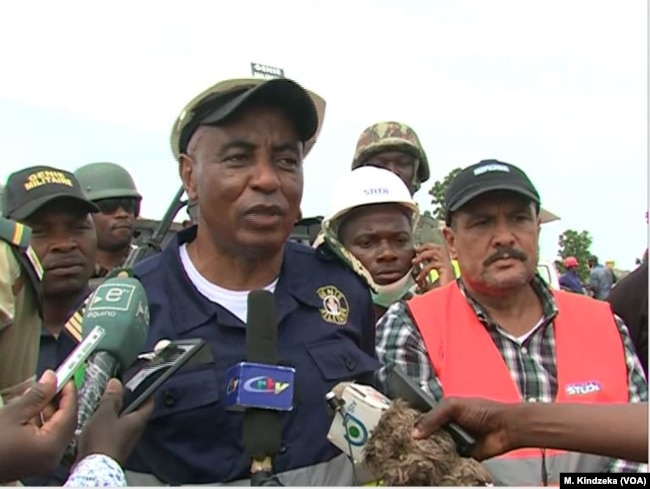
The road project was interrupted in 2014 following an assault on the base camp of the Chinese road contractors in which 10 of their workers were kidnapped by suspected Boko Haram rebels. The kidnappers also stole 10 vehicles and a container of explosives. The workers escaped but road construction companies refused to resume work there for fear of the terrorists,
The government of Cameroon convinced project funders that its military engineering corps could construct the road even while the war against Boko Haram was raging. The World Bank provided about $125 million for the project, which is to be completed in 24 months.
General Mohamud Muhamed Ali, governor of Kenya’s Marsabit region and head of the 17-man Kenyan delegation of military and officials from the ministry of transport, said they came to Cameroon to learn from the Central African state’s experience.
“The military was challenged with a very very unique situation which is nor very normal in their line of duty. Because of serious level of insecurity where contractors have not been able to show any interest to undertake major construction work in the area infested by Boko Haram, they showed leadership and undertook that serious national project,” he said.
Ali said the Kenyan government’s plan to link the country with Somalia by constructing a link road to increase trade between the two countries has been facing threats from the al-Qaida-linked al-Shabab insurgency.
In April 2019, the International Crisis Group reported that since 2015, al-Shabab has conducted over one hundred small-scale assaults in the north east of Kenya, killing dozens of soldiers and police, mostly with roadside bombs.
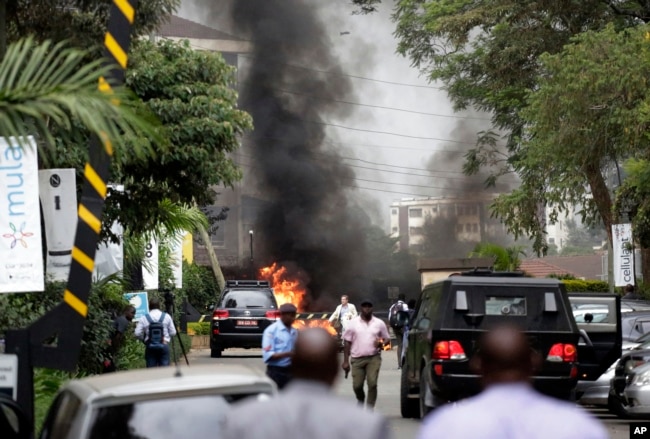
Kenyan General James Gitiba, who was also in Cameroon, said African militaries will contribute more to reducing pain and suffering in the continent’s several conflict zones if they also embrace development initiatives that go beyond simply fighting enemies.
“Most militaries in Africa are known for the various basic function of enhancing mobility which is basically clearing a route for the troops to pass and also survivability. So for Cameroon this is a milestone and I think I could also urge other friendly countries to come here and learn,” he said.
Soldiers from Cameroon, Nigeria, Chad and Niger, part of the multi-national joint task force of the lake Chad Basin Commission, have been fighting Boko Haram terrorism that began in northeastern Nigeria 9 years ago and has left 25,000 people dead and forced more than 2.6 million others to flee their homes, according to the United Nations.
Source: VOA



















20, May 2019
Congo-Kinshasa: Ebola Containment Efforts Threatened by Insecurity, Underfunding 0
The International Federation of Red Cross and Red Crescent Societies warns the Ebola epidemic in eastern Democratic Republic of Congo could spread to urban areas and across international borders because of heightened insecurity and a serious shortage of money. DR Congo Ministry of Health reports 1,739 cases of Ebola, including 1,147 deaths, which indicates a 66 percent fatality rate.
The Ebola epidemic in conflict-ridden North Kivu and Ituri provinces started 40 weeks ago on August 1. What is particularly frightening about the latest situation report is that 20 percent of overall cases have occurred in just the last three weeks.
The International Red Cross Federation finds this sharp upsurge alarming. It is urging the international community to redouble its efforts to contain this deadly virus before it escalates further.
The IFRC’s Director of Health and Care, Emanuele Capobianco, says the Ebola response faces a double jeopardy of insecurity and critical underfunding. He says the security situation is complex and will require a range of responses. But he notes the funding situation could be fixed now.
“At the moment, the financial situation for many of the humanitarian organizations is quite dire,” he said. “There is a real need to step up the response. Otherwise, activities will have to be scaled down and the impact on the future of the epidemic will be extremely serious.”
People who get infected with the Ebola virus have a very high risk of dying. Studies from the 2014 historic outbreak in West Africa show that between 60 and 80 percent of Ebola cases were linked to Ebola-infected bodies at traditional burials.
Capobianco says Red Cross efforts to provide communities with safe and dignified burials are meeting with increasing success.
“Up to now, there have been up to 5,000 safe and dignified burials conducted and they are conducted for, as I mentioned before, the people who died either in the community or the Ebola treatment centers of Ebola confirmed,” he said. Also, for people who may be just suspected of Ebola. And, that is why the number of 5,000 is so high. That is a critical part of the work that we have done and which, at the moment is threatened by the lack of funding.”
Capobianco says the Red Cross has received less than half of the $30 million it needs to carry out its Ebola-control activities across affected parts of DR Congo, as well as preparedness efforts in neighboring Burundi, Rwanda, South Sudan and Uganda.
He warns Red Cross operations will be forced to close within the next two weeks without additional urgent investment.
Source: VOA