
28, May 2018
Menka-Pinyin Massacre: Barrister Agbor Balla declines to say whether Biya regime killed Ambazonians 0
More than two dozen people have been killed in one of Cameroon’s Anglophone regions, local sources said on Saturday, although the exact circumstances of their deaths were not immediately clear.
The incident in the town of Menka in Cameroon’s Northwest Region is one of the deadliest since armed secessionists from the English-speaking minority launched an insurrection last year against the predominantly Francophone central government.
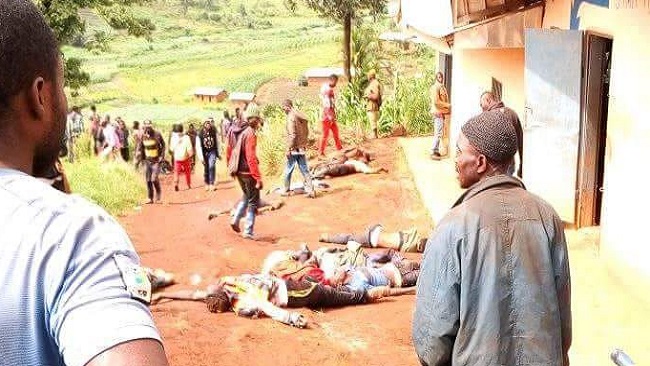
Agbor Balla Nkongho, a local human rights lawyer and activist, told Reuters that at least 34 bodies were found on Friday in Menka. He declined to say who had killed them.
Another local source who visited Menka on Saturday and asked not to be named said she saw a total of 29 bodies, including three outside a school, riddled with gunshot wounds. Some were women and others boys as young as 13, she said.
The bodies “are rotting already and reek,” she said.
Army spokesperson confirms battle with separatists
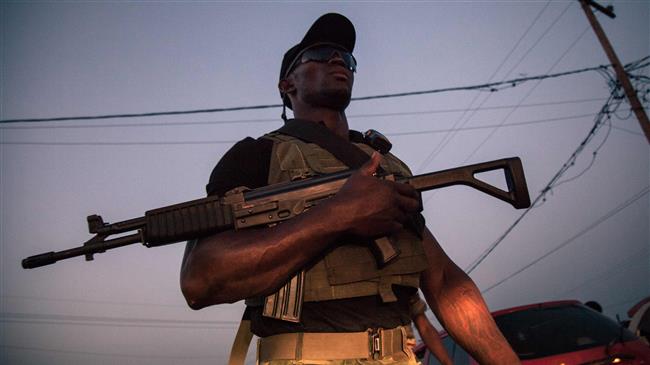
Army spokesman Colonel Didier Badjeck said in a statement to local media that government troops surrounded a hotel in Menka on Friday morning after they were tipped off to the presence of separatist rebels.
A long firefight ensued and “several terrorists were neutralised”, Badjeck said, without providing further details.
A representative for the separatists did not immediately respond to a request for comment.
Armed conflict erupted last year in Cameroon’s Anglophone Northwest and Southwest Regions after the government violently repressed peaceful protests that begun in 2016 against perceived marginalisation of English speakers.
Behind Cameroon’s linguistic divide
Cameroon’s linguistic divide harks back to the end of World War One, when the League of Nations divided the former German colony of Kamerun between the allied French and British victors.
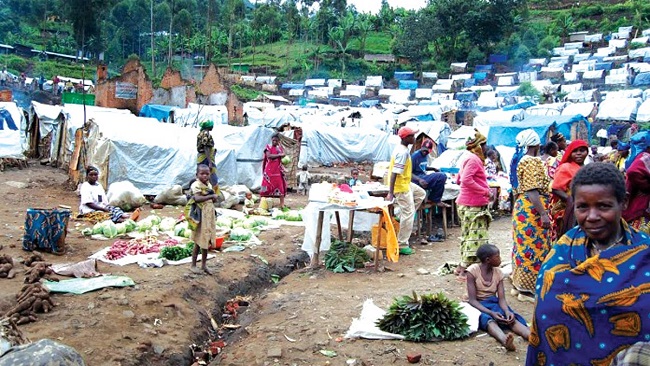
Dozens of people have been killed since late last year – including more than 20 soldiers and police ambushed by the separatists – and tens of thousands of refugees have fled to neighbouring Nigeria.
The United States and rights groups have accused the Yaounde government of burning down villages and carrying out targeted killings in the Anglophone regions, charges the government has angrily denied.
The latest violence comes just months ahead of an election in which President Paul Biya, who has ruled the Central African oil producer for the last 35 years, is expected to stand for a fresh term.
REUTERS
















29, May 2018
Biya regime’s secret extermination campaign at Buea and Mbouda prisons 0
It has been two years since the outbreak of the Southern Cameroons conflict. The senseless war fought between Cameroon government forces and the Ambazonia Self-Defense Council Restoration Forces has already driven more than two hundred thousand Southern Cameroonians out of their homes and approximately some 1600 have died in it. Southern Cameroonians civilians do not suffer in Kondengui Central prison or the famous New Bell prison in Douala only: Cameroon Intelligence Report correspondents have uncovered the Biya government’s campaign of extrajudicial executions at detention facilities in Buea and Mbouda.
Ever since the beginning of the crisis, every week and often twice a week, groups of up to 40 Southern Cameroonians were executed. In two years, as many as 1600 people, most of them civilians believed to be opposed to the Biya regime in Yaoundé, have been killed in secret at Mbouda and Buea. The Ambazonian detainees suffer in inhuman conditions: repeated torture and the systematic deprivation of food, water, medicine and medical care. We also gathered that the Interim Government of the Federal Republic of Ambazonia have acquired documentation depicting how these extermination policies have killed massive numbers of Southern Cameroons detainees. Our chief reporter in Northern Zone, Sama Ernest who contributed to this report said there are strong reasons to believe that this routine is still ongoing today.
The Yaoundé government, led by Paul Biya, has never taken time to investigate any killings. All it has always done is to resort to collective punishment wherein the houses of innocent civilians are razed, and innocent youths are gunned down point blank. The actions of the country’s armed forces have created more fighters over the last six months, as ordinary civilians – both boys and girls – now believe they have to defend themselves against a military that is using their tax money to murder the people they are supposed to protect.
Southern Cameroonians have been calling for international assistance. They now want the world to protect them against their supposed protectors. The government’s mass murdering tactics and collective punishment have drawn a lot of flak in recent times and even the Trump Administration has been disappointed by the methods the dictatorial government in Yaoundé is using to restore order in the two restive English-speaking regions of the country.
Amnesty International and the International Crisis Group have also been very vocal against the Yaoundé government’s irresponsible actions. For the past six months, the government of Cameroon has been working hard to wipe off villages from its own map through a scorch-earth policy that many in the international community have frowned upon. Amnesty International and the International Crisis Group have all called the government’s action against Southern Cameroonians into questions. The world has been taken aback by the government’s commitment of such human rights abuses.
Kwakwa, Mbonge, Etoko and Kembong in the South West region have been rolled back into the 10th Century by the government. Its plan was to intimidate the people into submission, but the strategy has so far been counter-productive. In Kwakwa, many old people were burnt alive by government forces as a move to punish the entire population for the killing of an army soldier by some unknown and unidentified gunmen.
Other villages have also experienced the government’s wrath and frustration with a rebellion it felt it could put out in one single military action. Mbonge, Bali and Batibo have all been victims of the Yaounde government’s malicious policy designed to stamp out any opposition.
Terrorism has become the buzzword in Cameroon and anybody who holds a view that is contrary to the government’s is considered a terrorist. This is a new tool it is using to stamp out opposition, but times have changed, and the people of Southern Cameroons are clearly resisting a government they believe is corrupt to the marrow and inefficient.
source: www.cameroonintelligencereport.com