
20, June 2022
Belgium returns Lumumba tooth to family 0
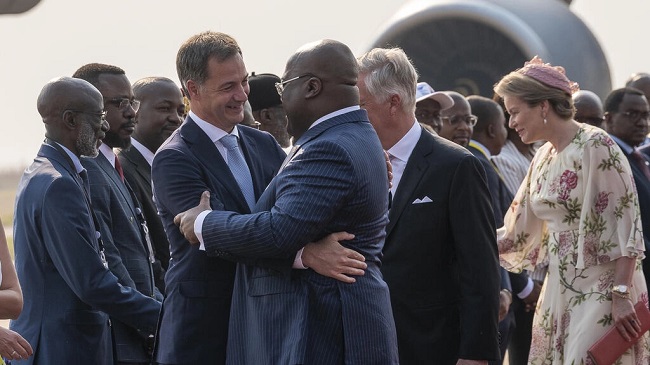
Belgium on Monday handed over the last remains of slain Congolese leader Patrice Lumumba — a tooth — to his family, turning a page on a grim chapter in its colonial past.
Chief prosecutor Frederic Van Leeuw gave the relatives a small, bright blue box containing the tooth in a televised ceremony, and said legal action they had taken to receive the relic had delivered “justice”.
The tooth was placed in a casket that was then draped in the flag of the Democratic Republic of Congo, which celebrates Lumumba, who was murdered by separatists and Belgian mercenaries in 1961, as an anti-colonial hero.
Lumumba’s assassination — and the brutal history of Belgian control of the Congo — have been enduring sources of pain between the two countries.
Belgian Prime Minister Alexander De Croo reiterated that his country’s authorities bore a “moral responsibility” over the killing.
“I would like, in the presence of his family, to present in my turn the apologies of the Belgian government,” he said.
“A man was murdered for his political convictions, his words, his ideals.”
Lumumba’s son Francois told Belgium’s RTBF broadcaster that his relatives had been waiting “more than 60 years” for this event.
“I think it will provide solace for the family and the Congolese people,” he said.
“We are opening a new page in history.”
A fiery critic of Belgium’s rapacious rule, Lumumba became his country’s first prime minister after it gained independence in 1960.
But he fell out with the former colonial power and the United States and was ousted in a coup a few months after taking office.
He was executed on January 17 1961, aged just 35, in the southern region of Katanga, with the support of Belgian mercenaries.
His body was dissolved in acid and never found.
But the tooth was kept as a trophy by one of those involved, a Belgian police officer.
The tooth was seized by Belgian authorities in 2016 from the daughter of the policeman, Gerard Soete, after Lumumba’s family filed a complaint.
‘National mourning’
The casket containing the tooth is set to be flown back to the DRC where it will be officially laid to rest at a memorial site.
The country is set to hold three days of “national mourning” from 27 to 30 June — its 62nd anniversary of independence — to mark the burial ceremony.
Lumumba’s older son Francois filed a complaint in Belgium in 2011, pointing the finger of responsibility for his father’s killing at a dozen Belgian officials and diplomats.
The investigation for “war crimes” is still ongoing but only two of the targeted officials are still alive.
A Belgian parliamentary commission of enquiry in 2001 concluded that Belgium had “moral responsibility” for the assassination and the government presented the country’s “apologies” a year later.
De Croo said Belgian officials “chose not to see, chose not to act” to stop the killing, even if they had not directly intended it to happen.
Lumumba’s children were also received Monday by Belgium’s King Philippe, who this month travelled to DR Congo to express his “deepest regrets” over the colonial past.
Historians say that millions of people were killed, mutilated or died of disease as they were forced to collect rubber under Belgian rule. The land was also pillaged for its mineral wealth, timber and ivory.
Source: AFP













1, July 2022
Tunisia’s president pushes for new constitution that gives him broad powers 0
Tunisian President Kais Saied published a planned new constitution on Thursday that he will put to a referendum next month, expanding his own powers and limiting the role of parliament in a vote that most political parties have already rejected.
Saied has ruled by decree since July, when he brushed aside the parliament and the democratic 2014 constitution in a step his foes called a coup, moving towards one-man rule and vowing to remake the political system.
His intervention last summer has thrust Tunisia into its biggest political crisis since the 2011 revolution that ousted former autocrat Zine al-Abidine Ben Ali and introduced democracy.
Voters will be asked to approve the new constitution in a July 25 referendum for which there is no minimum level of participation.
With most of the political establishment opposed to his moves and urging their supporters to boycott the vote, analysts say the measure is likely to pass, but with only limited public involvement.
Many Tunisians are far more focused on a growing economic crisis and threats to public finances that has caused salary delays and threatens shortages of key subsidised goods.
The draft constitution published in the official gazette late on Thursday says Saied would continue to rule by decree until the creation of a new parliament through an election expected in December.
The new constitution would also allow him to present draft laws and have sole responsibility for proposing treaties and drafting state budgets, the gazette said.
It would create a new ‘Council of Regions’ as a second chamber of parliament.
Previously, political power was more directly exercised by the parliament, which took the lead role in appointing the government and approving legislation.
Under the new constitution the government would answer to the president, not to the parliament, though the chamber could withdraw confidence from the government with a two-thirds majority.
The president could serve two terms of five years each and has the right to dissolve parliament. A separate electoral law laying out how voting would work under the new political system will be published later, the draft constitution said.
However, judges, police, army and customs officials would not have a right to go on strike. Judges have recently been on strike for weeks in protest at Saied’s moves to curtail judicial independence.
In a move that may chafe with conservatives, Islam will no longer be the state religion, though Tunisia will be regarded as part of the wider Islamic nation.
However, Saied has maintained most parts of the 2015 constitution that enumerated rights and liberties, including freedom of speech, the right to organise in unions and the right to peaceful gatherings.
Source: REUTERS