24, June 2025
Célestin Djamen: Ohh those Francophones! 0
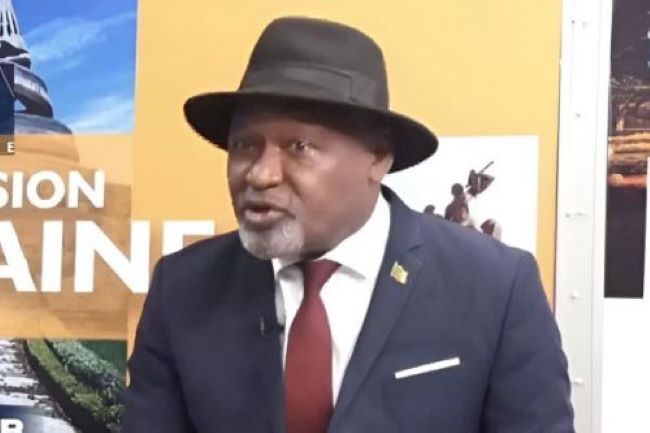
Célestin Djamen officially announced his candidacy for Cameroon’s upcoming presidential election in Douala on June 17, 2025. He will run under the banner of the Alliance Patriotique Républicaine (APAR), the party he leads. This declaration comes amidst a tense political climate, where the legal criteria for presidential candidate admissibility are generating debate, criticism, and conflicting interpretations.
Many are recalling Djamen’s earlier opposition to Maurice Kamto’s candidacy. Djamen had argued that Kamto’s Cameroon Renaissance Movement (MRC) lacked elected officials after boycotting the 2020 municipal and legislative elections. Now, attention has shifted to APAR, a party with no known electoral base, raising questions about whether it meets the legal requirements.
Djamen has not publicly clarified whether APAR has any municipal or regional councilors. However, on May 8, David Eboutou, a university lecturer and political activist known to be close to Djamen, posted on social media that two municipal councilors would soon join APAR. Eboutou wrote, “Good news for Célestin Djamen’s APAR party, which will welcome two municipal councilors in the coming weeks. The party will thus have a presidential candidate.”
A Stir of Controversy
Eboutou’s statement quickly sparked a wave of critical, often mocking, online commentary. Many users pointed to the apparent inconsistency in Djamen’s stance. “These are the same people who kept shouting ‘inadmissible’ at the MRC, and now they’re using the same strategy,” one user wrote. Another remarked sarcastically, “So, Mr. Djamen, you’re now invoking the same constitutional provisions you so loudly opposed when it came to the MRC?“
Some users directly addressed Eboutou, accusing him of double standards. “David, aren’t you ashamed? When it’s APAR, it’s good news. When it’s the MRC, Kamto is manipulating the law.”
In an effort to clarify the issue, Eboutou also shared an opinion piece by Djamen. In it, the APAR leader re-examines the interpretation of Article 121, paragraph 2 of the Electoral Code, frequently cited in the ongoing debate. According to Djamen, the law does not require the political party itself to “have elected officials.” Instead, it stipulates that a candidate must be endorsed by a party represented in the National Assembly, Senate, or an elected council, whether municipal or regional.
Based on this reading, Djamen argues that his party can legitimately field a candidate, provided it includes elected officials, regardless of their original affiliation, and follows proper endorsement procedures. He concluded with a touch of irony: “All that remains for APAR, which has yet to contest any election, is to exercise its right to nominate a candidate by simply recycling a few excluded officials from across the country.”
Although legally reasoned, this position has not silenced critics, particularly concerning political coherence. By seeking to exploit loopholes in Cameroon’s electoral framework, Djamen now appears to be adopting a strategy he once vehemently denounced. His reversal raises questions about the principles guiding political competition in a country heading into what promises to be a contentious presidential race.
Source: Business in Cameroon















26, June 2025
Race for Etoudi: Issa Tchiroma resigns from government 0
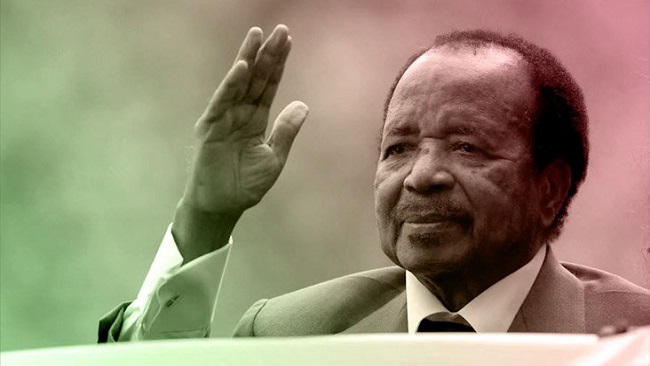
At 76, Issa Tchiroma Bakary has voluntarily stepped down from government after serving in various ministerial roles for over two decades. The timing comes shortly after a series of strong public criticisms against the very regime he had consistently supported for years.
Tchiroma, the former Minister of Employment and Vocational Training, has recently re-emerged at the center of Cameroon’s political scene. His impassioned speech in Garoua denouncing the current administration, a subsequent meeting with the French ambassador, and now his formal resignation just months before the October presidential election have all fueled speculation about his motivations.
A Calculated Exit?
For many political observers, Tchiroma’s departure was anticipated. What has drawn attention is the dramatic nature of his exit. Some view it as a carefully planned move. One political analyst, who wished to remain anonymous, noted, “He’s staged his return to the opposition the way one would launch a campaign.”
Once nicknamed the “griot of Paul Biya” for his enthusiastic defense of the president, Tchiroma’s sudden change in tone has unsettled even his colleagues. Within Prime Minister Joseph Dion Ngute’s cabinet, some react discreetly, while others, like Minister Delegate for Justice Jean De Dieu Momo, have taken to social media. Momo wrote on Facebook, with an ironic tone reflecting the discomfort within the ruling elite, “My brother Issa Tchiroma really surprised me. And now, how is President Paul Biya going to look at me? As if I’ll do the same thing? Come on! You don’t do that.”
Since his return to government in 2009, Tchiroma had been one of Biya’s most vocal supporters. This new political shift is particularly striking given that between 1996 and 2009, he was among the regime’s fiercest critics. That stance disappeared the day he was appointed Minister of Communication on June 30, 2009. At the time, Jeune Afrique editor François Soudan described him as a “minister of communication in vuvuzela mode,” highlighting the dramatic nature of his political turn.
A Tumultuous Political Path
Tchiroma’s political journey has been far from straightforward. Trained as a railway engineer, he began his political activism in the 1970s with the Cameroon National Union (UNC) while studying in France. Upon his return in 1977, he worked at Regifercam before being arrested in 1984 for suspected links to a failed coup against Biya. He spent several years in detention without trial in Yoko prison.
Freed in 1990, he organized a protest in Garoua and co-founded the National Union for Democracy and Progress (UNDP), becoming a Member of Parliament in 1992. That same year, he was named Minister of Transport but was expelled from the UNDP in 1995 for joining the government. He later co-founded the ANDP with Hamadou Moustapha but was ousted from government again in 1996.
He returned to the political scene in 2007 with the creation of the Cameroon National Salvation Front (FSNC), and in 2009, he regained a ministerial post under Biya, becoming one of the regime’s most ardent defenders.
An Opposition of Convenience?
By resigning now, Tchiroma appears to be returning to his opposition roots. Yet his pattern of oscillating between government and opposition has created skepticism. Each withdrawal has been followed by a return; each alliance by a reversal. By blurring these lines so frequently, he has come to represent not so much change as ambiguity.
His current criticism of a system he once championed, with no admission of his own role in its governance, makes it hard to view this break as anything more than a tactical move. As the election approaches, his political reinvention seems driven less by ideological conviction than by opportunity. What emerges is a portrait of consistency in inconsistency, one that ultimately undermines his credibility.
Source: Business in Cameroon