6, October 2018
Anglophone crisis looms over Cameroon’s presidential election 0
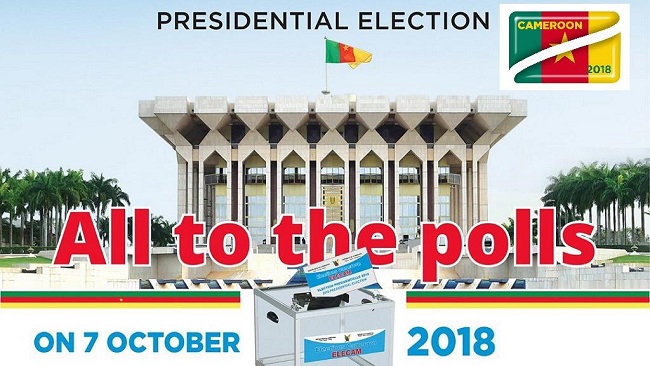
On the morning of October 7, eight of Cameroon’s 10 regions will vote in a presidential election that could end the long-running leadership of Paul Biya, who has been in office since 1982 and was prime minister in the seven years before that.
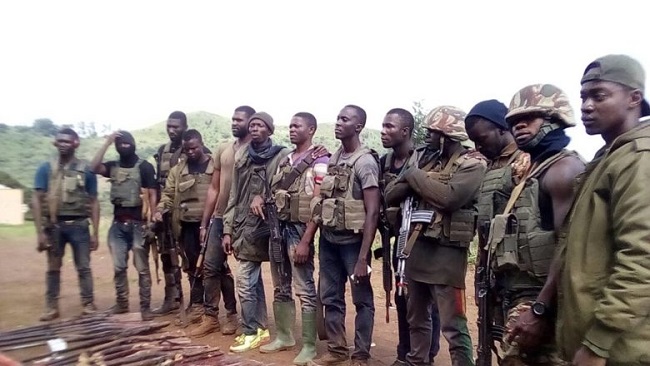
Dissidents in the remaining two regions – the South West and North West – home to Cameroon’s English-speaking minority, have threatened a showdown. “There is localised violence in the Anglophone regions … more than 1,000 men have pledged to dislodge the elections in those regions by violence,” says Hans de Marie Heungoup, senior analyst for Central Africa at the International Crisis Group.
Besides fighting by Boko Haram in the Far North and North regions and rebel incursions from the Central African Republic into the Eastern region, Cameroon is largely beset by the Anglophone crisis, a separatist uprising with roots in the pre-World War I era when it was a German colony.
“We are very much on the brink of a civil war,” said Kah Walla, who is from an Anglophone region. She is the leader of the Cameroon People’s Party (CPP), but the group declined to put forward a candidate for the coming vote.
“Separatist groups have gotten to a stage where they control some territory and have promised violence if the authorities attempt to hold elections there and government has vowed to hold elections there. So the population is caught in the middle.”
Southern Cameroons became German Kamerun in 1885, eventually transiting to joint French and British administration. Opting not to join Nigeria as it sought independence in 1961, it instead joined the French Cameroons, which had already gained independence a year earlier.
By 1972, the federal republic of Cameroon had become a unitary state; while the south kept its English laws and academic system, the rest of the country stuck to the French legal system and the baccalaureate schooling alternative.
There are now complaints of marginalisation and a dearth of infrastructure in those English-speaking provinces, despite being home to the oil that accounts for 40 percent of the country’s GDP. People looking to go from Mamfe to Akwaya in the same region, for instance, travel through a Nigerian border town before returning to Cameroon – a journey that could take as long as a day – because of the roads’ terrible condition.
The elections won’t be free and fair. The system is already rigged to give the president a structural advantage-KAH WALLA, CAMEROON PEOPLE’S PARTY LEADER
Rising tensions and subsequent protests caused by these divisions snowballed spectacularly in 2016.
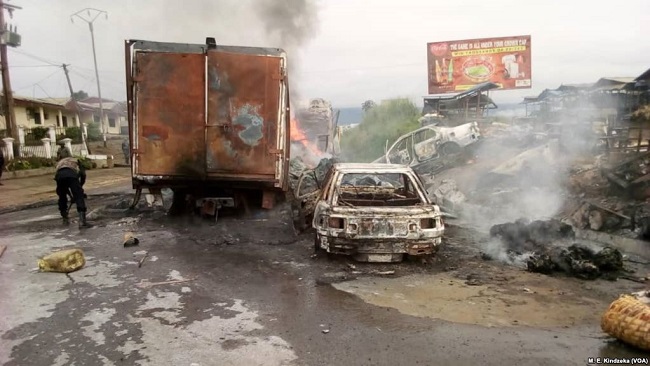
At least 400 people have died so far. A further 20,000 people have fled into neighbouring Nigeria as their villages were razed. Schools have been closed and a three-month internet shutdown was enforced in those provinces, forcing a few hundred untrained secessionist fighters to group and arm themselves against a military crackdown.
A recent poll by GICAM, Inter-Patronal Grouping of Cameroon said more than 6,000 jobs have been lost to the crisis. In the Northwest region, a dusk-to-dawn curfew has been imposed. Thousands have fled both provinces, moving to stay with friends and relatives elsewhere nationwide after threats by separatists who are expected to begin taking up arms in the days leading up to the elections.
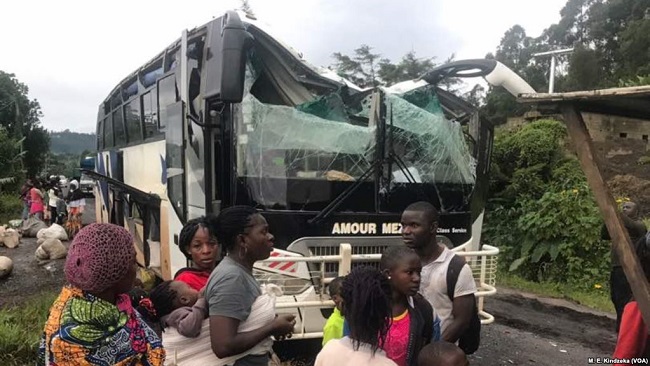
Others remain trapped in their hometowns or in informal camps for displaced people in host communities. Weeks ago, Bernard Bilai, the Southwest governor, went with a party of gendarmes to a popular motor park in Buea, capital of the region, to ask panicked people gathered there to remain.
Despite violence inflicted on them by both the military and rebel troops, many in the Anglophone areas are sympathetic to the secessionist cause, although this support is not voiced, say experts.
Early this year in Abuja, the Nigerian capital, the self-declared leader of the separatist agenda, Julius Ayuk Tabe, was arrested with nine others and has since being extradited to Cameroon for trial on charges of treason.
Who is running?
Eight presidential candidates are angling to retire Biya, who is seeking a fresh seven-year mandate in what could be his seventh term.
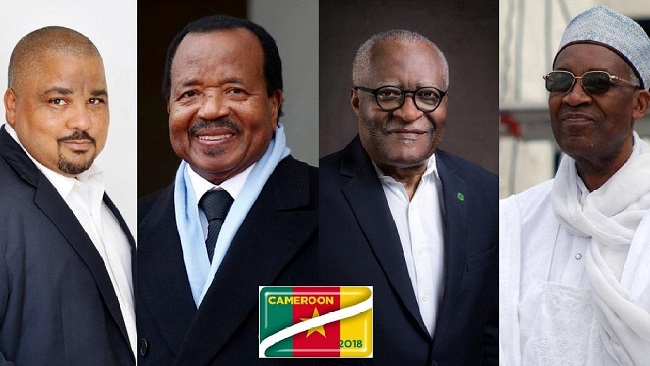
The frontrunners include Joshua Osih of the main opposition Social Democratic Front and Akere Muna, a veteran lawyer, former vice president of Transparency International and son of a former vice president of the Federal Republic of Cameroon running with the Front Populaire Pour Le Developpement (FPD).
Both are from the English-speaking provinces. Akere Munna is 66 years old and believes it is time for Cameroon to be run by someone from the Anglophone regions
There is also Maurice Kamto, who leads the Mouvement pour la Renaissance du Cameroun (MRC) party. He was justice minister during the 2008 constitutional amendments that revised presidential term limits and led the legal team in negotiations with Nigeria over the disputed Bakassi peninsula in the early 2000s. He has a strong following in the west of the country, where he hails from.
Most young people seem to favour Cabral Libii, an eloquent 38-year-old journalist with Univers Party and law lecturer at the University of Yaounde II. Kamto and Libii have roots in the Francophone regions.
Key Issues
In 2014, Transparency International ranked Cameroon 136 out of 175 countries in a corruption index. An estimated 48 percent of Cameroon’s population lives below the poverty line.
In March, 85-year-old Biya – who reportedly presides over the country’s affairs while living in a five-star hotel in Geneva, more than 6754km away from the presidential palace in Yaounde – held his first cabinet meeting in three years.
“The key issues include unemployment and underemployment, which is generally seen as more important and sensitive than the Anglophone crisis to some of the candidates,” says a technocrat who requested anonymity out of fear of being targeted by the authorities.
Political reforms, such as issues relating to staying a federation and changing presidential term limits, are also on the table. “It’s time for a change,” the technocrat continues. “We’ve never had this many good candidates at once.
“Osih has deep political experience from his time in parliament; Muna has international experience. Same with Kamto. “While I don’t rule out a coalition happening between the candidates post-elections … I don’t see the possibility of a coalition happening before the elections.”
The end of Biya?
It remains a tall order to dislodge the strongman of Cameroonian politics, experts and analysts say, warning that voter apathy and presidential gimmicks will be at play.
Presidential candidates have been made to pay a CFA 30million ($52,100) caution fee – to guarantee they won’t encourage their supporters to violence – and were given half that amount by the government to fund their campaigns barely two weeks before the elections.
“The elections won’t be free and fair,” says Walla, the CPP leader from the Anglophone region. “The system is already rigged to give the president a structural advantage. The minister of Territorial Administration, whose ministry supervises the elections, is a diehard Biya fan. Many of the district officers in the ministry who will count votes are helping relaunch Biya’s book on his political philosophy, so there is no line between the civil service and politics.”
Biya controls the police and military forces and has substantive influence over the electoral commission; he regularly appoints its chief. Its board members only quit their ruling party membership the day their appointments were announced.
The president also appoints all judges in the country. Members of the electorate have little faith in the biometric reader system put in place for the election and do not expect Biya to concede in the unlikely event of a loss.
Local media is also suspect, recently reporting a story about Ennovate Solutions, a supposed American election-monitoring organisation, predicting a landslide victory of 81 percent for the incumbent. The firm turned out to be a web design firm owned by a relative of Paul Nji, Biya’s minister of territorial administration.
Biya still has a strong base especially among his Beti kinsfolk, one of the major ethnic groups.
Serge Alomomou, a taxi driver in Yaounde, is one of them and blames French colonialists for the country’s problems.
“Every country has its own problems and we signed a lot of contracts with the French at independence that put us in this mess. I trust Biya and he knows the best for us, he knows us more than the people who want to try and replace him. It is those working around him that mess up his efforts.”
‘Mounting hate speech’
Over the past year, hate speech has risen. A petition against controversial TV host Ernest Obama surfaced online last October over his frequent outbursts against the Anglophone community.
In June, Prime Minister Philemon Yang blamed Cameroonian citizens in the Diaspora for inciting their compatriots to violence on social media over the Anglophone issue.
Kamto, the candidate and former justice minister, has lambasted TV host Obama’s channel, Vision 4. He pulled out of a debate on the network because, he wrote on Facebook, it “promotes division and hatred among Cameroonians, particularly against the innocent English-speaking Cameroonian population trapped between secessionist activities and security forces”.
The MRC party chief has himself been accused of stoking tribal tensions between his own Bamileke people and Biya’s Beti people, two of Cameroon’s major ethnic groups.
“There are ethnic and political tensions we can see mounting between the Bamileke and Beti ethnicities,” says Heungoup. “There is mounting hate speech and it is worrying because, in Cameroon, most of the candidates have regional bases, so what if any of them decides to reject the results?”
SOURCE: AL JAZEERA NEWS















6, October 2018
Oh Lucky Man:Biya at helm of six-time election winning machine 0
President Paul Biya, the 85-year-old Cameroonian leader who will seek a seventh term on Sunday, has developed an effective system to stay in power despite long overseas absences. One of Africa’s longest serving leaders, he has made Yaounde’s Etoudi presidential palace his home since 1982.
“Those who want power don’t last, it’s those who can (rule)” he told journalists in 2015, making a rare remark about his long time in charge of Cameroon.
One aspect of his time in office is the “subtle balance of forces” which Biya has created in the country, in a region where leadership changes are often accompanied by force, according to International Crisis Group’s (ICG) Hans de Marie Heungoup.
Cameroon’s system was “designed so that everyone polices themselves and maintained inter-generational and ethnic rivalries”, Heungoup said.
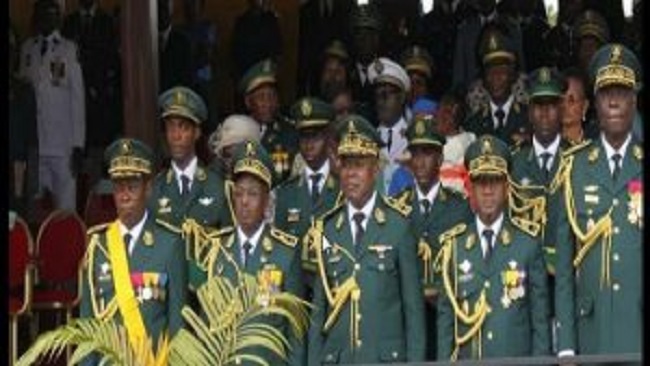
“No one can move an active (security force) unit without the say-so of the president,” he added, emphasising the importance of the balance between the regularly army, the rapid intervention force, and the presidential guard – the last two of which report directly to the president.
The president’s appointment of loyalists to key posts has also assured his long rule.
‘Go against Biya, you’ll be crushed’
The speaker of the National Assembly, the head of the army and the head of the state-run oil and gas company are all confidants of the president, and have each held their jobs for more than 15 years.
The system has been strengthened through “a mix of resigned acceptance and patronage among certain elite leaders who rally behind the regime,” said Fred Eboko, a researcher at the French Institute for Research and Development (IRD). Biya’s primary motivation since coming to office has been “to stay in power,” he added.
“The system is built on a single individual and this individual is identified with the job,” said Titus Edzoa, a former confidant of the president who was secretary general of Biya’s presidency between 1994 and 1996 and held ministerial posts on several occasions.
“If you try to go against Biya, you’ll be crushed,” he said.
‘In power for 35 years… that’s talent’
He should know. After resigning as a health minister in 1997 to stand in elections, he was arrested and accused of stealing millions of CFA francs. He spent 15 years behind bars.
Now a free man, he warns that by centring the system on Paul Biya’s personality “not only could the system implode, but so too could the whole of Cameroon” in the near future.
“Whether you want him or not, he’s still human and you have to think of the future,” he said. “How do you look back on the story of a people dominated by an individual?”
Osvald Baboke, the deputy director of the presidency, wrote in a book published in September that “Biya’s fate seemed pre-determined” and “an opportunity given by God”. “Being in power for 35 years and standing again, that’s talent,” added Edzoa.
His repeated long absences from Cameroon, mostly in Switzerland or in his home village in his country’s south, have been bitterly criticised.
According to the Organized Crime and Corruption Reporting Project (OCCRP), a consortium of investigative journalists, Biya spent “at least four-and-a-half years of his 35 years in power on private visits” abroad.
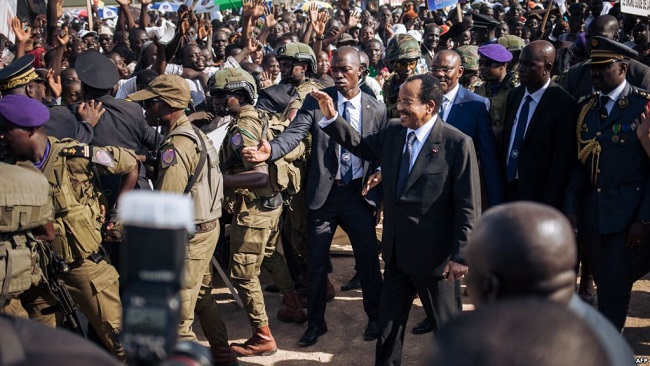
But for the final leg of the campaign, which concludes on Saturday, Biya did at least make a rare public appearance, visiting the far-north which has been engulfed by Boko Haram jihadist violence — his first trip there since 2012.
AFP